The simulation depicts the expansion of a technological civilization through the Milky Way, created along lines previously described in the literature. What we are looking at is the transition between a Kardashev Type II civilization, and a Type III, which has spread throughout the galaxy. This might be a fast process considering the motions of stars themselves, which would overcome the inertia of slower growing settlements and boost expansion rates. Issues like starship capabilities and the lifetime of colonies come into play, but the striking thing is how fast galactic settlement occurs and how the motions of stars factor into the settlement wave. The parameters are everything, and they’re interesting:
- Ships are launched no more frequently than every 100 ka;
- Technology persists in a given settlement for 100 ma before dying out;
- Ship range is 10 light years.
- Ship speeds are 10 km/s; Voyager-class speeds.
- The simulation covers 1 ga
Tag: visualization
LOOPY
In a world filled with ever-more-complex technological, sociological, ecological, political & economic systems… a tool to make interactive simulations may not be that much help. But it can certainly try.
play with simulations
It’s the ancient, time-honored way of learning: messing around and seeing what happens. Play with simulations to ask “what if” questions, and get an intuition for how the system works!programming by drawing
Raw code is too inaccessible. Also drag-and-drop is too mainstream. But with LOOPY, you can model systems by simply drawing circles & arrows, like a wee babyremix others’ simulations
Want to build upon your friends’ models? Or challenge your enemies’ models? LOOPY lets you have a conversation with simulations! You can go from thinking in systems, to talking in systems
Search Record
search-record.net is a living collection of tools for making things with your Google Search history. Try the tools with sample data below, or follow these directions to get started with your own archive.
Bats as disease vectors
because they live really long for their size, and they can fly
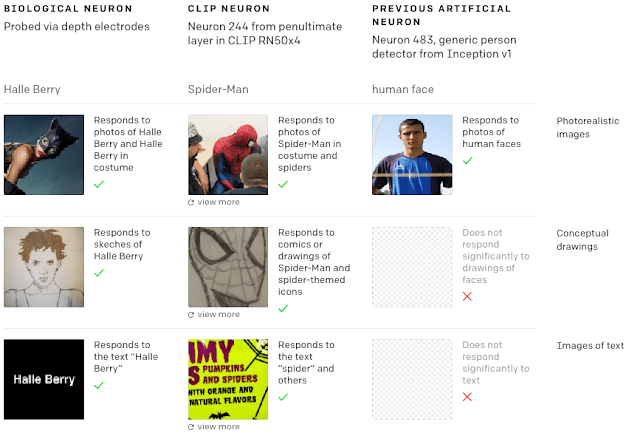
Multimodal Neurons
Using the tools of interpretability, we give an unprecedented look into the rich visual concepts that exist within the weights of CLIP. Within CLIP, we discover high-level concepts that span a large subset of the human visual lexicon—geographical regions, facial expressions, religious iconography, famous people and more. By probing what each neuron affects downstream, we can get a glimpse into how CLIP performs its classification.
1 ga of plate tectonics
Rome in 3D
a good amount of progress since we last looked at this
History in 3D lives up to its name. The virtual recreations of ancient temples, cities, palaces and fortresses are vividly rendered in granular detail with realistic lighting effects and animated fly-ins. They’ve built models of everything from Sevastopol in 1914 to the flooding of Titanic’s grand staircase to Corinth in the 2nd century.
4 years ago, their most ambitious project, a reconstruction of Rome’s city center as it was in 320 Rome in 3D, made its debut on their YouTube channel. They had already been working on it for years and had enough of it ready to make a riveting trailer, a few tantalizing minutes of what promised to be the most comprehensive virtual recreation of ancient Rome ever made. The aim was to integrate it into a game engine, building a fully realized city based on the latest, most accurate information to provide an immersive experience of walking its streets.
Last month, History in 3D released their latest Rome in 3D video. They assured followers that the project was still ongoing, that they had encountered challenges and obstacles but were surmounting them and coming back better than ever, deploying new technological tools to redesign buildings and objects. The new trailer showcases the Forum, the beating heart of Roman society, and it is a huge leap forward in quality.
COVID-19 vaccines
Cutting corners could lead to headlines about how the vaccine is unsafe, going too slow has obvious problems.
In March, Heeney’s sense of time started to grow muddled. Things happened so fast, and his weeks were so full, that dates lost their meaning. “The coronavirus dominates our days”. He wakes before dawn to pore through feeds of scientific data and journal articles. “There are conference calls, there’s all this paperwork to fill out so we can deal safely with pathogens, there’s the need to scale up the lab to work on the vaccine. There’s just no routine anymore. It feels like the wild west right now.”
great visualization of the various tradeoffs.
A proposal to speed things up on the regulatory side:
Even if clinical trials are not complete, there should be enough data that informed patients may reasonably desire to get vaccinated. Congress should not let the traditional FDA approval process stop them from doing so.
2020-07-08: Lots ands lots of vaccines in trials (but most were too slow)
There are now so many of these running that unless the program is especially noteworthy I’ll only touch on the ones that are in trials right now, or about to start soon. And I’m going to arrange them by vaccine class
2020-08-10: DIY vaccines
Estep and at least 20 others, have volunteered as lab rats for a do-it-yourself inoculation against the coronavirus. They say it’s their only chance to become immune without waiting a year or more for a vaccine to be formally approved. Among those who’ve taken the DIY vaccine is George Church, who took 2 doses a week apart earlier this month. The doses were dropped in his mailbox and he mixed the ingredients himself.
Good for them, the pearl clutching is disappointing given the source. And here’s another DIY effort:
I’ve written a blog post about Benjamin Jesty, the dairy farmer who successfully immunized his wife and kids against smallpox the same year that King Louis XV of France died of the disease. I explicitly use this as an example of what Rationalism should strive to consistently achieve. Yet when a near-perfect real world equivalent came along, on super-easy mode with most of the work already done by somebody else, it still took me until December to notice. The radvac vaccine showed up in my newsfeed back in July, and I apparently failed to double-click. That level of performance is embarrassing, and I doubt that I will grade my COVID response any higher than a D.
So I’m doing this, in part, to condition the mental motions. To build the habit of Doing This Sort Of Thing, so next time I hopefully do better than a D.
2020-12-28: A short overview what makes the mRNA vaccine so amazing.
So why would you do that? As noted above, our immune system takes a very dim view of ‘exogenous’ RNA, RNA code coming from outside the cell. To evade detection, the ‘U’ in the RNA was already replaced by a Ψ.
2020-12-31: 3 approved, ~10 more close. impressive! Now if only distribution weren’t so slow & incompetent.
2021-01-10: Federal Delay Administration
the FDA needs to stop playing games and authorize the Oxford-AstraZeneca vaccine. It’s safe, cheap ($2-$3 a dose), and is the easiest vaccine to distribute. It does not require freezing and is already approved and being administered in the United Kingdom.
Sadly, the FDA is months away from authorizing this vaccine because FDA career staff members insisted on another clinical trial to be completed
2021-01-13: a comparison of the various vaccines
In this page I will look at:
BioNTech/Pfizer/Fosun: BNT162b2, also known as Tozinameran also known as Comirnaty. A modified mRNA-in-lipid-nanoparticle vaccine, expressing a modified S protein.
Moderna: mRNA-1273. A modified mRNA-in-lipid-nanoparticle vaccine, expressing a modified S protein.
Curevac: CVnCoV, an unmodified mRNA-in-lipid-nanoparticle vaccine, expressing a modified S protein.
Oxford/AstraZeneca: AZD1222, aka Oxford–AstraZeneca vaccine, Covishield, or ChAdOx1 nCoV-19. A viral vector vaccine, expressing the unmodified S protein.
Janssen/Johnson & Johnson: Ad26.COV2-S aka JNJ-78436735. A viral vector vaccine, expressing a modified S protein.
Gamaleya Research Institute of Epidemiology and Microbiology: Sputnik V aka Гам-КОВИД-Вак aka Gam-COVID-Vac. A viral vector vaccine using 2 different viruses, S protein modification unknown. But there IS a Twitter account!
Novavax: NVX-CoV2373. A protein subunit vaccine containing a doubly modified S protein, using a special ‘adjuvant’.
2021-04-24: What happened to Novavax
Novavax, though, isn’t quite yet ready to shine. If the past few months have given the world a crash course in vaccine manufacturing, Novavax has provided the most interesting case study. In 2019, after a setback on their RSV vaccine, the company sold off their only factory. They have since tried to pull off one of the most herculean feats in the history of industry: to go from a little-known, barely solvent company with no approved products and no manufacturing facilities to a biotech that could annually churn out 2 billion doses of the world’s most sought after product. Amazingly, it’s largely been a success. Factories on 3 different continents are now churning out or preparing to churn out different components of Novavax’s vaccine, NVX-CoV2373. And the data that have come back are strong: In a 15K-person UK study, the vaccine appeared as effective as the Pfizer-BioNTech and Moderna shots: 96% effective against the original SARS-CoV-2 virus and 86% effective against the variant now common in the country.
2021-05-24: the actual timeline was faster than any of the NYT options: Pfizer was approved on Dec 2, 2020 by the UK, compared to Feb 2021 in the NYT version. this includes the several weeks of sitting around when nothing was approved around Thanksgiving. Lots of factors came together, familiar virus family, new approaches. Good reminder that the Overton window of middle brow publications like the NYT is quite narrow.
The first vaccine to get an emergency use authorization will create huge moral hazard for other candidates.
New study protocols can get more flexibility and statistical power.
Trials can start, stop, and then start again when new hot spots crop up. An independent group collects the data and accounts for differences in the various arms of the study. “The bigger the trial, the faster you can accrue people and get answers. But the bigger value and innovation in my mind is that this makes it more robust when outbreaks end unexpectedly. If China had been willing to team up with a larger group or larger effort, then they could have finished their trials, because someone else could have picked up where they left off.”
2022-04-22: No money for next-gen vaccines.
Scientists at BARDA are vetting an array of next-generation vaccine concepts, including those that trigger mucosal immunity and could halt transmission. The process is similar to the one used to prioritize candidates for billions of dollars of investment through the original Operation Warp Speed program. But there’s a catch.
“We could Operation Warp Speed the next-generation mucosal vaccines, but we don’t have funding to do it. We’re doing everything we can to get ready … just to get ready in case we have resources available.”
In my estimation, Operation Warp Speed was the highest benefit to cost ratio of any government program since the Manhattan Project. Amazingly, despite having now seen the benefits of the program and the costs of the pandemic, a government that spends trillions every year can’t get behind millions for a nasal vaccine.
What pan-coronavirus vaccine might mean:
“pan-coronavirus” can mean different things in different press releases. There are several vaccines along the spectrum that are in the clinic:
Type I Vaccines: generate immunity to all 4 genuses of coronavirus. None at the moment (that’s a tall order)
Type II Vaccines: generate immunity to the betacoronaviruses. DIOSynvax, from a Cambridge startup working with CEPI.
Type III Vaccines: generate immunity to the sarbecovirus (lineage B) betacoronaviruses. Walter Reed’s SpFN ferritin-nanoparticle vaccine. GBP511 is coming along towards the clinic here, too.
Type IV Vaccines: generate immunity to current and future variants of just the particular sarbecovirus we’re dealing with, SARS-CoV-2. Gritstone Bio’s GRT-R910, ImmunityBio’s hAd5 S+N.
2022-07-18: We could have universal COVID vaccines very soon — if we urgently reform the process
Broadly speaking, the holdups involve some combination of logistical challenges and regulatory requirements, and the intersection between both. (You don’t in principle have to run a primate trial, but the FDA makes it harder to run a human trial if you don’t. You don’t in principle need to use “acute infection” as a trial endpoint; you could also use neutralizing antibody titers, which would be much faster and simpler.)
To speed things up:
- We should lower the barrier for human clinical trials and use simpler endpoints. For many vaccine candidates, we could run human trials concurrent with primate trials (once basic safety data has been obtained). In humans, we don’t need to repeat Phase I trials for platforms that have already been validated and derisked. (In this vein, the FDA’s recent announcement about not requiring trials for updated platforms was encouraging.)
- We should help these groups to scale manufacturing faster. Operation Warp Speed itself cost $10 billion; a second incarnation, with a tenth of that budget, could almost certainly accomplish a great deal.
Overall, we the federal government should empower someone to intervene (as it did with Operation Warp Speed). Private actors can’t change FDA policy. In our view it is probably true that, with competent execution, we could roll out pan-variant COVID vaccines before the end of 2022. Actually making that happen would require significant and coordinated logistical, regulatory, and administrative action. However, it would by no means be impossible. Not having pan-variant vaccines in 2022 is best thought of as a choice.
2022-12-17: A nice summary how “Public Health” has absolutely nothing to do with health and needs to be destroyed
America chose to care about the appearance of favoring approved groups over disapproved groups, rather than to care about saving lives, getting shots into arms, people not getting sick and being able to resume their lives and other neat stuff like that. We retaliated against doctors who gave to ‘the wrong people’ doses that would otherwise expire. In doing all this, we created a complex web that favored only and exactly the same managerial class that was signaling their concern for ‘equity’ at the expense of saving lives, while those the policy claimed to benefit lacked the skills or resources to navigate the systems and were left behind even more. Funny that.
Remember how this prioritization process worked. Expect it to happen again.
Various other political concerns were also allowed to override the ability to do a variety of things that would have allowed shots to go into arms. Thanks to ridiculous government-imposed requirements, our existing vast logistical infrastructure that commonly delivers vaccines with exactly the same shelf-life conditions was not used, and instead doses were left untracked. Tech companies were shunned rather than embraced and felt the need to not be visible. Pharmacies were paid so little that some actively sought to avoid giving out doses and intentionally crippled their own websites. The government preferred not sharing vaccine info anywhere to giving the impression that some states were served better than other states. Local and state politicians did not want to share their information with the federal government lest they lose the credit.
Best 2019 Dataviz
For The Washington Post, Tim Meko made a series of maps, each conjuring the aesthetic of the natural disaster it represented.

Visualizing Atoms
if you imagine an atom being the size of a tennis ball, blood cells would be as large as a small town and a penny would be almost precisely the diameter of the Earth
 Gregor J. Rothfuss