this would be far more impressive if the whole construction had taken 5 weeks instead of 5 yearss.
Tag: video
K/T extinction event
66 ma ago, maybe on a Tuesday afternoon, life was the same as it had been the day before or 1 ka before or pretty much 1 ma before. Things were good for our feathered dinosaur buddies. Until a tiny, tiny detail in the sky changed.
2021-04-06: Chicxulub created rainforest
the dinosaur extinction was also a massive reset event for neotropical ecosystems, putting their evolution on an entirely new path leading directly to the extraordinary, diverse, spectacular and gravely threatened rainforests in the region today.
2022-10-05: The Chicxulub Impact Produced a Powerful Global Tsunami
The Chicxulub asteroid impact produced a global tsunami 30k times more energetic than any modern-day tsunami produced by earthquakes. Here we model the first 10 min of the event with a crater impact model, and the subsequent propagation throughout the world oceans using 2 different global tsunami models. The Chicxulub tsunami approached most coastlines of the North Atlantic and South Pacific with waves of 10m high and flow velocities of 1 m/s offshore. The tsunami was strong enough to scour the seafloor in these regions, thus removing the sedimentary records of conditions before and during this cataclysmic event in Earth history and leaving either a gap in these records or a jumble of highly disturbed older sediments.

Galactic Settlement
The simulation depicts the expansion of a technological civilization through the Milky Way, created along lines previously described in the literature. What we are looking at is the transition between a Kardashev Type II civilization, and a Type III, which has spread throughout the galaxy. This might be a fast process considering the motions of stars themselves, which would overcome the inertia of slower growing settlements and boost expansion rates. Issues like starship capabilities and the lifetime of colonies come into play, but the striking thing is how fast galactic settlement occurs and how the motions of stars factor into the settlement wave. The parameters are everything, and they’re interesting:
- Ships are launched no more frequently than every 100 ka;
- Technology persists in a given settlement for 100 ma before dying out;
- Ship range is 10 light years.
- Ship speeds are 10 km/s; Voyager-class speeds.
- The simulation covers 1 ga
Worst Translator
UAV 3D capture
Yesterday autonomous drone manufacturer Skydio rolled out 3D Scan, an adaptive scanning software package that will greatly improve the workflow of those designing on top of existing spaces. They’re not marketing it that way, however; the rollout is aimed at the inspection industry, where large, complicated structures once had to be scaled by experienced climbers. With Skydio’s technology, you don’t even need a skilled drone pilot. Instead, you use their app to set boundaries around what structure(s) you would like captured, by dropping “pillars” around them. Then the drone’s software figures out the flight path it will automatically take, avoiding obstacles along the way. You choose the resolution, and the software figures out how many photos the drone will need to snap, tightening or loosening its flight path accordingly. The drone takes flight, and the model is generated in real time. You can then review the model on your device, on-site, in case you decide another pass is needed.
Salad Mug
impressive burner aesthetic in this blender movie. amazing what can be accomplished with free tools if you put in the work.
NIMBY Art Piece
a great illustration for why community boards and zoning need to be destroyed.
UAV L1 Autonomy Safety
EASA has a roadmap for autonomous flight with 3 levels of autonomy: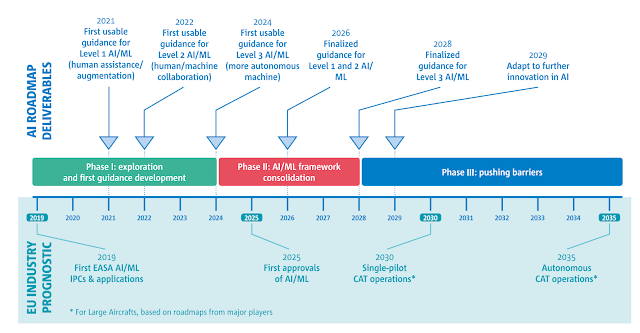

They, in collaboration with my friends at Daedalean, just released their approach how to certify the safety of the whole L1 system, a first for a ML system in aviation, as far as I know. This ought to help the nascent UAV market with overcoming regulatory barriers. You can get a sense for the state of the art with the EHang 216 drone in this autonomous test flight with the CEO on board.
Starline
let’s hope this goes somewhere, unlike Glass. perhaps this can be bootstrapped via C-level status symbol purchases, like cisco telepresence (which was 10 years ahead of its time)
3D printed sawdust
Forust has devised a way “to make high-volume wood 3D printing affordable, reliable, and sustainable [by] applying the speed, precision and quality of binder jetting to produce strong, lightweight wood components derived from 2 wood waste streams – sawdust and lignin.”
 Gregor J. Rothfuss