200 mpa concrete is key.
In 1956, Frank Lloyd Wright proposed the Illinois Sky-City, a skyscraper taller than 1600 meters. That’s more than 2x the height of Dubai’s Burj Khalifa, currently the tallest structure in the world.
Sapere Aude
Tag: urbanism
200 mpa concrete is key.
In 1956, Frank Lloyd Wright proposed the Illinois Sky-City, a skyscraper taller than 1600 meters. That’s more than 2x the height of Dubai’s Burj Khalifa, currently the tallest structure in the world.
From the car-obsessed cities of the 20th to the cities of the 21th century. One is being built in China now
These new megacities could evolve into sprawling, polluting megaslums. Or they could define a new species of world city. Unlike New York or London, they are blank slates — less affluent, perhaps, but also free from legacy designs and technologies tailored to the world of the 19th and 20th centuries. That is a huge advantage. It took Boston 20 years and more than $14B just to reroute a freeway underground. New York can hardly install a second network of water pipes. Most of Los Angeles is too spread out for fast public transit or combined heat and power plants. And because these cities are so isolated from agricultural land, most of the food that locals eat gets shipped 100s of km. “Shanghai today is making 90% of the mistakes that American cities made” — spreading out, building up single-family homes, replacing naturally mixed-use neighborhoods with isolated zones for living, shopping, and working, and connecting it all with car travel. But fixing these problems is still possible. Dongtan breaks ground later this year on a plot about the size of Manhattan on Chongming Island.
2012-07-03: CO2-negative cities. It is well-understood that per-capita resource usage is lower in urban areas than in rural ones, and the first CO2-neutral cities are coming online. Covering vertical surfaces with plants would allow for CO2-negative cities.
2012-07-05: The first eco city, Dongtan, is so eco-friendly it doesn’t even exist.
Dongtan was a planned development described as an eco-city on the island of Chongming in Shanghai, China. Design began in 2005, and by 2010 the development had stalled. The project has been described as a failure.
2021-04-24: Green NYC
Global design firm WATG periodically rolls out speculative GIFs demonstrating how famous urban stretches can be realistically green-ified

2021-11-12: Not sure why it took so long for this to get a bit more traction, but here’s a proposal:
Urban Sequoia achieves substantially more significant CO2 reductions than has been achieved by applying these techniques separately. These strategies can be applied to buildings of all sizes and types. For cities, SOM’s prototype design is a high-rise building that can sequester 1000 tons of CO2 per year, equivalent to 48k trees. The design incorporates nature-based solutions and materials that use far less CO2 than conventional options and absorb CO2 over time. Materials like bio-brick, hempcrete, timber, and biocrete reduce the CO2 impact of construction by 50% compared to concrete and steel. A progressive approach could reduce construction emissions by 95%.
2021-11-13: Another, more ambitious concept:
Carlo Ratti Associati (CRA) has unveiled a project dubbed “the world’s first farmscraper,” to be built in Shenzhen, China. The 218-meter-high, 51-story Jian Mu Tower will contain a large-scale farm system with the ability to produce crops to feed 40k people per year, as well as offices, a supermarket, and a food court. The scheme’s façade consists of a 10k-square-meter vertical hydroponic farm extending the entire height of the building, estimated to produce 270k kilograms of food per year. The Jian Mu Tower seeks to “establish a self-sustained food supply chain” where the cultivation, harvest, sale, and consumption of food takes place under 1 roof.

the “typical dream of a New Yorker”: a homeowner pushes aside some coats and sweaters in the upstairs closet… only to reveal a door, and, behind that, another room, and, beyond that, perhaps a whole new wing secretly attached to the back of the house.
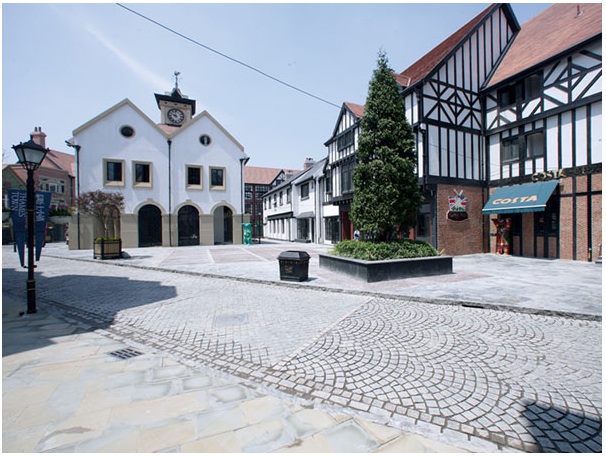
Shanghai urban planners are trying to preserve the center of the city by not building any more new highways, and by setting up 9 satellite cities, or “New Towns” far out in the Shanghai suburbs. But they need to attract people out of the city, into the outskirts–a tough job, unless you can create an atmosphere and lifestyle that one can’t find downtown. Thus the 9 theme cities, 7 based on the architecture of the UK, Italy, Germany, Spain, Sweden, Holland and Canada.
luring people to the burbs by turning them into disneylands
Sinocity, a fictitious city in an imaginary Chinese province, reflects more reality of mid-sized Chinese cities than many will admit. The Sinocities Awards seeks to explore awards ways of dealing with this status quo of the near future.
2010-09-02: 1b city by 2040
Going to 2400 km/h in the 2030 to 2040 timeframe would enable 90% of China’s population to be 1 hour apart by low pressure maglev.
2015-04-02: City Hypergrowth. While not quite the fastest growing at 200k people / year vs Karachi at nearly 1m / year, these pictures of rapid transformation are still interesting.

Tim Franco captures the massive urbanization of Chongqing, which has been described as “the biggest city you’ve never heard of” and “China’s Detroit.”
2017-04-02: Megacity integration
China is breaking the administrative barriers between Beijing-Tianjin-Hebei. This will enable coordinated development. Transportation, education, medical, economic, ecological services are moving towards integration in the cities which make up the 130M Jing-jin-ji megacity area.
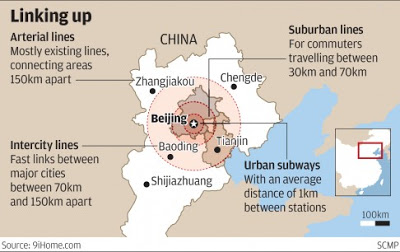
2017-07-13: China Megacities
Chinese megacities are associated with the greatest migration in human history, namely the movement of several 100M people from the countryside into urban areas. This has created over 100 cities with a population of more than 1M. And while Westerners tend to see only the harmful effects of that transformation, it’s gone fairly smoothly. Wages and living standards have risen to create the biggest rapid boost in prosperity the world has seen, ever. Surely it’s worth taking a closer look at that.
If you spend a few days in these places, they will stand out as quite distinct. To suggest otherwise is actually to repeat a common Western imperialist meme about the Chinese, namely that they “are all the same” in some underlying manner. Observing and understanding diversity is a skill, and the Chinese megacities are one of the best places for cultivating this capacity.
2018-07-03: Faster commutes are key for integration
It seems clear that China will continue to leverage technology to enable faster commuting within city regions.
- more high-speed rail lines
- robotic buses
- robotic cars and ridesharing with high-speed roads and tunnels
- ultra-fast elevators to commute from skyscraper to skyscraper and to speed the last 300 meters.
China will do what takes to get the potential 50% GDP boost from truly efficient 1-hour connections.
2018-09-04: China Urbanism
China is creating 19 supercity clusters by strengthening the links between existing urban centers. The supercities will have 800m people and more than 80% of the country’s GDP in 2030. 287m people have moved from low-income agriculture to higher-income city industries, the largest population transfer in history. Another 40m people will migrate to cities by 2020 and the productivity gap will have more than halved since 2000.
congestion charge likely coming, but exempting cabs, which is irritating.
2012-08-01: we need congestion charges in nyc. the stupid “highways” are now clogged up even during non-rush hours.
Because of the steadily decreasing price/performance ratios of our tunneling technologies, the increasing intelligence and cleanliness of our automobiles, and the ever increasing social value of our spare time, some overcrowded city (LA? NY?) will eventually decide to put a nice, long AHS express tube underground, creating a fast connection between 2 important and yet informationally different urban cores, at the same time bypassing the most gridlocked sections of the city. Only certified, AHS-equipped, electric vehicles will be allowed into these underground connector tubes. Want Speed? Get Intelligent and Go Green.
if you really need suburbia, at least but all roads into tunnels. should be cost-effective soon.
much of upper manhattan is an eruv, a jewish workaround for moving around on sabbath. look it up 😉
Imagine a cluster of 30-story towers on Governors Island or in Hudson Yards producing fruit, vegetables, and grains while also generating clean energy and purifying wastewater. 150 such buildings could feed the entire city of New York for a year. Using current green building systems, a vertical farm could be self-sustaining and even produce a net output of clean water and energy.
So when does this go live? This would be useful to kick the agro lobby in the groin, of which more later.
2008-07-21: Land still too expensive for vertical farms in Manhattan
Would a tomato in lower Manhattan be able to outbid an investment banker for space in a high-rise? My bet is that the investment banker will pay more.
2014-05-18: LED lights can be tuned to the optimal wavelength for plant growth, lowering excess heat. 22h of light / day halves the time to maturity, and the indoor environment avoids pests and bad weather. This is probably the future of our agriculture. It allows to bring fresh produce into cities and lowers the huge footprint agriculture has on the planet. we lost 3x the size of the us since 1700 due to depleted soil, and agriculture is the #2 greenhouse factor.
2016-06-09: Newark may have better economics than Manhattan
Newark, NJ-based AeroFarms, the largest vertical farm in the world, employs aeroponics and LED lights to grow indoors all year round. Aside from aeroponics using 95% less water than soil farming and zero pesticides, we are able to grow locally, cutting out a very complex supply chain and enhancing shelf life versus products typically grown in California. We’re 75% more productive annually than the average farm because we bypass the complexity of it.
2017-01-09: It’s time to replace most agriculture around the world with this. Traditional agriculture has a huge water / co2 footprint, uses up a lot of land, and food is grown far away from where it is consumed. This uses 10% of the water.
Ed Harwood’s original prototype mini-farm still produces crops 6x every school year. The invention sits in a corner of the cafeteria by the round lunch tables and the molded black plastic cafeteria chairs, an improbable-looking teaching tool. Examining it, you feel a mystified wonder, and perhaps a slight misgiving about the inventor’s soundness of mind, remembering what happened to Wile E. Coyote. For concentrated ingenuity and handcrafted uniqueness, its closest simile is the Wright brothers’ first biplane, the Flyer, now on display in the National Air and Space Museum, in Washington. Like the Flyer, and like many other great inventions, Harwood’s prototype is also an objet d’art. Its dimensions are 1.5m wide by 3.6m long by 2m high. Essentially, it consists of 2 horizontal trays of thick plastic, both 25cm deep, 1 above the other, suspended in a strong but minimal framework of aluminum. Below the trays, at floor level, a plastic tank holds 1000 liters of water. The cloth is attached to the frame by snaps. On small pipes running along the inside bottom of the tray, Harwood’s special nozzles emit a constant, sputtering spray of water at a downward angle. The spray hits the bottom of the tray and bounces up, and some of it becomes the mist that nourishes the roots growing through the cloths. Eventually, most of the water drains down and returns to the tank to be reused.
2017-05-03: Different types of vertical farming
There are a lot of ways to farm indoors and below are 3 different soilless processes. Done properly at various scales, they’re as effective as at growing crops in skyscrapers as they are in studio apartments:
Hydroponics
One of the oldest and most common methods of vertical farming, hydroponics includes growing plants without soil and in a water solvent containing mineral nutrients. The simplest hydroponic method (called the floating raft system) suspends the plants in soilless raft like a polystyrene sheet and lets the roots hang to absorb the oxygen-aerated solution. Another common method is the nutrient film technique, which is popular for growing lettuce. Here, a stream of the nutrient-dissolved solution is pumped into an angled channel, typically a plastic pipe, containing the plants. This runs past the plants’ root mat and can then be recirculated for continuous use. New York’s Gotham Greens and Square Roots use hydroponics.
Aeroponics
It’s no surprise that NASA has been backing research on aeroponic growth for the past 20 years as it’s free-floating-roots aesthetic is typically used in futuristic scifi movies. With aeroponics, the dangling roots absorb a fine mist comprised of an atomized version of the nutrient solution sprayed directly onto the roots by a pump. Although aeroponics enables plants to grow much more quickly than hydroponics, it requires more solution and therefore is more costly. Newark’s Aerofarms uses aeroponics.
Aquaponics
Like hydroponic systems, an aquaponic system contains a soil-free plant bed suspended over a body of water containing nutrients necessary for plant growth. But within the body of water is a population of fish (typically herbivores) that produce waste that function as fertilizer for the plants. In turn, the plants help purify the water to make the water suitable for the fish.
Given that a balance must be achieved to ensure the system of both life forms, aquaponics requires greater attention than hydroponics or aeroponics although filtration and aeration systems can help manage these complications. Furthermore, the types of plants one can grow are much more limited as the necessary plant nutrients must be compatible with those necessary for the fish. Brooklyn’s Edenworks and Oko Farms use aquaponics.
2018-06-01: The economics are starting to work, even in NYC
Gotham Greens’ prices are competitive with local and organic lettuce brands, about $3.99 for a 4.5-ounce container. Still, the company is a small-scale producer vying for consumers faced with a financial decision: pay the price for local organic, save 50 cents by purchasing a well-known organic brand, or a whole $ for conventional greens from California or Arizona. “There is always a consumer who will pay for value. Gotham may be in a good position because they’ve got loyal regional markets, but replacing lower-cost producers will be tough.”
2021-08-27: Farmscrapers
Carlo Ratti Associati (CRA) has unveiled a project dubbed “the world’s first farmscraper,” to be built in Shenzhen, China. The 218-meter-high, 51-story Jian Mu Tower will contain a large-scale farm system with the ability to produce crops to feed 40k people per year, as well as offices, a supermarket, and a food court.

2023-07-29: Hydroponics comes to subsistence farming. Hardware costs are still too high and it needs a water solution for arid climates.
And the solution is replicable beyond India. Pastoralism is practiced in arid and semi-arid climates across South Asia, East Asia and Africa. Kamath has received inquiries from Bangladesh to Nepal, Bhutan to Kenya. “Many times I get asked how many fodder stations can be set up. Scaling up is very hard for hardware-based solutions”.
Perhaps the biggest challenge is the up-front cost –– setting up a hydroponic station costs $30k. “It takes 3 years to break even”. Even though Bahula invested in setting up the station on Palu’s land, she has to pay $20 each week to arrange water for irrigation, which is delivered by truck. “While the cost of the water is recovered from fodder sales, we do not make enough to cover labor costs”.

2023-09-16: The economics remain terrible
Vertical farming writ large is having a tough time. AeroFarms entered bankruptcy in July and Kentucky-based AppHarvest filed a notice of default in June. IronOx laid off staff at the end of last year. Dreyfus acknowledges the difficulties the industry is facing, but compares vertical farming’s progress to the early and much less profitable days of the solar industry, which once routinely lost money but has become more stable. “So many crops that were not profitable are going to become profitable” as more time is spent perfecting the technology and understanding the business.


 Gregor J. Rothfuss