The autonomous flight space is further heating up, with Merlin Labs and Reliable Robotics. Both are aiming to automate cargo flights, and Reliable Robotics is partnering with Daedalean. The Merlin demo video looks good.
Tag: uav
UAV 3D capture
Yesterday autonomous drone manufacturer Skydio rolled out 3D Scan, an adaptive scanning software package that will greatly improve the workflow of those designing on top of existing spaces. They’re not marketing it that way, however; the rollout is aimed at the inspection industry, where large, complicated structures once had to be scaled by experienced climbers. With Skydio’s technology, you don’t even need a skilled drone pilot. Instead, you use their app to set boundaries around what structure(s) you would like captured, by dropping “pillars” around them. Then the drone’s software figures out the flight path it will automatically take, avoiding obstacles along the way. You choose the resolution, and the software figures out how many photos the drone will need to snap, tightening or loosening its flight path accordingly. The drone takes flight, and the model is generated in real time. You can then review the model on your device, on-site, in case you decide another pass is needed.
UAV L1 Autonomy Safety
EASA has a roadmap for autonomous flight with 3 levels of autonomy: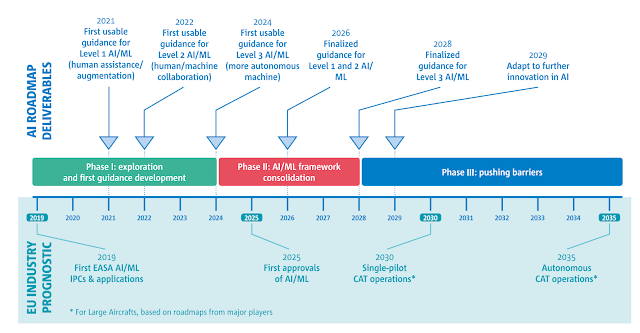

They, in collaboration with my friends at Daedalean, just released their approach how to certify the safety of the whole L1 system, a first for a ML system in aviation, as far as I know. This ought to help the nascent UAV market with overcoming regulatory barriers. You can get a sense for the state of the art with the EHang 216 drone in this autonomous test flight with the CEO on board.
Human-Tracking Drones
It always starts innocuously, doesn’t it? Autonomous drones look like good bets for home security cameras or hands-free versions of selfie sticks. But could they be used to track a person running through the woods, or a fleeing car? Short answer: Yes. The commercially-available Skydio drone uses 6 4K cameras and AI to 3D-map its surroundings and avoid obstacles as it follows whatever object (or person) it’s tasked with following.
Indoor drone flights
Flying ambulances in NYC
Hatzolah Air, the air division of the volunteer emergency medical service organization pre-ordered 4 air ambulances from Urban Aeronautics. Renderings from press releases announcing the purchase show a futuristic-looking vehicle landing on crowded city streets to assist at the site of an accident.
“Its compact size will enable it to land in the middle of a busy city street, making it a perfect fit for medical evacuation missions by dramatically decreasing the time it takes to arrive on-scene, treat and transport sick or injured patients to appropriate medical facilities,”
while the flying car cosplay on display is a bit premature, there are prototypes, and they seem to at least be thinking about noise.
Desk Forklift drivers
these kinds of intermediate solutions will drastically speed up the transition to autonomy, since all this teleoperation creates training data, and you can start having operators monitor more than 1 vehicle, like drone operators have for years.
UAV thermal archaeology
The advantage of late-night archaeology is that big, underground objects retain and emit heat at different rates than the soil surrounding them. Take thermal images of the ground at just the right moment, when everything is cooling down, and you’ll see clear subterranean variations that may be undetectable using other methods.
Drone Design Evolution
We’ve seen a sharp evolution in designs from Amazon. The most primitive was this testing drone we saw from them back in 2013:
To me, this is the most exciting design because it is both a sharp departure from what came before, yet still integrates elements of each previous iteration, showing that the designers/engineers are learning. The total number of rotors has again been changed, this time to 6, and the rear propeller has been nixed. The dual fixed wings have been replaced by a single wraparound wing that takes a hexagonal configuration. The drone takes off vertically, like a helicopter, but then pitches forward at an angle for straight-line flight, using the lift provided by the unusual wing design.


very impressive learning rate.
Drone self defence
They have hit on a low-power, lightweight self-defence system suitable for small drones. Instead of employing light or radio waves to detect incoming threats, it harnesses sound waves and the Doppler effect.
 Gregor J. Rothfuss