On Kickstarter you contribute to a project and if a contribution threshold isn’t reached you get your money back. The Kickstarter contract is useful but it’s still easy for a good project to fail because there are many equilibria with non-funding. For example, if I think that you won’t contribute then I may decide not to contribute and if I don’t contribute then you may decide not to contribute. Neither of us can do better by contributing, given the other person is not-contributing, and so non-contributing is a Nash equilibrium. Now introduce refund bonuses which pay out only if the threshold is not reached. Now if I think that you won’t contribute then I want to contribute, to earn the refund bonus, and the same is true for you. The only equilibria in the crowdfunding game with refund bonuses have the project being funded. Thus, a nice feature of refund bonus game is that in equilibrium the refund bonuses are never paid! Without refund bonuses only ~30% of socially valuable projects succeed (perhaps coincidentally almost the exact same as on Kickstarter). But with refund bonuses the success rate increases 60% and it doesn’t much matter much what type of refund bonuses are used!
Tag: startup
UAV L1 Autonomy Safety
EASA has a roadmap for autonomous flight with 3 levels of autonomy: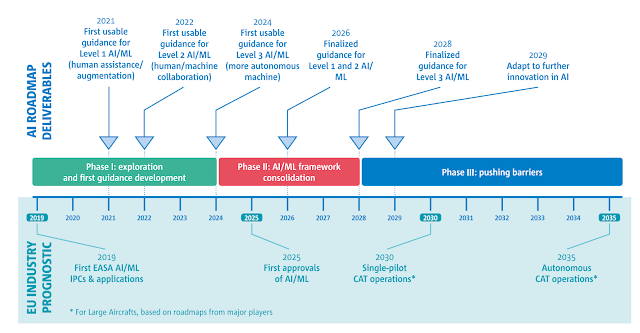

They, in collaboration with my friends at Daedalean, just released their approach how to certify the safety of the whole L1 system, a first for a ML system in aviation, as far as I know. This ought to help the nascent UAV market with overcoming regulatory barriers. You can get a sense for the state of the art with the EHang 216 drone in this autonomous test flight with the CEO on board.
Innovation Wealth
People who don’t look any deeper than the Gini coefficient look back on the world of 1982 as the good old days, because those who got rich then didn’t get as rich. But if you dig into how they got rich, the old days don’t look so good. In 1982, 84% of the richest 100 people got rich by inheritance, extracting natural resources, or doing real estate deals. Is that really better than a world in which the richest people get rich by starting tech companies? Why are people starting so many more new companies than they used to, and why are they getting so rich from it? The answer to the first question, curiously enough, is that it’s misphrased. We shouldn’t be asking why people are starting companies, but why they’re starting companies again. In 1892, the New York Herald Tribune compiled a list of all the millionaires in America. They found 4047 of them. How many had inherited their wealth then? Only @20% — less than the proportion of heirs today. And when you investigate the sources of the new fortunes, 1892 looks even more like today. Hugh Rockoff found that “many of the richest … gained their initial edge from the new technology of mass production.”
See also income inequality
Alternative funding
If you have real revenue and real cash flow coming in, and you want to grow your business by pulling that revenue forward, don’t sell debt, or a WBS; don’t sell a claim on the black box of your entire business. Sell the smallest unit possible. Sell the thing itself: your revenue. And the purest way to represent that – the atomic, tradable unit of the subscription economy – is the revenue contract.
a possible alternative to debt or equity financing.
The Paul Graham story
over the years, i’ve found paul graham essays to be ok in small doses. this one explains where he’s coming from: what i’ve worked on
Blands
On all the garbage direct to consumer startups.
All startups seek to disrupt and disintermediate a smug status quo, or originate and dominate an entirely new niche. But what makes a brand a bland is duality: claiming simultaneously to be unique in product, groundbreaking in purpose, and singular in delivery, while slavishly obeying an identikit formula of business model, look and feel, and tone of voice.
Despite hiding in plain sight (and plain recycled packaging), this “slight of bland” has won the wallets of a generation that considers itself above marketing, and created some of the buzziest companies of the age.
2023-04-01: It’s worse, average is everywhere
The interiors of our homes, coffee shops and restaurants all look the same. The buildings where we live and work all look the same. The cars we drive, their colors and their logos all look the same. The way we look and the way we dress all looks the same. Our movies, books and video games all look the same. And the brands we buy, their adverts, identities and taglines all look the same.
But it doesn’t end there. In the age of average, homogeneity can be found in an almost indefinite number of domains.
The Instagram pictures we post, the tweets we read, the TV we watch, the app icons we click, the skylines we see, the websites we visit and the illustrations which adorn them all look the same. The list goes on, and on, and on.
There are many reasons why this might have happened.
Perhaps when times are turbulent, people seek the safety of the familiar. Perhaps it’s our obsession with quantification and optimization. Or maybe it’s the inevitable result of inspiration becoming globalized.
Regardless of the reasons, it seems that just as Komar and Melamid produced the “people’s choice” in art, contemporary companies produce the people’s choice in almost every category of creativity.
TikTok and the Sorting Hat
TikTok doesn’t bump into the negative network effects of using a social graphs at scale because it doesn’t really have one. It is more of a pure interest graph, one derived from its short video content, and the beauty is its algorithm is so efficient that it its interest graph can be assembled without imposing much of a burden on the user at all. It is passive personalization, learning through consumption. Because the videos are so short, the volume of training data a user provides per unit of time is high. Because the videos are entertaining, this training process feels effortless, even enjoyable, for the user.
the reason tiktok has taken off is because it’s recommendation algorithm is really good, and it doesn’t need a social graph to thrive.
When Tailwinds Vanish
there’s no more users or minutes in the day, so tech will have to pivot to lower growth, lower margin industries.
Permission to Speak Freely
The Orchid network is a decentralized, open source VPN for securely anonymous internet access, even in China. 75% of humans live with restricted or censored access today
Entrepreneurial Space
Zubrin observes the new entrepreneurial approach has caused an entrepreneurial surge in nuclear fusion development. Nuclear fusion rockets can be more impactful and useful than nuclear fusion for energy. Nuclear fusion for energy is displacing alternatives for energy using solar, wind, coal etc… Nuclear for energy has to achieve lower cost to develop major new energy advantages. Nuclear fusion for rockets can enable entirely new capabilities like travel up to 10% of light speed.
 Gregor J. Rothfuss