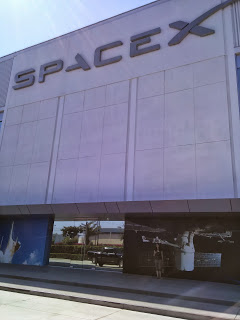
Tag: spacex

Making life multi-planetary

It is important that we take action now to make life multi-planetary, because this is really the first point in the 4B-year history of Earth that it has been possible. That window of possibility will hopefully be open for a long time, but it may only be open for a short time. That’s why I think urgent action is required on making life multi-planetary.

2012-11-12: This guy has more vision (and execution) than all the web 2.0 kiddies together.

Elon Musk wants to help establish a Mars colony of up to 80K people by ferrying explorers to the Red Planet for perhaps $500K a trip. In Musk’s vision, the ambitious Mars settlement program would start with a pioneering group of fewer than 10 people, who would journey to the Red Planet aboard a huge reusable rocket powered by liquid oxygen and methane.

2013-10-03: My latest toy to mess with tiny Luddite brains

2015-08-17: Long but worthwhile read

I’ve always envied everyone who was alive during the excitement of the moon landing in the late 60s. When I’ve thought about The Story of Humans and Space, the 1960s always seemed like a fluky 10 years of supreme excitement in the middle of an otherwise calm and steady trajectory: But now, I’m seeing the moon landing more as a precursor of something much bigger. Without realizing it, we may be standing on the precipice of one of the great leaps in biological history, and the moon landing may later be seen as the first labor contraction in the birth of an entirely new era for life on Earth. And somehow, we may actually be alive as that new era dawns.

2017-06-15: More details have been published

SpaceX is estimating they will be able to achieve $140K per ton for the trips to Mars. If a person plus their luggage is less than that, taking into account food consumption and life support, the cost of moving to Mars could ultimately drop below $100K. Cost will be brought down 5M % with fully reusable rocket, orbital refueling, propellent production on Mars, CH4 / O2 DEEP-CRYO Methalox fuel.

2018-08-31: Using Starship for habitation

SpaceX plans to live out of the BFS ships initially on Mars and then build out the facilities (habitation, power systems, mining and landing pads). The BFS would land on Mars with 100 tons including the ship.

Space Solar Power

None of the 4 new design concepts now offer as credible a price tag as the SERT designs, simply because sufficient funding has not yet been available to evaluate the uncertainties and develop sharp cost estimates. But in at least 3 of the 4 cases, there is excellent reason to expect that costs will be much less than 17 cents / kWh when we get there. There are important risks – but with all 4 options together, the objective risk of not being able to beat coal or fission on cost is probably less here than with any other technology large enough to meet all the world’s energy needs.

Why are we wasting time and money on ethanol again? Another company thinks 2500MW of space based solar power plants for $4b is doable. A similar nuclear reactor would come to ~$18b.
2021-09-01: With starship, this now seems feasible and perhaps inevitable.

Assuming a 70% transmission loss from orbit (beaming power by microwave to antenna farms on Earth is inherently lossy) we would need 60TW of PV panels in space. Which is 60k GW of panels, at 1 km^2 per GW. With maximum optimism that looks like somewhere in the range of 3k-60k Starship launches, at $2M/flight is $6b to $120b … which, over a period of years to decades, is chicken feed compared to the profit to be made by disrupting the 95% of the fossil fuel industry that just burns the stuff for energy. The cost of manufacturing the PV cells is another matter, but again: ground-based solar is already cheaper to install than shoveling coal into existing power stations, and in orbit it produces 4x as much electricity per unit area. Even if Musk doesn’t go there, someone is going to get SBPS working by 2030-2040, and in 2060 people will be scratching their heads and wondering why we ever bothered burning all that oil. But most likely Musk has noticed that this is a scheme that would make him unearthly shitpiles of money (the global energy sector in 2014 had revenue of $8t) and demand the 1000s of Starship flights it will take to turn reusable orbital heavy lift into the sort of industry in its own right that it needs to be before you can start talking about building a city on Mars.

2023-06-09: Prototype confirmation

A satellite has steered power in a microwave beam onto targets in space, and even sent some of that power to a detector on Earth. “No one has done this before. They’re bringing credibility to the topic by demonstrating this capability.” The transmitted power was small, just 200 milliwatts, less than that of a cellphone camera light. But the team was still able to steer the beam toward Earth and detect it with a receiver at Caltech.

2024-01-22: NASA study goes into great detail, and concludes

The following combination of revised assumptions yields SBSP solutions that are cost competitive with terrestrial alternatives, with lower GHG emissions:

  • launch cost: $50M per launch, or $500/kg; $425/kg with 15% block discount
  • electric propulsion orbital transfer from LEO to GEO
  • extended hardware lifetimes: 15 years
  • cheaper servicer and debris removal vehicles: $100M and $50M, respectively
  • efficient manufacturing at scale: learning curves of 85% and below

Space Tourism

Cottage industries on top of Virgin Galactic. Cute.

Loretta and George Whitesides plan to be the first couple to honeymoon in space. The sub-orbital spaceflight will launch the couple over 100 km high, past the boundary of space. The flight will include several minutes of weightlessness, a view of the blackness of space and the curvature of the Earth.

2007-04-10: Space Adventures Lunar Mission

The first private expedition to the moon. Price – $100m By joining the Space Adventures Lunar Mission you will contribute to the dawning of a new era in space exploration and enter the history books alongside the great explorers of our time.

2007-06-29: Space Hotel with space-based bingo. oy

the company has sent a collection of pictures and other memorabilia from fee-paying customers keen to see their personal possessions photographed in space.” The company “also hopes to activate a space-based bingo game to be played by people back on Earth.”


2007-08-01: Galactic Suite space hotel

$4M for a 3 day stay. During that time guests would see the sun rise 15x a day

2008-01-26: 90% can do suborbital

NASTAR reckons that more than 90% of the population could handle a sub-orbital flight. Nor does Mr King see any reason why children as young as 5 or 6 could not go too.

2013-02-21: Mars tourists. You gotta wonder when the ambitions of a moderately wealthy (think 100Ms, not Bs) individual exceed the ambitions of all nations. Conclusion: things are run by luddite lawyers and the sooner people like Tito succeed, the sooner hope returns to humanity.

The Inspiration Mars Foundation, a newly formed nonprofit organization led by American space traveler and entrepreneur Dennis Tito plans to take advantage of a unique window of opportunity to launch an historic journey to Mars and back in 501 days, starting in January 2018.

2017-02-27: Moon Tourism

SpaceX has been approached to fly 2 private citizens on a trip around the moon late next year. They have already paid a significant deposit to do a moon mission. Like the Apollo astronauts before them, these individuals will travel into space carrying the hopes and dreams of all humankind, driven by the universal human spirit of exploration. Spacex expects to conduct health and fitness tests, as well as begin initial training later this year. Other flight teams have also expressed strong interest and Spacex expects more to follow. Additional information will be released about the flight teams, contingent upon their approval and confirmation of the health and fitness test results.

2018-09-17: Moon Junket

I choose to go to the Moon, with artists. If Pablo Picasso had been able to see the moon up-close, what kind of paintings would he have drawn? If John Lennon could have seen the curvature of the Earth, what kind of songs would he have written? If they had gone to space, how would the world have looked today? People are creative and have a great imagination. We all have the ability to dream dreams that have never been dreamt, to sing songs that have never been sung, to paint that which has never been seen before. I hope that this project will inspire the dreamer within each of us. Together with Earth’s top artists, I will be heading to the moon… just a little earlier than everyone else. I am truly blessed by this opportunity to become Host Curator of “#dearMoon”. I would like to thank Elon Musk and SpaceX for creating the opportunity to go around the moon in their BFR. I would also like to thank all those who have continuously supported me. I vouch to make this project a success. Stay tuned!

2019-02-01: Commercial Human Space

Let’s start with low-key suborbital space tourism, of the type Virgin Galactic and Blue Origin would like to offer. Some economists see this as fairly feasible: If we know 1 thing about the world, it’s that some subset of the population will always have too much money and will get to spend it on cool things unattainable for the plebs. If such flights become routine, though, their price could go down, and space tourism could follow the trajectory of the commercial aviation industry, which used to be for the wealthy and is now home to Spirit Airlines. Some also speculate that longer, orbital flights—and sleepovers in cushy 6-star space hotels (the extra star is for the space part)—could follow.

After there’s a market for space hotels, more infrastructure could follow. And if you’re going to build something for space, it might be easier and cheaper to build it in space, with materials from space, rather than spending billions to launch all the materials you need. Maybe moon miners and manufacturers could establish a proto-colony, which could lead to some people living there permanently.

2019-08-23: Von Braun Station

The Goal of Gateway Foundation Von Braun Station is to build a dual-use station that is economically self-sustaining. They plan a larger Gateway Spaceport with 11M cubic meters of pressurized volume versus 931 meters for the International space station. This would be a 12000x larger volume.

Blue Origin

mr bezos new space venture. bringing rocket-powered space exploration to the masses.
2015-11-24: not a bad way for blue origin to come out of stealth mode, but this is no spacex so far.

2016-09-18:

Amazon CEO Jeff Bezos would like to see a fully colonized solar system. Bezos also has a rocket company Blue Origin and he has helped fund General Fusion. Blue Origin moves toward its goal of having “millions of people living and working in space,” the company has launched and landed the same rocket 4x in a row, an unprecedented feat aimed at ultimately lowering the cost of space travel. By 2018, it plans to fly tourists on short jaunts past the edge of space in capsules designed with large windows.

“I wish there were a trillion humans in the solar system. Think how cool that would be. You’d have a 1000 Einsteins at any given moment—and more. There would be so much dynamism with all of that human intelligence. But you can’t do that with the resources on Earth or the energy on earth. So if you really want to see that kind of dynamic civilization as we expand through the solar system, you have to figure out how to safely move around and use resources that you get in space.”

“I think NASA should work on a space-rated nuclear reactor. If you had a nuclear reactor in space– especially if you want to go anywhere beyond Mars, you really need nuclear power. Solar power just gets progressively difficult as you get further away from the sun. And that’s a completely doable thing to have a safe, space-qualified nuclear reactor.”

and

Rumors circulate of Bezos stepping back from his chief executive role at Amazon. He wants to spend more than the 1 day a week he works on Blue Origin

“I’m perfectly willing to fund this for as long as is required. There are way easier ways to make money. You don’t go through the list of best risk-return possibilities and find spaceflight. That’s not it. The reason you do this is because you’re a missionary for this. You’re passionate about it.”

2018-04-26:

SpaceX has growing revenue which is crushing Amazon stock funded Blue Origin. Blue Origin new Glenn rocket might be flying by 2020 and could have 3 to 8 commercial flights by 2023. By the end of 2020, SpaceX should have 100 more commercial launches and by 2023 will have 200+ commercial launches and should be flying the SpaceX BFR.

2018-10-05:

Blue Moon is a robotic space cargo carrier and lander design concept for making cargo deliveries to the Moon. Designed by Blue Origin, and as of 2018 planned to be operated by Blue Origin, on a mission aimed for 2024. Blue Moon benefits from the vertical landing technology heritage used in Blue Origin’s New Shepard suborbital rocket. The lander is planned to be capable of delivering 4500 kilograms to the surface of the Moon. The cargo vehicle could also be used to support NASA activities in cislunar space, or transport payloads of ice from Shackleton Crater to support space activities. Blue Origin began development work on the lander in 2016, publicly disclosed the project in 2017, and unveiled a mockup of the Blue Moon lander in May 2019.

2021-10-02 update, it appears they’re trying to cut corners:

Safety concerns about Blue Origin’s New Shepard crewed suborbital flight, which took place on 20 July, were dismissed in an atmosphere that discourages dissent and free discussion. At Blue Origin, a common question during high-level meetings was, “When will Elon or Branson fly?” Competing with other billionaires—and “making progress for Jeff”—seemed to take precedence over safety concerns that would have slowed down the schedule. In the opinion of an engineer who has signed on to this essay, “Blue Origin has been lucky that nothing has happened so far.” Many of this essay’s authors say they would not fly on a Blue Origin vehicle. And no wonder—we have all seen how often teams are stretched beyond reasonable limits. In 2019, the team assigned to operate and maintain one of New Shepard’s subsystems included only a few engineers working long hours. Their responsibilities, in some of our opinions, went far beyond what would be manageable for a team double the size, ranging from investigating the root cause of failures to conducting regular preventative maintenance on the rocket’s systems.

Space exploration

Against Human space exploration

It is true that science can be done in the space station. But science can also be done dressed in a clown suit atop a large Ferris wheel. The argument ought to be over where is the best place for it. Performing experiments in microgravity does not require a $100B platform. Moreover, much of the work that can genuinely be done only on the station is justified through another magnificently circular leap of logic. Research into the effects of microgravity on human health and the growth of soybeans, for instance, is useful only in the context of a manned mission to Mars.

It doesn’t pay to lift humans out of earth’s gravity well. Billions each year could instead be spent on research and development for cheaper transport options, spurring the advent of a commercial space industry.
2006-10-24: Our Non-Expeditions to the Moon and Mars

President Bush is right. The space shuttle and the space station deserve termination. The true heart of his proposal is the elimination of these programs, and the substitution of robotic exploration.

2007-01-28: Space for Survival

Space exploration is fundamentally about the survival of the species, about ensuring better odds for our survival through the promulgation of the human species. But as we do it, we will also ensure the prosperity of our species in the economic sense, in a 1000 ways.

NASA is starting to take extinction events seriously and arguing for space missions as a hedge. About time.
2007-06-06: Future of NASA

Reducing the cost of space access is now being addressed by the private sector. NASA is now acting as a responsible potential customer of commercial launch services (COTS). The government has a poor record competing with the private sector in the arena of cost effectiveness. NASA spent many years and billions of dollars in pursuit of next generation launch technologies, with limited success. NASA has now wisely chosen to provide a market with exploration programs and to permit private enterprise to have a crack at making that affordable. In the meantime NASA is developing the Ares family of launch vehicles to provide the capabilities it requires to initiate the human exploration program until the market is able to offer cheaper alternatives. As for the International Space Station (ISS), it is essential that we learn how to truly live and work in space – not just pay visits. ISS is a vital international laboratory for learning how to build, live aboard, maintain, and operate a complex vehicle in space. The same is true for a lunar base that enables us to use the resources of space and assists our education in how to reach Mars. As for favored contractors, the COTS program and the market established by exploration will open new venues for many companies and communities around the world to participate.

nasa’s reply to allegations of suckiness by wired et al
2010-05-15: The New Space Frontier

Today, the President will articulate an ambitious and exciting new plan that will alter our destiny as a species. I believe this address could be as important as President Kennedy’s 1962 speech at Rice University. For the first time since Apollo, our country will have a plan for space exploration that inspires and excites all who look to the stars. Even more important, it will work.

NASA finally creates a real space industry. You know, with competition and stuff.
2012-03-03: Space exploration future .Beyond on a related note, getting into AMNH early without all the crowds makes it twice as awesome.

2012-05-27: Mars Drive

The reference mission design of the MarsDrive Consortium is discussed, which has been created to facilitate exploration of the red planet through methods that are both realizable and cost-sustainable with existing technology. This mission plan—known as Mars for Less—is predicated on the use of existing medium-lift launch vehicles. In this architecture, 25-ton propulsion stages are placed individually in low-Earth orbit, where they are mated to Mars-bound payloads and ignited at successive perigees to execute trans-Mars injection. Spacecraft follow conjunction-class trajectories to the red planet and utilize aerodynamic methods for orbital capture and descent. Return vehicles are fueled with methane/oxygen bipropellant synthesized primarily from Martian resources. Dispatching expeditions from orbit with individual, high energy stages—rather than directly from the Earth’s surface—allows for the division of mission mass into more manageable components, which can be launched by vehicles that exist today. This plan does not require the development of heavy-lift launch technology: an effective yet costly proposition that may otherwise hinder current space exploration initiatives. Without the need for heavy-lift boosters, piloted missions to Mars may be undertaken presently, and within the capabilities of private initiatives. It is argued that the mission design herein represents a more viable method of conducting early human Mars exploration than proposals which require heavy-lift launch vehicles—an alternative method by which the red planet can be opened to humanity.

Between the safety fetish and cover your ass problems with government funded spaceflight, private companies have a 100x cost advantage. What flag will they plant in the regolith?

Here is one such proposal
2013-02-27: Going to Mars in 2018? This will be the most awe-inspiring and profound event this quarter-century.

Inspiration Mars Foundation believes in the exploration of space as a catalyst for growth, national prosperity, knowledge and global leadership. History has shown that strong nations reap these benefits when they boldly follow a path rooted in curiosity and guided by technological innovation. In 2018, the planets will literally align, offering a unique orbit opportunity to travel to Mars and back to Earth in only 501 days. Inspiration Mars is committed to sending a 2-person American crew – a man and a woman – on an historic journey to fly within 160 km around the Red Planet and return to Earth safely.

2013-03-12: Mars Research Station. I salute this effort. Very often, things look silly to our eyes that become crucial for humanity later on.

In the vast open spaces of southern Utah, Reuters photographer Jim Urquhart recently paid a visit to the Mars Desert Research Station (MDRS). Built and operated by a space advocacy group called the Mars Society, the research facility is investigating the feasibility of human exploration of Mars, using the Utah desert’s Mars-like terrain to simulate working conditions on the red planet. Since 2000, more than 100 small crews have served 2-week rotations in the MDRS, conducting research in an on-site greenhouse, observatory, engineering area, and living space. Urquhart was able to accompany members of the Crew 125 EuroMoonMars B mission inside the MDRS facility, and on a simulated trip to collect Martian geological samples.

2014-02-18: Indian Mars Exploration. India’s Mars mission is 9x cheaper than a similar NASA one. I hope they succeed and put another nail into the coffin of bloated military-industrial complex projects.

While India’s recent launch of a spacecraft to Mars was a remarkable feat in its own right, it is the $75m mission’s thrifty approach to time, money and materials that is getting attention.

2014-10-31: Exploration is sacrifice, and we’d best re-learn that lesson.

I would like to share my deepest personal thoughts on today’s Virgin Galactic Accident. As you know, this is deeply meaningful to me, my family and friends.

Today, most importantly, my heart goes out to those who have lost loved ones, and the many at Virgin Galactic, Scaled Composites, the Virgin Group and the Mojave Spaceport who this accident deeply affects.

I urge all of us to keep something in mind. We are on the verge of opening the space frontier, one of the greatest endeavors of our species.

Many Americans forget that 500 years ago 1000s of European gave their lives to open the Americas, and 200 years ago, the early American’s risked their lives to open the west. This is what exploring is all about. We risk our lives for what we believe in. This is the American way, the explorer’s way.

I for one, am proud to be a Virgin Galactic client. I believe in the company, and know, without a doubt, that they will succeed, and I will fully trust them with my safety when my turn to fly materializes.

2014-12-15: No More Space Race

A far cry from the fierce Cold War Space Race between the US and the Soviet Union, exploration in the 21st century is likely to be a far more globally collaborative project. This spirit of trans-border ownership and investment seems set to continue. One key part of this is the Global Exploration Roadmap, an effort between space agencies like NASA, France’s Centre National d’Etudes Spatiales, the Canadian Space Agency, and the Japan Aerospace Exploration Agency, among many others, that is intended to aid joint projects from the International Space Station to expeditions to the Moon and near-Earth asteroids—and to reach Mars. On a recent trip to India’s space agency, Stofan recounted to me, she met with many Indian engineers who were just as excited as the Americans to get scientists up there, not only to explore, but also to begin nailing down the question of whether there was ever life on the red planet. It’s also clear that the next stage of space exploration will not only be more global, but will equally involve greater private and public partnerships. Companies like Space X are increasingly involved in NASA’s day-to-day operations

2015-02-03: The caveman in space

At 61, Dr Stone appreciates the limits of human exploration. 23 of his friends lost their lives on expeditions and he has personally recovered 7 bodies. Now Stone Aerospace is developing a team of robots to hunt for microbial life on Europa. The discovery of Europan life would, Dr Stone reckons, be “a pretty good contender” for one of the most momentous events in human history. That might satisfy most explorers, but not Dr Stone. He has founded the Shackleton Energy Company to process water on the Moon into oxygen and hydrogen for rocket fuel.

2018-03-27: NEO Manned missions

The possibility of applying the Space-X Falcon-Heavy booster to human exploration of the inner solar system is discussed. A human-rated Dragon command module and an inflatable habitat module would house and support the 2-4 person crew during a ~1 year interplanetary venture. To minimize effects of galactic cosmic rays, older astronauts should conduct the mission during Solar Maximum. Crew life support is discussed as is application of a ~1-km square solar photon sail. The sail would be applied to rendezvous with the destination Near Earth Object (NEO) and to accelerate the spacecraft on its return to Earth. An on-line NASA trajectory browser has been used to examine optimized trajectories and destinations during 2025-2026. A suitable destination with well established solar-orbital parameters is Asteroid 2009 HC.