Tag: space

Galaxy Colonization Highest Good

Right now, outside of Earth, the universe as we know it is full of vast empty spaces, fiery stars, and lifeless planets. It’s beautiful, but it’s as dead as a rock. I, for one, would not want to be a rock. Being a human is wonderful, but even being a monkey or a dog or a bird would be better than being a rock. There is more happiness and pleasure (and whatever else makes life worth living) in a single bird than there is in the whole known universe outside of Earth. That would no longer be the case if humanity colonizes outer space.

Unified tyranny would be difficult to maintain across the vast distances of outer space.

To get a sense of the possibilities, consider a Dyson swarm, which is a series of structures that a civilization could place around a star to collect its radiation. If humanity builds a Dyson swarm around the sun, we could get a billion times more energy than from Earth. That alone would enable a huge improvement, but then note that the Milky Way has a few 100B stars. A network of Dyson swarms could power a massive galactic civilization that utterly dwarfs anything we can achieve on Earth. However much good we may be able to do by making the world a better place is utterly dwarfed by making the universe a better place.

and a counterpoint

These facts make it look hopeless for a governing system to effectively coordinate law enforcement activities, judicial decisions, and so on, across cosmic distances. The universe is simply too big for a government to establish law and order in a top-down fashion.

But there is another strategy for achieving peace: Future civilizations could use a policy of deterrence to prevent other civilizations from launching first strikes.
Moon Base Alpha

an economically self-sustainable lunar base could be established for $5B. This price point is surprising and significant for the space community. Not only could this be achievable within current space program budgets, it offers the tantalizing possibility that a single passionate donor could fund the entire program

Inflatable ISS module

this is cool, i missed it, the first inflatable module from bigelow has been installed at ISS

Bigelow Aerospace and Axiom Space — plan to launch habitat modules to orbit in 2020, with the aim of making some money off Earth. If all goes to plan, private space stations will eventually form the backbone of commercial facilities that replace the International Space Station (ISS), which is currently funded through 2024.

Space colony simulator

In addition to being a great game, High Frontier is the most detailed and accurate space colony simulator ever made. It’s so detailed, in fact, that work on it has already led to a couple of novel results.

Stability Benefit of Inverted Endcaps
A cylinder tends to tumble end-over-end if it’s made too long. Previous studies on space colonies didn’t study the idea of cylinder endcaps that bulge inward, like the bottom of a soda can. So we tried it out in High Frontier, and found that such inverted endcaps are better. We don’t mean just a little better; they’re a lot better. So much so, that when real space settlements get built someday, we can pretty much guarantee you’ll see inverted endcaps.

Advantages of Low-Earth Orbit
The classic space settlement studies always assumed they would be built in freespace, such as the L4 and L5 orbits. But in researching the radiation environment of various orbits, we found that the environment in low-Earth orbit (LEO) is much, much more benign than higher orbits. Incidentally, we also found that those classic studies underestimated the amount of shielding needed by 2x.

30 days to Mars

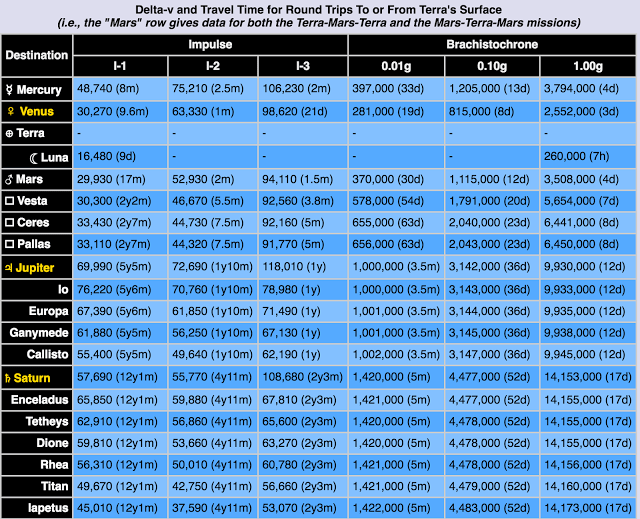
ProjectRho has round trip space mission times based on 3 types of rocket missions and 3 levels of constant acceleration. Constant acceleration could be achieved with an antimatter catalyzed fusion propulsion system like Positron Dynamics is developing

15 days 1 way to Mars with a constant 0.01 G acceleration and deceleration.
6 days 1 way to Mars with a constant 0.1G acceleration and deceleration.
2 days 1 way to Mars with a constant 1G acceleration and deceleration.


2022-02-19: It is also possible to get to Mars in 45 with Laser Thermal Propulsion: A Earth-based Laser heats up onboard propellant. This has very promising characteristics:

For lower velocity missions within the solar system, coupling the laser to the spacecraft via a reaction mass (i.e., propellant) is a more efficient way to use the delivered power than reflecting it off a lightsail. Reflecting light only transfers a tiny bit of the photon’s energy to the spacecraft, but absorbing the photon’s energy and putting it into a reaction mass results in greater energy transfer. The greater power that can be delivered results in greater thrust, so a more intense propulsive maneuver can be performed nearer to Earth. The closer to Earth the propulsive burn is, the smaller the laser array needs to be in order to keep the beam focused on the spacecraft, making it more feasible as a near-term demonstration of directed energy propulsion. The scaled-up version of our design (Mission Mars 2a) intended for crewed missions used a 40-ton spacecraft derived from the Orion capsule and European Service Module. The greater payload requires a more powerful (4 GW) laser to effectuate the same 45-day transit to Mars, but the laser array occupies the same 10-m footprint on earth.
The other mission we considered was a cargo mission (Mission Mars 2b). Robert Zubrin often makes the point that—even if advanced propulsion capable of high thrust and high specific impulse was available—he would still opt for a 6-month free-return trajectory and use the enhanced propulsion capability to bring more payload. So, the Mars 2b mission uses the performance of laser thermal propulsion to maximize the amount of cargo that could be brought to Mars with a Hohmann-like transfer, and shows that the payload could be increased by a 10x over what a Centaur upper stage—with the same mass of propellant—could throw to Mars.

400 days to Titan

Adam Crowl has been examining the Spacex Interstellar Transport System and analyzing the possible missions to Saturn’s Titan and Jupiter’s moons. Flying to Titan will be easier than flying to the large Moons of Jupiter. The thick atmosphere as thick as Titan’s is a boon to space-travelers trying to shed excess speed. Plus Titan is held in its orbit by a lighter planet – Jupiter masses 318x Earth, while Saturn masses 95x. The minimum delta-vee for a parabolic solar orbit is 8.75 km/s from LEO. Working out gravity losses from finite time boosts in LEO isn’t easy, but at a guess it’ll be 0.1 km/s. That leaves about 0.4 km/s in the tank. We’ll need that aerobrake at Titan to land.

Colonizing Mars

this is seminal. the most inspirational thing you’ll watch this year.

we can go to mars in our lifetimes.

For immigrants, who will spend the rest of their lives on Mars, or even explorers who would spend 2.5 years on a round trip, the advantage of reaching Mars one-way in 4 months instead of 6 months is negligible — and if shaving off 2 months would require a reduction in payload, meaning fewer provisions could be brought along, then the faster trip would be downright undesirable.