
someone needs to take a class in gravity 🙂
Tag: space
Leakage SETI
Previous SETI programs would not have detected an Earth-like civilization. The searches often looked for beacon-like signals deliberately beamed across space. Such beacons may not exist. Also, most radio SETI projects examined frequencies higher than 1 Gigahertz in order to avoid interference from both Earth-based and natural cosmic sources. Instead of looking for deliberate broadcasts, Loeb suggests looking for accidental leakage from an alien civilization. The new MWA-LFD, which is designed to study frequencies of 80-300 Megahertz, will pick up the same frequencies used by Earth technologies. It could detect Earth-like radio signals from a distance of up to 30 LY, which would encompass 1k stars. Future observatories like the Square Kilometer Array could detect Earth-like broadcasts from 10x farther away, which would encompass 100m stars.
Google Joins LSST Project
a moving picture of the universe, 30TB/day. holy shit. unfortunately, only in 2013 🙂
Blue Origin
mr bezos new space venture. bringing rocket-powered space exploration to the masses.
2015-11-24: not a bad way for blue origin to come out of stealth mode, but this is no spacex so far.
2016-09-18:
Amazon CEO Jeff Bezos would like to see a fully colonized solar system. Bezos also has a rocket company Blue Origin and he has helped fund General Fusion. Blue Origin moves toward its goal of having “millions of people living and working in space,” the company has launched and landed the same rocket 4x in a row, an unprecedented feat aimed at ultimately lowering the cost of space travel. By 2018, it plans to fly tourists on short jaunts past the edge of space in capsules designed with large windows.
“I wish there were a trillion humans in the solar system. Think how cool that would be. You’d have a 1000 Einsteins at any given moment—and more. There would be so much dynamism with all of that human intelligence. But you can’t do that with the resources on Earth or the energy on earth. So if you really want to see that kind of dynamic civilization as we expand through the solar system, you have to figure out how to safely move around and use resources that you get in space.”
“I think NASA should work on a space-rated nuclear reactor. If you had a nuclear reactor in space– especially if you want to go anywhere beyond Mars, you really need nuclear power. Solar power just gets progressively difficult as you get further away from the sun. And that’s a completely doable thing to have a safe, space-qualified nuclear reactor.”
and
Rumors circulate of Bezos stepping back from his chief executive role at Amazon. He wants to spend more than the 1 day a week he works on Blue Origin
“I’m perfectly willing to fund this for as long as is required. There are way easier ways to make money. You don’t go through the list of best risk-return possibilities and find spaceflight. That’s not it. The reason you do this is because you’re a missionary for this. You’re passionate about it.”
2018-04-26:
SpaceX has growing revenue which is crushing Amazon stock funded Blue Origin. Blue Origin new Glenn rocket might be flying by 2020 and could have 3 to 8 commercial flights by 2023. By the end of 2020, SpaceX should have 100 more commercial launches and by 2023 will have 200+ commercial launches and should be flying the SpaceX BFR.
2018-10-05:
Blue Moon is a robotic space cargo carrier and lander design concept for making cargo deliveries to the Moon. Designed by Blue Origin, and as of 2018 planned to be operated by Blue Origin, on a mission aimed for 2024. Blue Moon benefits from the vertical landing technology heritage used in Blue Origin’s New Shepard suborbital rocket. The lander is planned to be capable of delivering 4500 kilograms to the surface of the Moon. The cargo vehicle could also be used to support NASA activities in cislunar space, or transport payloads of ice from Shackleton Crater to support space activities. Blue Origin began development work on the lander in 2016, publicly disclosed the project in 2017, and unveiled a mockup of the Blue Moon lander in May 2019.
2021-10-02 update, it appears they’re trying to cut corners:
Safety concerns about Blue Origin’s New Shepard crewed suborbital flight, which took place on 20 July, were dismissed in an atmosphere that discourages dissent and free discussion. At Blue Origin, a common question during high-level meetings was, “When will Elon or Branson fly?” Competing with other billionaires—and “making progress for Jeff”—seemed to take precedence over safety concerns that would have slowed down the schedule. In the opinion of an engineer who has signed on to this essay, “Blue Origin has been lucky that nothing has happened so far.” Many of this essay’s authors say they would not fly on a Blue Origin vehicle. And no wonder—we have all seen how often teams are stretched beyond reasonable limits. In 2019, the team assigned to operate and maintain one of New Shepard’s subsystems included only a few engineers working long hours. Their responsibilities, in some of our opinions, went far beyond what would be manageable for a team double the size, ranging from investigating the root cause of failures to conducting regular preventative maintenance on the rocket’s systems.

Space Suits
The Mission of Orbital Outfitters is to provide affordable, industrial quality spacesuits and related services to commercial and government space travelers and explorers.
2007-02-16:
Astronauts’ spacesuits may one day be covered in motion-sensitive protein called prestin, which is found in the outer hair cells of the human ear. In the cell membranes of these cells, prestin converts electrical voltage into motion, elongating and contracting the cell. This movement amplifies sound in the ear. However, prestin can also work in reverse, producing electrical charges in response to mechanical stresses, such as tiny vibrations.”
2007-07-15:
retro cool. now we only need a spacecraft that does not suck.
2010-05-18:
Hubert Vykukal demonstrates mobility of the Hardsuit AX 3 Space Suit design.
with disco shoes.
2019-10-16:
Even though it’s primarily designed for launch and reentry, the Orion suit can keep astronauts alive if Orion were to lose cabin pressure during the journey out to the Moon, while adjusting orbits in Gateway, or on the way back home. Astronauts could survive inside the suit for up to 6 days as they make their way back to Earth. The suits are also equipped with a suite of survival gear in the event they have to exit Orion after splashdown before recovery personnel arrive. Each suit will carry its own life preserver that contains a personal locator beacon, a rescue knife, and a signaling kit with a mirror, strobe light, flashlight, whistle, and light sticks.
Spacewalk

that shit would make a nice GE layer
Exowater

Bright new deposits seen in 2 gullies on Mars suggest water carried sediment through them sometime during the past 7 years.
Terraforming just got 1% easier 🙂 Also, in other news, what’s the big deal? Water has been found on mars for some time:
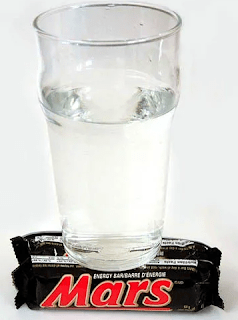
2007-03-16: Lots of water on Mars
Mars has enough water ice at its south pole to blanket the entire planet in more than 10m of water if everything thawed out.
2007-04-11: Extrasolar water atmospheres
We now know that water vapor exists in the atmosphere of one extrasolar planet and there is good reason to believe that other extrasolar planets contain water vapor
2011-10-26: First extrasolar water world? Gliese 581d.
2013-12-05: More detailed studies of extrasolar atmospheres
The presence of atmospheric water was reported previously on a few exoplanets orbiting stars beyond our solar system, but this is the first study to conclusively measure and compare the profiles and intensities of these signatures on multiple worlds. The 5 planets — WASP-17b, HD209458b, WASP-12b, WASP-19b and XO-1b — orbit nearby stars.
2013-12-26: Europa has a 201km high water vapor plume. Marked down as a prime tourism destination.
NASA’s Hubble Space Telescope has observed water vapor above the frigid south polar region of Jupiter’s moon Europa, providing the first strong evidence of water plumes erupting off the moon’s surface.
2014-09-11: Extrasolar ice
A team of scientists has discovered the first evidence of water ice clouds on an object outside of our own Solar System. Water ice clouds exist on our own gas giant planets — Jupiter, Saturn, Uranus, and Neptune — but have not been seen outside of the planets orbiting our Sun until now.
2014-11-23: Europa has an ocean 100km deep, with 3x as much water as earth. Looks like NASA is getting serious about a mission there. That mission will be a defining moment for this century: Imagine what will happen if they find life. See also this amazing overview picture:

2015-04-10: Looks like the Mars water estimates vary:
Mars has distinct polar ice caps, but Mars also has belts of glaciers at its central latitudes in both the southern and northern hemispheres. A thick layer of dust covers the glaciers, so they appear as surface of the ground, but radar measurements show that underneath the dust there are glaciers composed of frozen water. New studies have now calculated the size of the glaciers and thus the amount of water in the glaciers. It is the equivalent of all of Mars being covered by more than 1 meter of ice.
2016-11-28: There’s now about 12 of them in the solar system
Pluto is a wondrous world indeed. Another new finding makes it even more remarkable: evidence for a subsurface ocean of water. This had also been reported on previously by AmericaSpace, but the new update strengthens the case. A water ocean on Pluto? How is that even possible? Well, first it is a subsurface ocean, similar to ones on Jupiter’s moon Europa and Saturn’s moon Enceladus, among others. Temperatures on the surface are much, much too cold for liquid water (water ice is hard as rock and at lower latitudes near the equator, temperatures on Pluto can reach almost -200 degrees Celsius), but deep below the surface seems to be a different story.
2017-04-26: Most habitable planets are waterworlds
We find that most habitable planets have surfaces that are over 90% water. If Earth is indeed unusually dry for a habitable planet, then one might wonder what the mechanism was. Does the Solar system have some distinguishing feature that was responsible? For example, perhaps the low eccentricities and inclinations of Solar system planets are inefficient at promoting water delivery. It also appears feasible that the Earth has an unusually deep ocean basin. The gravitational potential associated with its surface fluctuations is much higher than any other body in the Solar system. In turn, this may suggest that the Earth has unusually strong tectonic activity, and consequently, an abnormally strong magnetic field.
2018-08-17: Another Mars water estimate
The radar investigation shows that south polar region of Mars is made of many layers of ice and dust down to a depth of ~1.5 km in the 200 km-wide area analyzed in this study. A particularly bright radar reflection underneath the layered deposits is identified within a 20 km-wide zone.
2018-08-18: More data on exoplanet water
Our data indicate that 35% of all known exoplanets which are bigger than Earth should be water-rich. These water worlds likely formed in similar ways to the giant planet cores (Jupiter, Saturn, Uranus, Neptune) which we find in our own solar system. The newly-launched TESS mission will find many more of them, with the help of ground-based spectroscopic follow-up. The next generation space telescope, the James Webb Space Telescope, will hopefully characterize the atmosphere of some of them. This is an exciting time for those interested in these remote worlds. This is water, but not as commonly found here on Earth. Their surface temperature is expected to be in the 200-500 Celsius range. Their surface may be shrouded in a water-vapor-dominated atmosphere, with a liquid water layer underneath. Moving deeper, one would expect to find this water transforms into high-pressure ices before we reaching the solid rocky core.
2018-12-29: Korolev crater 
ESA’s Mars Express mission recently photographed the Korolev crater on Mars, filled almost to the brim with water ice. When I first saw this image I thought, oh cute!, assuming the crater was maybe 10m across. But no, it’s 82km across and the thickest part of the ice is over 1600m thick.
2021-10-12: Exoweather:
JWST is a dream come true for exoplanet astronomers. It’s the most ambitious space telescope ever built. I like to say that the JWST will be 10000x better than the Hubble Space Telescope. A 10x bigger mirror, so with more light-gathering power you can observe things that are fainter; 10x more wavelength coverage — well into the infrared where Hubble stops. Having the infrared wavelength coverage will let us push to much cooler and thus potentially more habitable planets than we’ve been able to study before, and it helps us see through the clouds on these planets. There’s also 10x better stability, and 10x better spectral resolution. That means we can see the exact wavelengths in the planet’s color spectrum that are getting absorbed by molecules in its atmosphere, which lets us determine the chemical composition of atmospheres more precisely. There is no planet known where JWST will have the sensitivity required to detect biosignatures like this. Oxygen is really challenging to detect because the features are small compared to other molecules. For observable planets that are in the habitable zone of their stars, even if there is much more oxygen than is present on Earth, we would still need 10s of transits of the planet in front of the star to detect it. Any added difficulty, like clouds in the atmosphere or instrumental noise from JWST, would make it prohibitive. We would basically need to get lucky in every possible aspect to have a prayer of seeing oxygen, and in my experience exoplanets are always tougher than expected. I’m really optimistic that we’ll see some of the easier-to-observe molecules, particularly CO2. While that isn’t a biosignature, it’s still an important piece of the puzzle of habitability.
2023-05-13: About 20 Water Objects in the Solar System
Re-analysis of data from NASA’s Voyager spacecraft, along with new computer modeling, has led NASA scientists to conclude that 4 of Uranus’ largest moons likely contain an ocean layer between their cores and icy crusts. Their study is the first to detail the evolution of the interior makeup and structure of all 5 large moons: Ariel, Umbriel, Titania, Oberon, and Miranda. The work suggests 4 of the moons hold oceans that could be 10s of km deep.
Phobos

that’s an awesome render.
2015-10-13:
NASA wants to land a human crew on Mars in the 2030s. But to succeed with such an ambitious, expensive, long-timescale project, the agency needs a roadmap that inspires confidence that it really can send people to the Red Planet. Firouz Naderi, director of Solar System Exploration at NASA-JPL, has a budget-conscious idea: Let’s land on Phobos first.
Sun-cancellation cloud
a trillion reflecting shields at L1. talk about debris!
Will “a swarm of umbrellas” protect the Earth from global warming? “A trillion miniature spacecraft, each about a gram in mass and carrying a half-meter-diameter sunshade… would act as a mostly transparent umbrella for the entire planet.”

Shuttle Launch Seen From ISS
pretty good visibility at 360km
 Gregor J. Rothfuss