you know something profound has changed when spaceports are hailed as the savior for economically depressed areas. is the future finally here?
Tag: space
Bulletproof
objects made of iron, larger than our solar system, are moving 400 km per second through huge, interstellar curtains of colored gas… I wonder if you could build houses on them.
Solar System Bodies > 320km

Interplanetary Supply Chain
Sustainable space exploration will require appropriate interplanetary supply-chain management. Unlike Apollo, where everything was carried along, future exploration will have to rely on a complex supply-chain network on the ground and in space. The primary goal of the Interplanetary Supply Chain Management and Logistics Architectures (IPSCM&LA) project is to develop a comprehensive SCM framework and planning tool for space logistics.

SpaceX Falcon
Falcon 1, priced at $6.7M, will provide the lowest cost per flight to orbit of any launch vehicle in the world, despite receiving a design reliability rating equivalent to that of the best launch vehicles currently flying in the United States.
$50M orbital race
Anyone who wants to follow in the shoes of Burt Rutan and win the next big space prize will have to build a spacecraft capable of taking a crew of no fewer than 5 people to an altitude of 400 kilometers and complete 2 orbits of Earth at that altitude. Then they have to repeat that accomplishment within 60 days. While the first flight must demonstrate only the ability to carry 5 crew members, the winner will have to take at least 5 people up on the second flight. They have to do it by Jan. 10, 2010.
finally some movement
Telescopes
Phased Array Optics
It’s now been over 15 years since cryonics pioneer, molecular nanotechnologist, and optics buff Dr. Brian Wowk came up with the super-cool idea of phased array optics. Essentially, the plan is to use a 2D array of micron-sized screens to emit light at the precise amplitude and phase necessary to create the illusion of a 3D image. This technology could be fantastically effective: even using binoculars or a telescope, a person looking at the screen would be able to see details “km away” (if the image were high enough resolution) even if the screen were right in front of their face. Outside of tapping into the optic nerve directly, this may be the most convincing display technology ever. The limits of optics. The only problem is that it would require a metric truckload of computing power, but it’s nothing that specialty nanocomputers won’t be able to handle, right? Here is a diagram of the apparatus:

2008-06-03: GLIMPSE
GLIMPSE (Galactic Legacy Infrared Midplane Extraordinaire) is a survey of the inner part of the Milky Way Galaxy in which we reside. The images come from the IRAC instrument on board the Spitzer Space Telescope. These surveys have 100x the sensitivity and over 10x the resolution of previous surveys, allowing us to see stars and dusty objects throughout most of the Galaxy for the first time.
2008-09-19: Space flux telescopes
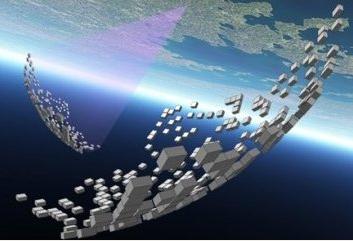
Holding the mirror pieces together magnetically seems the only practical way to reach the 40m+ diameter required to detect extrasolar planets directly
2009-06-11: The new refraction limit is wavelength / 20, a 10x improvement. This allows imagining of molecules with optical microscopes, and maybe also improvements for telescopes.
2013-12-09: DARPA MOIRE. The thickness of plastic wrap, each membrane serves as a Fresnel lens, which unfold in orbit. The diameter of 20 m would be the largest telescope ever made and gives it ~30x the light-gathering power of the HST.
2015-09-01: 3.2 Gigapixel
The US Department of Energy has approved the start of construction for a 3.2-gigapixel digital camera—the world’s largest—at the heart of the Large Synoptic Survey Telescope. Assembled at SLAC National Accelerator Laboratory, the camera will be the eye of LSST, revealing unprecedented details of the universe and helping unravel some of its greatest mysteries.
2016-08-15: LUVOIR
The Large Ultraviolet Optical Infrared Surveyor is a proposed space telescope that would be 5x as big and 100x as sensitive as the Hubble, with a 12m mirror, and would orbit the sun ~1.6m km from Earth. The revolutionary HDST space-based observatory would have the capability to find and study 10s of Earth-like worlds in detail. The 10 milliarcsec resolution element of a 12 meter telescope (diffraction limited at 0.5 micron) would reach a new threshold in spatial resolution. It would be able to take an optical image or spectrum at ~100 parsec spatial resolution or better, for any observable object in the entire Universe. Thus, no matter where a galaxy lies within the cosmic horizon, we would resolve the scale at which the formation and evolution of galaxies becomes the study of their smallest constituent building blocks—their star-forming regions and dwarf satellites. Within the Milky Way, a 12 m telescope would resolve the distance between the Earth and the Sun for any star in the Solar neighborhood, and resolve 100 AU anywhere in the Galaxy. Within our own Solar System, we would resolve structures the size of Manhattan out at the orbit of Jupiter
2017-04-08: Planet wide radio telescope
VLBI (Very Long Baseline Interferometry) now links radio telescopes spread across the globe into a telescope the size of our planet– extending the array to millimeter wavelengths achieved a further boost in resolving power. The result is a 10x increase in the sensitivity of the world’s millimeter VLBI networks.

2018-07-30: Adaptive optics Neptune
In astronomy, adaptive optics refers to a technique where instruments are able to compensate for the blurring effect caused by Earth’s atmosphere, which is a serious issue when it comes to ground-based telescopes. Basically, as light passes through our atmosphere, it becomes distorted and causes distant objects to become blurred (which is why stars appear to twinkle when seen with the naked eye).

2018-09-08: Imaging Oort Cloud objects
The most distant galaxies can be seen by our telescopes but smaller and closer objects in the Oort clouds cannot be seen. The Oort cloud objects are too faint to see with the James Webb Space Telescope, but it should be able to see bright galaxies and quasars even at 13B light years. Detecting Oort cloud dwarf planets would likely take a space telescope with an 11 kilometer mirror.
2019-03-21: Exoplanet Gigapixel Imaging
If we send a telescope to the solar gravitational lens (SGL) point on the opposite side of our sun then light from objects like exoplanets will be focused to provide 100B times more magnification. The Sun becomes a telescope that is 1.4M kilometers wide for the SGL regions.
We could resolve exoplanets around Proxima B to 450-meter resolution using a 1-meter telescope SGL mission. If there was an earth-sized planet around Proxima B, we could resolve to 800 megapixels. We would only be able to resolve 10 square kilometers at a time. The space telescope would have to roam around the einstein-ring image of the target object to assemble the full image. The image would need to be converted from an einstein ring back into the image of the exoplanet. A giant 1.3 kilometer focus line diameter space telescope would be able to resolve an entire einstein-ring image of an earth-sized exoplanet at 100 light years from the right SGL location.
2019-12-04: 1000km Space Telescopes

The 1000km baseline arrays would have over 400K times the light collection of the Hubble Space telescope.
2020-07-08: Gravity Lenses. If we send telescopes out to 4 light days we can use the gravity of the sun to amplify the power of telescopes by 100B times.
2021-05-14: Quantum Interferometry
A quantum hard drive at each telescope can record and store the wavelike states of incoming photons without disturbing them. After a while, you transport the hard drives to a single location, where you interfere the signals to create an incredibly high-resolution image. Not everyone thinks it’ll work. “In the long run, if these techniques are to become practical, they will require a quantum network”. Bartholomew counters that “we have good reasons to be optimistic” about quantum hard drives. “I think in a 5-to-10-year time frame you could see tentative experiments where you actually start looking at real [astronomical] sources.” By contrast, the construction of a quantum internet is decades from reality.
Space Tourism
Cottage industries on top of Virgin Galactic. Cute.
Loretta and George Whitesides plan to be the first couple to honeymoon in space. The sub-orbital spaceflight will launch the couple over 100 km high, past the boundary of space. The flight will include several minutes of weightlessness, a view of the blackness of space and the curvature of the Earth.
2007-04-10: Space Adventures Lunar Mission
The first private expedition to the moon. Price – $100m By joining the Space Adventures Lunar Mission you will contribute to the dawning of a new era in space exploration and enter the history books alongside the great explorers of our time.
2007-06-29: Space Hotel with space-based bingo. oy
the company has sent a collection of pictures and other memorabilia from fee-paying customers keen to see their personal possessions photographed in space.” The company “also hopes to activate a space-based bingo game to be played by people back on Earth.”

2007-08-01: Galactic Suite space hotel
$4M for a 3 day stay. During that time guests would see the sun rise 15x a day
2008-01-26: 90% can do suborbital
NASTAR reckons that more than 90% of the population could handle a sub-orbital flight. Nor does Mr King see any reason why children as young as 5 or 6 could not go too.
2013-02-21: Mars tourists. You gotta wonder when the ambitions of a moderately wealthy (think 100Ms, not Bs) individual exceed the ambitions of all nations. Conclusion: things are run by luddite lawyers and the sooner people like Tito succeed, the sooner hope returns to humanity.
The Inspiration Mars Foundation, a newly formed nonprofit organization led by American space traveler and entrepreneur Dennis Tito plans to take advantage of a unique window of opportunity to launch an historic journey to Mars and back in 501 days, starting in January 2018.
2017-02-27: Moon Tourism
SpaceX has been approached to fly 2 private citizens on a trip around the moon late next year. They have already paid a significant deposit to do a moon mission. Like the Apollo astronauts before them, these individuals will travel into space carrying the hopes and dreams of all humankind, driven by the universal human spirit of exploration. Spacex expects to conduct health and fitness tests, as well as begin initial training later this year. Other flight teams have also expressed strong interest and Spacex expects more to follow. Additional information will be released about the flight teams, contingent upon their approval and confirmation of the health and fitness test results.
2018-09-17: Moon Junket
I choose to go to the Moon, with artists. If Pablo Picasso had been able to see the moon up-close, what kind of paintings would he have drawn? If John Lennon could have seen the curvature of the Earth, what kind of songs would he have written? If they had gone to space, how would the world have looked today? People are creative and have a great imagination. We all have the ability to dream dreams that have never been dreamt, to sing songs that have never been sung, to paint that which has never been seen before. I hope that this project will inspire the dreamer within each of us. Together with Earth’s top artists, I will be heading to the moon… just a little earlier than everyone else. I am truly blessed by this opportunity to become Host Curator of “#dearMoon”. I would like to thank Elon Musk and SpaceX for creating the opportunity to go around the moon in their BFR. I would also like to thank all those who have continuously supported me. I vouch to make this project a success. Stay tuned!
2019-02-01: Commercial Human Space
Let’s start with low-key suborbital space tourism, of the type Virgin Galactic and Blue Origin would like to offer. Some economists see this as fairly feasible: If we know 1 thing about the world, it’s that some subset of the population will always have too much money and will get to spend it on cool things unattainable for the plebs. If such flights become routine, though, their price could go down, and space tourism could follow the trajectory of the commercial aviation industry, which used to be for the wealthy and is now home to Spirit Airlines. Some also speculate that longer, orbital flights—and sleepovers in cushy 6-star space hotels (the extra star is for the space part)—could follow.
After there’s a market for space hotels, more infrastructure could follow. And if you’re going to build something for space, it might be easier and cheaper to build it in space, with materials from space, rather than spending billions to launch all the materials you need. Maybe moon miners and manufacturers could establish a proto-colony, which could lead to some people living there permanently.
2019-08-23: Von Braun Station
The Goal of Gateway Foundation Von Braun Station is to build a dual-use station that is economically self-sustaining. They plan a larger Gateway Spaceport with 11M cubic meters of pressurized volume versus 931 meters for the International space station. This would be a 12000x larger volume.
Enceladus

Particles spewed from Saturn’s moon Enceladus are sandblasting neighboring moons, leaving them sparklingly bright
2008-03-25: Life on Enceladus?
Could microbial life exist inside Enceladus, where no sunlight reaches, photosynthesis is impossible and no oxygen is available? The answer appears to be, yes, it could be possible.
I invite you to imagine the day when we might journey to the saturnian system and visit the Enceladus interplanetary geiser park, just because we can.
2008-10-24: Cassini pictures 
Saturn’s tiny, icy moon Enceladus has recently been visited by NASA’s Cassini orbiter on several very close approaches – once coming within a mere 25 kilometers of the surface. Scientists are learning a great deal about this curious little moon. Only 500 kilometers wide, it is very active, emitting internal heat, churning its surface, and – through cryovolcanism – ejecting masses of microscopic ice particles into Saturnian orbit. Cassini has been orbiting Saturn for over 4 years now, and has provided some amazing views of tiny Enceladus, some collected here.
2022-11-11: Phosphorus predicted
Team members performed thermodynamic and kinetic modeling that simulates the geochemistry of phosphorus based on insights from Cassini about the ocean-seafloor system on Enceladus. They developed the most detailed geochemical model to date of how seafloor minerals dissolve into Enceladus’s ocean and predicted that phosphate minerals would be unusually soluble there.
“The underlying geochemistry has an elegant simplicity that makes the presence of dissolved phosphorus inevitable, reaching levels close to or even higher than those in modern Earth seawater. What this means for astrobiology is that we can be more confident than before that the ocean of Enceladus is habitable.”

Space Seed Garden
This complex will now “safeguard the world’s agriculture from future catastrophes, such as nuclear war, asteroid strikes and climate change. Construction begins in March, and the seed bank is scheduled to open in 2008.” Thus, a whole new building type has quietly emerged into architectural history – update your textbooks. Vitruvius would be proud: it’s the botanical Arctic Ark-archive. But is Spitsbergen really that safe? Perhaps these seeds should really be stored on, say, the International Space Station? Leaving aside how it would be possible to retrieve them, in the event of a truly global catastrophe, the premise nonetheless reminds me of China’s “space seed” project – which seems to have all but disappeared from public discourse.
the extinction risk meme is growing
 Gregor J. Rothfuss
