someone on ISS taking a picture as it flies through an aurora borealis.
Tag: space
Mars Express


 those are utterly amazing
Pulsar Navigation
An interstellar GPS system that has the ability to determine the position of any point in the galaxy to within 1m.
Space shuttle

A most amazing picture. Consider the distances involved. The space shuttle is about the relative size of Earth.
2012-04-27:
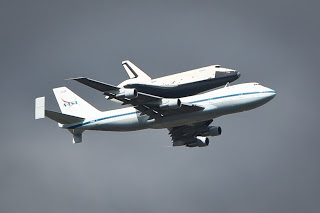






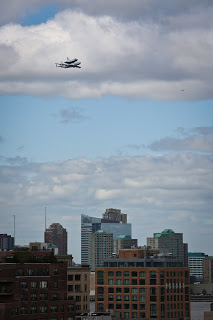
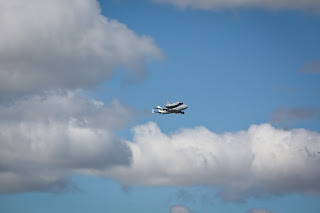



2012-10-13: Amazing swan song of the Space Shuttle program: you cost so much yet achieved so little.
A Space Shuttle on the Streets of Los Angeles The space shuttle Endeavour is on its last mission today, a 20 km creep through Los Angeles city streets on a 160-wheeled carrier. It is passing through neighborhoods and strip malls, headed toward its final destination, the California Science Center in South Los Angeles. At times, the shuttle has barely cleared trees, houses and street signs along a course heavily prepared for the trip. The move will cost an estimated $10m.

James Webb Space Telescope
The James Webb Space Telescope will collect light 9x faster than the Hubble Space Telescope
2016-11-05: Construction is complete
The telescope element of the James Webb Space Telescope (JWST), the largest space telescope ever constructed, stands completed in an enormous clean room at NASA’s Goddard Space Flight Center. JWST will now go through a series of rigorous tests, including shaking and noise tests to simulate launch conditions, and cryogenic tests to make sure it can stand up to the frigid conditions of space.
2021-11-07: Still not launched, but here’s why it matters:
The telescope is 14 years behind schedule and 20x over budget. “We’ve worked as hard as we could to catch all of our mistakes and test and rehearse. We’re going to put our zillion-dollar telescope on top of a stack of explosive material” and turn things over to fate. Other researchers want to understand the first stars. Some think Webb will see so-called “Population III stars,” primordial beasts that are hypothesized to have been roughly 10000x heavier than our sun. Such stars would help solve another major mystery of galaxy formation: how galaxies’ centers ended up with supermassive black holes — physically small yet incredibly powerful gravitational sinkholes that can weigh billions of times the mass of our sun. Nobody knows how supermassive black holes grew so heavy, or when, or why their properties are correlated with properties of their host galaxies. One theory is that Population III stars seeded the holes, but there are 1m other theories. Webb will look for signatures of the different scenarios.

2022-07-15: The first images.
Neutrino Communication
Jolting the star with neutrinos could advance the pulsation by causing it to heat up and expand. Information could thus be shuttled around our galaxy’s network of 500 or so Cepheids – and out as far as the Virgo cluster of galaxies.
does this mean we’ll finally have internet in the subway?
Beams of neutrinos have been proposed as a vehicle for communications under unusual circumstances, such as direct point-to-point global communication, communication with submarines, secure communications and interstellar communication. We report on the performance of a low-rate communications link established using the NuMI beam line and the MINERvA detector at Fermilab. The link achieved a decoded data rate of 0.1 bits/sec with a bit error rate of 1% over a distance of 1.035 km, including 240 m of earth.
To make use of neutrinos an advanced civilization can use a gravitational lens as a focus and amplifier. The lens can be a neutron star or a black hole. Using wave optics one can calculate the advantage of gravitational lensing for amplification of a beam and along the optical axis it is exceptionally large. Even though the amplification is very large the diameter of the beam is quite small, less that 1 cm. This implies that a large constellation of neutrino transmitters would have to enclose the local neutron star or black hole to cover the sky. This means that such a beacon would have to be built by a Kardashev Type II civilization.
Cassini


Kepler mission
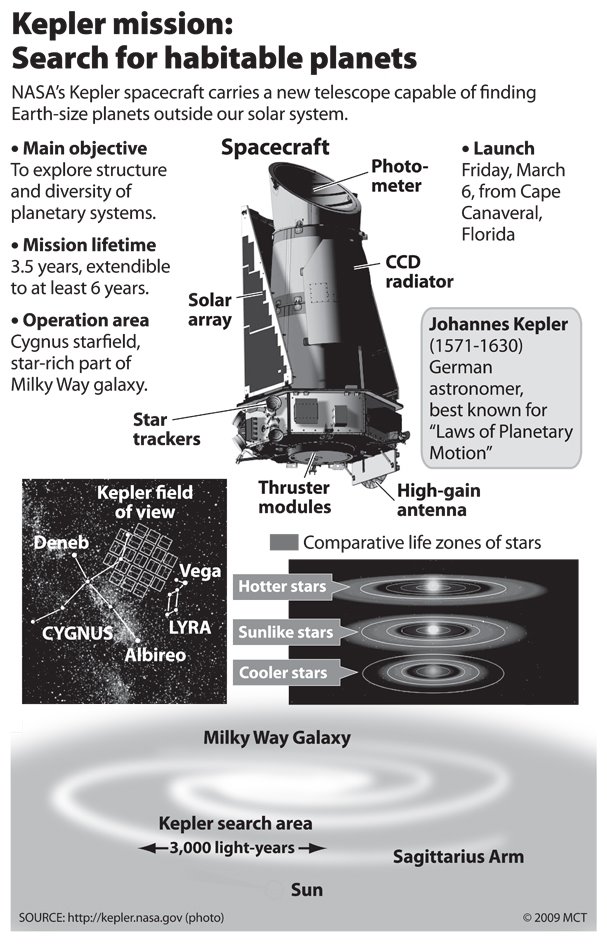
Launched today. Will search an area of 3000 light years in our neighbor arm, the sagittarius arm, for earth-like planets. Expected haul, 500.
2010-07-26: After finding more planets in the first year of the Kepler mission than all previous efforts combined: “earth-sized planets are common in the galaxy”
2011-02-01: Transit requires the right inclination for detection, and is quite unlikely, which means there should be 10k as many planets out there than they found. about 12M.
2013-11-23: Using a solar sail approach. Clever
NASA outlines ingenious plan to resurrect the Kepler planet hunter. “K2” mission would use its solar panels as a pointing device.
2015-12-15: Really awesome visualization about all the solar systems yet discovered.
2021-10-27: The final haul was 2662.
Large Space Payloads
Commercial vessels, nearly 3K in number, carried 7.4B tons of cargo in 2007. Consider, that say an Aldebaran flight a month would mean 360K tons of cargo in orbit, or 270K tons to the lunar surface PER ALDEBARAN PER YEAR. Assume 30 of these things flying, and you get 10.8M tons to orbit or 8.1M tons to the lunar surface. Assume 300 Aldebarans in the fleet, and you get 108M tons to orbit or 81M tons to the lunar surface per year. This is several 100x the lift capacity of the imaginary world of 2001: A Space Odyssey What could we do with such a capability? This is the question that a lot of space aficionados stop the analysis at and either go into Star Wars Universe like unlimited fantasy or snap back hard to current NASA limited mindset and experience a quailing of the spirit. But remember, I am not asking you to think, how would YOU get there, I am asking, IF WE WERE ALREADY THERE, how would you use the capability? Well, what do we use massive transport capability for on Earth? Supporting industry, which in the end, supports reinvestment and personal consumption. If a 300 Aldebaran vehicle fleet existed, it would be used for nothing less than the industrialization of the Solar System and the settlement of large numbers of people from Earth to offworld dwellings.
Sea Launch
a russian / american joint venture to launch orbital payloads from a ship. 20 satellites launched so far.
 Gregor J. Rothfuss