Tag: secondlife

Anshe Chung, SL tycoon

Anshe Chung Studios is a company that emerged from inside a virtual world. Driven by curiosity, our founder Anshe Chung decided to test in early 2004 if working in the economy of Second Life could sustain the real life of a person – a young boy in a developing country. She supported him by selling Linden dollars earned by providing services for other residents. In 2006 Anshe Chung became the first avatar with a net worth exceeding 1M US$. She has lead a new wave of virtual reality entrepreneurs who have demonstrated to the world the very real profit-making opportunities that exist within virtual world economies. Today Anshe Chung Studios maintains offices in the real world where it employs more than 80 people full time, and is extended by a huge network of virtual reality freelancers worldwide. It hosts 1000s of residents on more than 40 square kilometers of gated communities in virtual worlds, and in terms of sheer magnitude Anshe Chung Studios has developed more virtual property than any other Metaverse development company.

signpost: anshe is now a millionaire from her SL speculation.

Autodesk Enters Second Life

So 15 years later and with a new leader at the helm, rather than go it alone Autodesk is now poised to tap into the pioneering work of Linden Lab, the power of its community, and the spirit of all things 3pointD. Having used AutoCAD myself for over 10 years it will be most interesting to see where this goes. It could also be suggested that one of the reasons Second Life has been so widely accepted is because of its built in creation tools, lowering the barrier to entry for non-professionals (with the exception of Photoshop or the GIMP). Autodesk’s initiative seems to be about lowering the barrier for professionals who arrive with specialized knowledge and expensive tools

Autodesk bet on VR once before, in 1988. nice to have them back 🙂

Solar System in Second Life

A few months ago, groundbreaking 3D builder and avatar fashion designer Aimee Weber decided to expand the limits of machinima too, creating a planetarium-worthy tour of the solar system within Second Life. It wasn’t just the professional polish of the movie that struck me, but far as I can tell, it’s the first fully-realized use of machinima for educational purposes. Rather than interview her, however, I asked her to blog a behind-the-scenes account

Second life euphemism

Second life is an euphemism for a busy retirement

Though it is widely understood that broadband technologies that allow rapid and ‘always on’ connections to the Internet will provide significant benefits to the US economy, this report is the first to estimate the economic benefits to the nation due to cost savings and output expansion resulting from the use of broadband technologies for an important specific sub-group of the US population: the 70m Americans who are over 65 or under that age but have disabilities. 3 types of benefits from broadband deployment and use are addressed: lower medical costs; lower costs of institutionalized living; and additional output generated by more seniors and individuals with disabilities in the labor force. Considered together, these 3 benefits are estimated to accumulate to at least $927B in cost savings and output gains in 2005 $ (with future benefits discounted for the ‘time value of money’) over the 25 year period, 2005 to 2030. This amount is equivalent to 50% of what the United States currently spends annually for medical care for all its citizens ($1.8 trillion). As large as these benefits may appear, they are line with previous estimates for the benefits of broadband for the population as a whole. Policies designed to accelerate the use of broadband for these populations, however, could significantly add to the benefits, by cumulative amounts ranging from $532B to $847B (depending on the wages earned by the additional working seniors). The policy benefits are as substantial as what the federal government is likely to spend on homeland security over the next 25 years. Total cumulative benefits, under the right set of policies, could exceed what the United States currently spends annually for health care for all its citizens. Clearly, with so much at stake, policymakers have strong reasons to consider measures to accelerate the deployment and use of broadband technologies for America’s seniors and individuals with disabilities.

when you retire, your second life will be online. i had heard many a commenter mention their time constraints when faced with World of Warcraft or second life. is it unreasonable to expect a bimodal distribution on these platforms in the future? the young and the old certainly have the time. if these systems are able to attract older segments of the population, things will get interesting. actually, they already do.

if we leverage these enormous resources, ideally by making things like the mechanical turk or wikipedia fun for a large part of them, we’ll easily be able handle pensions and health care for a rapidly aging population, and still have funds left over for many more charity and nonprofit projects than today.

i always believed that a major reason for the bursting of the first bubble was that the internet experience of the average person is riddled with viruses, spyware and spam. it’s hard to overestimate how much this destroyed the trust and interest in all things internet. so maybe part of the appeal of these online worlds is there relative lack of annoyances (surely not for long..). what is needed, therefore, is a massive, probably grassroots, effort, to clean up the world’s computers and re-establish a safe browsing experience, and get these people back online. the rest will follow.
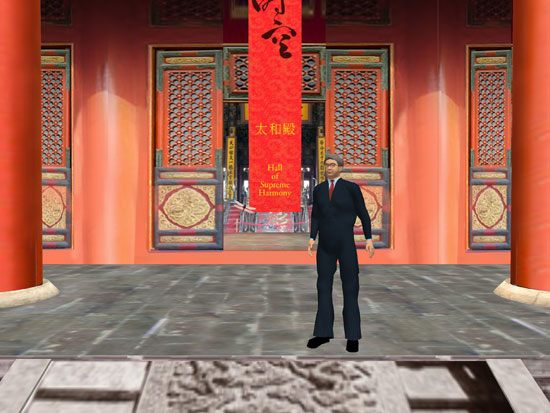
Unconferences are so 2003

New York Times-bestselling author Thomas Barnett comes to Second Life in avatar form to speak on his Blueprint for Action– October 26, 11:30-13:00. He’ll address us from the floor of a virtual UN building, speaking to an audience, one hopes, that’ll include Residents from around the globe– those in the Functioning Core, those in the Seam states, and with luck, even those from the Non-Integrating Gap itself.

barnett is very interesting, and this setting doubly so. i’ll most likely be there (as Kichiro Kawabata).
kichiro kawabata

Dawn of digital worlds

cory opens with a picture of bush, stating: meatspace is over. let’s move to cyberspace. cory is a lead developer on second life, probably the most advanced cyberworld today. cory asserts that there is a significant market for digital goods: estimated at $1B. The total strength of this trade is about $10B currently, rising sharply. Because digital goods are becoming commoditized, game companies are in an arms race with their user base to develop new content. Most online world force their users to assign copyright to them, which limits trade and economic interest.
“Atoms suck, you end up with traffic problems and Walmart”.
Markets are developing on second life. You can buy skydiving and even skydiving classes from user-run stores. (It turns out that cyber skydiving is great fun). There are also live DJ’s streaming and talking to their users.
Someone created a gun, and contracted out the pieces of it (artwort, physics etc) inside the gaming world. Cory Doctorov wrote a chapter of his latest book by hanging out in second life and interacting with users from around the world. This sets the stage for online collaboration. Currently, the application runs on 500 commodity pcs and covers 32 square kilometers. People are adding twists: Someone added alien abductions, and started abducting people..
Cory recommends the mystery of capital. He asserts that business is moving towards decentralization (quoted from Tom Malone) and that online worlds support this perfectly. The user community started protesting in the game against the game designers by walking around with protest signs in areas with new users. What a great way to put pressure on developers 🙂
Institutions of meatspace are recreated (only better) in cyberspace: Theaters, Digital cool hunting, exploring business models. Cory predicts that in a few years, their physical simulation will get good enough to be able to design real cars in record time.