Tag: science

Scaling Antimatter

Researchers have produced a record high number of electron-positron pairs, opening exciting opportunities to study extreme astrophysical processes, such as black holes and gamma-ray bursts.

The current lasers are at 500-1000 joules.
10-kilojoule-class lasers would provide 100x higher antimatter yield.
This would be ~100t (10^14) positron pairs.

There are many interesting applications if you can regularly and quickly generate 10^19 positrons in less than 1000 seconds. A 1 gigawatt antimatter ignited nuclear fusion generator becomes possible. 10^19 positrons can be used to trigger deuterium tritium fusion.

Hydrothermal Vents

the hydrothermal vents were a relic environment, one we believe resembles what the early conditions on Earth might have been. What we’re doing ultimately is trying to understand how life evolved on the planet. For all of their extremes of temperature, pressure, and other properties, deep-sea vents may have offered a relatively cozy refuge on the violent world of the early Earth. Our young planet was bathed in much stronger ultraviolet radiation from the sun because it hadn’t yet developed a protective ozone layer. That didn’t come along until after the evolutionary invention of photosynthesis pumped a steady supply of oxygen into our atmosphere. One big attraction is the presence of an ion gradient—a key ingredient in just about every known form of life—between the vent fluids and the seawater. The alkaline fluids are basic, with a pH (a measurement of acidity and alkalinity levels) of around 10 or 11, meaning they have a low concentration of protons. Seawater, with a pH of around 8, is less alkaline—that is, slightly more acidic—so it has more protons than the vent fluids. The vent would have acted as a natural hydrothermal reactor. Reactions between carbon dioxide and hydrogen, catalyzed by minerals found in the vents, can form a molecule known as pyruvate. Pyruvate is a precursor of many amino acids, which in turn can link together to create proteins.

AIs beat IQ tests

Our model can reach the intelligence level between the people with bachelor degrees and those with master degrees

and

it’s taken 60 years of AI research to build a machine in 2012 that can come anywhere close to matching the common sense reasoning of a 4-year old. But the nature of exponential improvements raises the prospect that the next 6 years might produce similarly dramatic improvements. So a question that we ought to be considering with urgency is: what kind of AI machine might we be grappling with in 2018?

Wolf Monkey societies

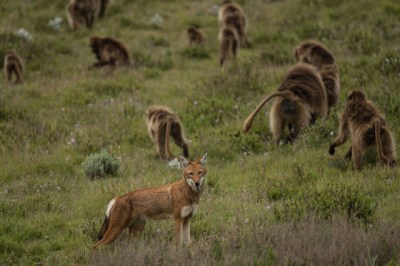
In the alpine grasslands of eastern Africa, Ethiopian wolves and gelada monkey are giving peace a chance. The geladas – a type of a baboon – tolerate wolves wandering right through the middle of their herds, while the wolves ignore potential meals of baby geladas in favor of rodents, which they can catch more easily when the monkeys are present.

The unusual pact echoes the way dogs began to be domesticated by humans.

When walking through a herd – which comprises many bands of monkeys grazing together in groups of 600 to 700 individuals – the wolves seem to take care to behave in a non-threatening way. They move slowly and calmly as they forage for rodents and avoid the zigzag running they use elsewhere.

This suggested that they were deliberately associating with the geladas. Since the wolves usually entered gelada groups during the middle of the day, when rodents are most active, he wondered whether the geladas made it easier for the wolves to catch the rodents – their primary prey.

Mega-journals

on the current state of open access journals, which have improved many, though not all, aspects of scientific publishing. it’s good that articles are now mostly freely available, and data can be reused under creative commons, but the actual format is still awkward pdfs instead of a more wiki-like process that would make it far easier to work in citations and keep them fresh.

AI prospects for biology

Banging through it all, though, to come up with a model that fit the data, tweaking and prodding and adjusting and starting all over when it didn’t work – which is what the evolutionary algorithms did – takes something else: inhuman patience and focus. That’s what computers are really good at, relentless grinding. I can’t call it intelligence, and I can call it artificial intelligence only in the sense that an inflatable palm is an artificial tree. I realize that we do have to call it something, though, but the term “artificial intelligence” probably confuses more than it illuminates.

2022-12-09: Some new hopes for paper mining, but see this caveat.

SciHub has 88m papers, and if we assume that we can extrapolate the Semantic Scholar dataset statistics (2600 words per article) with some paper loss due to old/faulty PDFs, it could be reasonable to expect 200b tokens of scientific knowledge, 10x bigger than the Minerva training set of Arxiv papers (21b tokens). This is a 10x boost in technical knowledge that would exist inside current LLMs.

There will be a universal language of physical science work that does not speak directly to humans. Monolithic cloud labs alone may not be optimal deployment of automated biology in the future. Projects like PyHamilton demonstrate growing open source communities for benchtop automation, and the SayCan collaboration by Google and Everyday Robots is a reminder of how multifunctional robots are steadily progressing (as well as ultralight indoor drones). As the cost curve goes down and the natural-language programmability goes up, there may be an intersection at which it is easier to convert an existing lab environment/protocol into an automated one, rather than to outsource work to a physically separate facility. Or, there may be a steady-state solution that some tasks are optimal for large automated warehouses and others are optimized for more distributed, edge labs. If there is any future of multiple robotic work providers, then interoperability will become a bottleneck, which will motivate a universal formalization of life science work.