The best theory of bird navigation implies that nature has found a way to preserve entanglement in messy biological systems at body temperature
Tag: quantum
Quantum physics and reality
they probed reality without disturbing it. Not disturbing it is the quantum-mechanical equivalent of not really looking. So they were able to show that the universe does indeed exist when it is not being observed.
Quantum cellular automaton
Quantum dot cellular automata are a proposed improvement on conventional computer design (CMOS), which have been devised in analogy to conventional models of cellular automata introduced by John von Neumann.
the technology to reach zettaflop performance
The concept of a memory device based on self-organized quantum dots (QDs) is presented, enabling extremely fast write times, limited only by the charge carrier relaxation time being in the picosecond range.
Leggett inequality
A team of physicists in Vienna has devised experiments that may answer one of the enduring riddles of science: Do we create the world just by looking at it? Leggett’s theory was more powerful than Bell’s because it required that light’s polarization be measured not just like the second hand on a clock face, but over an entire sphere. In essence, there were an infinite number of clock faces on which the second hand could point. For the experimenters this meant that they had to account for an infinite number of possible measurement settings. So Zeilinger’s group rederived Leggett’s theory for a finite number of measurements. There were certain directions the polarization would more likely face in quantum mechanics. This test was more stringent. In mid-2007 Fedrizzi found that the new realism model was violated by 80 orders of magnitude; the group was even more assured that quantum mechanics was correct.
Superstrings

A graphical representation of multi-dimensional spacetime
Photosynthesis
Quantum coherence allows photosynthesis to operate at nearly 100% efficiency. If this effect could be used for photovoltaics.
2009-07-15: Converting the photosynthesis of rice from the less-efficient C3 form to the C4 form would increase yields by 50% and would also use water 2x as efficiently.
2014-01-09: Rubisco. This little molecule underwrites your lavish lifestyle. It isn’t a very prolific sugar daddy:
Typical enzymes can process 1000 molecules per second, but rubisco fixes only 3 CO2 molecules per second.
2015-03-28: 2x photosynthesis?
“We have unprecedented computational resources that allow us to model every stage of photosynthesis and determine where the bottlenecks are, and advances in genetic engineering will help us augment or circumvent those steps that impede efficiency. Long suggested several strategies.
Add pigments. “Our lab and others have put a gene from cyanobacteria into crop plants and found that it boosts the photosynthetic rate by 30%. Some bacteria and algae contain pigments that utilize more of the solar spectrum than plant pigments do. If added to plants, those pigments could bolster the plants’ access to solar energy.
Add the blue-green algae system. Some scientists are trying to engineer C4 photosynthesis in C3 plants, but this means altering plant anatomy, changing the expression of many genes and inserting new genes from C4 plants.
“Another, possibly simpler approach is to add to the C3 chloroplast the system used by blue-green algae”. This would increase the activity of Rubisco, an enzyme that catalyzes a vital step of the conversion of atmospheric CO2 into plant biomass. Computer models suggest adding this system would increase photosynthesis as much as 60%.
More sunlight for lower leaves. Computer analyses of the way plant leaves intercept sunlight have revealed other ways to improve photosynthesis. Many plants intercept too much light in their topmost leaves and too little in lower leaves; this probably allows them to outcompete their neighbors, but in a farmer’s field such competition is counterproductive. Studies aim to make plants’ upper leaves lighter, allowing more sunlight to penetrate to the light-starved lower leaves.
Eliminate traffic jams. “The computer model predicts that by altering this system by up-regulating some genes and down-regulating others, a 60% improvement could be achieved without any additional resource”.
In silico simulation. “The next step is to create an in silico plant to virtually simulate the amazingly complex interactions among biological scales. This type of model is essential to fill current gaps in knowledge and better direct our engineering efforts.”
2015-03-31: Improving photosynthetic efficiency from the current 1-2% would be very profound.
worldwide agricultural yields must increase by 50% by 2050. And that ambitious goal does not factor in the effects of climate change. RIPE researchers demonstrated for the first time that it was possible to improve crop yields in the field by engineering photosynthesis. By increasing the expression levels of 3 genes involved in processing light, they improved tobacco yields by 20%
2015-05-03: Artificial photosynthesis
a nanowire array captures light, and bacteria convert CO2 into acetate. The bacteria directly interact with light-absorbing materials, the first example of “microbial photoelectrosynthesis.” Another kind of bacteria then transforms the acetate into chemical precursors that can be used to make a wide range of everyday products from antibiotics to paints, replacing fossil fuels and electrical power
2016-06-05: Bionic leaf
the work addresses 2 fundamental goals: storing the energy of the sun, and building something useful from CO2 in the atmosphere, thereby reducing a major greenhouse gas.
For the new bionic leaf, Nocera’s team has designed a system in which bacteria use hydrogen from the water split by the artificial leaf plus CO2 from the atmosphere to make a bioplastic that the bacteria store inside themselves as fuel. “I can then put the bug [bacteria] in the soil because it has already used the sunlight to make the bioplastic. Then the bug pulls nitrogen from the air and uses the bioplastic, which is basically stored hydrogen, to drive the fixation cycle to make ammonia for fertilizing crops.” The researchers have used their approach to grow 5 crop cycles of radishes. The vegetables receiving the bionic-leaf-derived fertilizer weigh 150% more than the control crops. The next step is to boost throughput so that 1 day, farmers in India or sub-Saharan Africa can produce their own fertilizer with this method.
there’s also
Researchers have engineered a potentially game-changing solar cell that cheaply and efficiently converts atmospheric CO2 directly into usable hydrocarbon fuel, using only sunlight for energy.
2019-01-11: More on improving RuBisCO:
Unfortunately, RuBisCO is, well, terrible at its job. It might not be obvious based on the plant growth around us, but the enzyme is not especially efficient at catalyzing the CO2 reaction. And, worse still, it often uses oxygen instead. This produces a useless byproduct that, if allowed to build up, will eventually shut down photosynthesis entirely. It’s estimated that crops such as wheat and rice lose anywhere from 20-50% of their growth potential due to this byproduct. While plants have evolved ways of dealing with this byproduct, they’re not especially efficient. So a group of researchers at the University of Illinois, Urbana decided to step in and engineer a better way. The result? In field tests, the engineered plants grew up to 40% more mass than ones that relied on the normal pathways.
2020-08-10: Plants are Green to reduce Photosynthesis Noise. Plants ignore the most energy-rich part of sunlight because stability matters more than efficiency
2022-07-04: Acetate could be a photosynthesis alternative
Experiments showed that a wide range of food-producing organisms can be grown in the dark directly on the acetate-rich electrolyzer output, including green algae, yeast, and fungal mycelium that produce mushrooms. Producing algae with this technology is 4x more energy efficient than growing it photosynthetically. Yeast production is 18x more energy efficient than how it is typically cultivated using sugar extracted from corn. “We found that a wide range of crops could take the acetate we provided and build it into the major molecular building blocks an organism needs to grow and thrive. With some breeding and engineering that we are currently working on we might be able to grow crops with acetate as an extra energy source to boost crop yields.”
2022-08-22: Better gene regulation increases yield by 20%
“Plants dissipate potentially damaging excess absorbed light energy in full sunlight by inducing a mechanism termed nonphotochemical quenching (NPQ),” the investigators explained. However, when the leaves are shaded (by other leaves, clouds, or the sun moving in the sky) this photoprotection needs to switch off so the leaves can continue the photosynthesis process with a reserve of sunlight.
It takes several minutes for the plant to switch off the protective mechanism, costing plants valuable time that could have been used for photosynthesis. “… NPQ mechanisms are slow to relax following the frequent sun–shade transitions that occur within crop canopies”. This results in 7.5% to 30% loss of photochemical energy that could otherwise be used for photosynthesis. “For soybean crop canopies, this slow NPQ relaxation upon sun–shade transitions was calculated to cost >11% of daily CO2 assimilation”. Modifications resulted in a 20% increase in yield, and importantly, without impacting seed quality. “Despite higher yield, seed protein content was unchanged. This suggests some of the extra energy gained from improved photosynthesis was likely diverted to the nitrogen-fixing bacteria in the plant’s nodules.”
No Femtotech Grey Goo?
The paper shows that it is not possible to make a self-replicating quantum mechanical device because of the linearity of quantum mechanics, the no cloning theorems and the conservation of entanglement.
would need decoherence. one worry less 🙂 otoh, also one hard scifi scenario less.
Telescopes
Phased Array Optics
It’s now been over 15 years since cryonics pioneer, molecular nanotechnologist, and optics buff Dr. Brian Wowk came up with the super-cool idea of phased array optics. Essentially, the plan is to use a 2D array of micron-sized screens to emit light at the precise amplitude and phase necessary to create the illusion of a 3D image. This technology could be fantastically effective: even using binoculars or a telescope, a person looking at the screen would be able to see details “km away” (if the image were high enough resolution) even if the screen were right in front of their face. Outside of tapping into the optic nerve directly, this may be the most convincing display technology ever. The limits of optics. The only problem is that it would require a metric truckload of computing power, but it’s nothing that specialty nanocomputers won’t be able to handle, right? Here is a diagram of the apparatus:

2008-06-03: GLIMPSE
GLIMPSE (Galactic Legacy Infrared Midplane Extraordinaire) is a survey of the inner part of the Milky Way Galaxy in which we reside. The images come from the IRAC instrument on board the Spitzer Space Telescope. These surveys have 100x the sensitivity and over 10x the resolution of previous surveys, allowing us to see stars and dusty objects throughout most of the Galaxy for the first time.
2008-09-19: Space flux telescopes
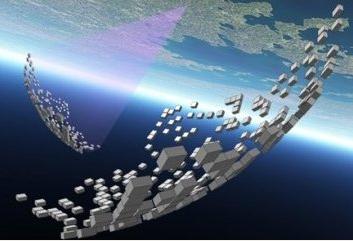
Holding the mirror pieces together magnetically seems the only practical way to reach the 40m+ diameter required to detect extrasolar planets directly
2009-06-11: The new refraction limit is wavelength / 20, a 10x improvement. This allows imagining of molecules with optical microscopes, and maybe also improvements for telescopes.
2013-12-09: DARPA MOIRE. The thickness of plastic wrap, each membrane serves as a Fresnel lens, which unfold in orbit. The diameter of 20 m would be the largest telescope ever made and gives it ~30x the light-gathering power of the HST.
2015-09-01: 3.2 Gigapixel
The US Department of Energy has approved the start of construction for a 3.2-gigapixel digital camera—the world’s largest—at the heart of the Large Synoptic Survey Telescope. Assembled at SLAC National Accelerator Laboratory, the camera will be the eye of LSST, revealing unprecedented details of the universe and helping unravel some of its greatest mysteries.
2016-08-15: LUVOIR
The Large Ultraviolet Optical Infrared Surveyor is a proposed space telescope that would be 5x as big and 100x as sensitive as the Hubble, with a 12m mirror, and would orbit the sun ~1.6m km from Earth. The revolutionary HDST space-based observatory would have the capability to find and study 10s of Earth-like worlds in detail. The 10 milliarcsec resolution element of a 12 meter telescope (diffraction limited at 0.5 micron) would reach a new threshold in spatial resolution. It would be able to take an optical image or spectrum at ~100 parsec spatial resolution or better, for any observable object in the entire Universe. Thus, no matter where a galaxy lies within the cosmic horizon, we would resolve the scale at which the formation and evolution of galaxies becomes the study of their smallest constituent building blocks—their star-forming regions and dwarf satellites. Within the Milky Way, a 12 m telescope would resolve the distance between the Earth and the Sun for any star in the Solar neighborhood, and resolve 100 AU anywhere in the Galaxy. Within our own Solar System, we would resolve structures the size of Manhattan out at the orbit of Jupiter
2017-04-08: Planet wide radio telescope
VLBI (Very Long Baseline Interferometry) now links radio telescopes spread across the globe into a telescope the size of our planet– extending the array to millimeter wavelengths achieved a further boost in resolving power. The result is a 10x increase in the sensitivity of the world’s millimeter VLBI networks.

2018-07-30: Adaptive optics Neptune
In astronomy, adaptive optics refers to a technique where instruments are able to compensate for the blurring effect caused by Earth’s atmosphere, which is a serious issue when it comes to ground-based telescopes. Basically, as light passes through our atmosphere, it becomes distorted and causes distant objects to become blurred (which is why stars appear to twinkle when seen with the naked eye).

2018-09-08: Imaging Oort Cloud objects
The most distant galaxies can be seen by our telescopes but smaller and closer objects in the Oort clouds cannot be seen. The Oort cloud objects are too faint to see with the James Webb Space Telescope, but it should be able to see bright galaxies and quasars even at 13B light years. Detecting Oort cloud dwarf planets would likely take a space telescope with an 11 kilometer mirror.
2019-03-21: Exoplanet Gigapixel Imaging
If we send a telescope to the solar gravitational lens (SGL) point on the opposite side of our sun then light from objects like exoplanets will be focused to provide 100B times more magnification. The Sun becomes a telescope that is 1.4M kilometers wide for the SGL regions.
We could resolve exoplanets around Proxima B to 450-meter resolution using a 1-meter telescope SGL mission. If there was an earth-sized planet around Proxima B, we could resolve to 800 megapixels. We would only be able to resolve 10 square kilometers at a time. The space telescope would have to roam around the einstein-ring image of the target object to assemble the full image. The image would need to be converted from an einstein ring back into the image of the exoplanet. A giant 1.3 kilometer focus line diameter space telescope would be able to resolve an entire einstein-ring image of an earth-sized exoplanet at 100 light years from the right SGL location.
2019-12-04: 1000km Space Telescopes

The 1000km baseline arrays would have over 400K times the light collection of the Hubble Space telescope.
2020-07-08: Gravity Lenses. If we send telescopes out to 4 light days we can use the gravity of the sun to amplify the power of telescopes by 100B times.
2021-05-14: Quantum Interferometry
A quantum hard drive at each telescope can record and store the wavelike states of incoming photons without disturbing them. After a while, you transport the hard drives to a single location, where you interfere the signals to create an incredibly high-resolution image. Not everyone thinks it’ll work. “In the long run, if these techniques are to become practical, they will require a quantum network”. Bartholomew counters that “we have good reasons to be optimistic” about quantum hard drives. “I think in a 5-to-10-year time frame you could see tentative experiments where you actually start looking at real [astronomical] sources.” By contrast, the construction of a quantum internet is decades from reality.
Truth to parallelism
We can speak truth to parallelism. So doofuses of the world: next time you excrete the words “NP-complete,” “solve,” and “instantaneous” anywhere near one another, brace yourselves for a Bennett-Bernstein-Brassard-Blitzirani the likes of which the multiverse has never seen.
Complexity Zoo
huh. when i was in school we pretty much stopped at P and NP, now there are 545 complexity classes.
 Gregor J. Rothfuss