Police in the UK are thinking about installing new CCTV cameras sensitive enough to record conversations up to 100 m away
cctv adds audio. file under transparent society. via rekha
Sapere Aude
Tag: privacy
Police in the UK are thinking about installing new CCTV cameras sensitive enough to record conversations up to 100 m away
cctv adds audio. file under transparent society. via rekha
i toss around this term all the time, better bookmark it. the perfect prison architecture
Jangl provides an ID that users can give out to other people to create a VOIP number unique to a single relationship between 2 people. VOIP is used as the connection between any 2 phones, be they land lines, cell phones or VOIP calls.
multiple identities / identity intermediaries are starting to appear in the real world. this is how you deal with the ‘OMG teh internets have predators’
A game where you compete in relaxation. The players’ brainwaves control a ball on a table, and the more relaxed scores a goal over the opponent.
2006-11-15: Slow but steady progress
Hitachi has successfully tested a brain-machine interface that allows users to turn power switches on and off with their mind. Relying on optical topography, a neuroimaging technique that uses near-infrared light to map blood concentration in the brain, the system can recognize the changes in brain blood flow associated with mental activity and translate those changes into voltage signals for controlling external devices. In the experiments, test subjects were able to activate the power switch of a model train by performing mental arithmetic and reciting items from memory.
2007-05-29: National Neurotechnology Initiative
We’ve learned more about the brain in the last 5 years than we did in the last 50 years. Lynch is working on a proposal for a 5-year National Neurotechnology Initiative with a budget of $200 million a year. It would identify projects to fund, such as the development of a “brain interface” device that would route signals from the muscles and sensory organs; technology that would allow nerves to control prosthetic devices; and a brain-simulation project that would replicate the way the brain works.
2007-08-25: Brainloop, Google Earth controlled by a brain computer interface.
2008-02-20: EEG startup.
Emotiv has created technologies that allow machines to take both conscious and non-conscious inputs directly from your mind.
I think I have future shock with this one.
Between this and haptic interfaces… woah.
2008-10-23: An update on the neuro cyborgs
He inserts a 4 sq. mm array of 100 neural probes into the M1 arm knob of the cortex. With a random sample of neural signaling from that region of the brain, and some Kalman filtering, patients can instantly control the cursor on screen (unlike biofeedback or sensory remapping which require training). They can deduce motor intent from a sample of an average of 24 neurons. When connected to a robot hand for the first time, and asked to “make a fist” the patient exclaimed “holy shit” as it worked the first time. Prior to the experiments, open questions included: Do the neurons stay active (other work indicates that the motor cortex reorganizes within minutes of decoupled sensory input)? Can thinking still activate the motor neurons? The test patients had been in sensory deprivation for 2-9 years prior. Will there be scarring and degradation over time? 1 patient is 3 years in. What are the neural plasticity effects?
2012-07-01: Brain in a vat is here!
The first real-time brain-scanning speller will allow people in an apparent vegetative state to communicate
2012-12-21: HCI chocolate
Researchers described the brain-computer interface that allowed Ms. Scheuermann to move an arm, turn and bend a wrist, and close a hand for the first time in 9 years. Less than 1 year after she told the research team, “I’m going to feed myself chocolate before this is over,” Ms. Scheuermann savored its taste and announced as they applauded her feat, “1 small nibble for a woman, 1 giant bite for BCI.”
2013-03-01: Brain to brain communication
Even though the animals were on different continents, with the resulting noisy transmission and signal delays, they could still communicate. This tells us that we could create a workable, network of animal brains distributed in many different locations.
2013-03-17: Hive mind privacy. One of the most interesting arguments for privacy in our (near) hive mind: to cut down on the quadratic communication overhead. Even our brain isn’t fully connected, rather sparsely in fact.
2014-03-04: I had somehow missed this 2 years ago. In the estimation of Mary Lou Jepsen: Could future devices read images from our brains? It should be possible to increase resolution 1000x in the next few years.
2014-04-27: Vegetative patients may be aware
a significant proportion of patients who were classified as vegetative in recent years have been misdiagnosed – Owen estimates perhaps 20%. Schiff, who weighs up the extent of misdiagnosis a different way, goes further. Based on recent studies, he says 40% of patients thought to be vegetative are, when examined more closely, partly aware. Among this group of supposedly vegetative patients are those who are revealed by scanners to be able to communicate and should be diagnosed as locked-in, if they are fully conscious, or minimally conscious, if their abilities wax and wane. But Schiff believes the remainder will have to be defined another way altogether, since being aware does not necessarily mean being able to use mental imagery. Nor does being aware enough to follow a command mean possessing the ability to communicate.
Another story:
For 12 years, Scott had remained silent, locked inside his body, quietly watching the world go by. Now, the fMRI had revealed a person: a living, breathing soul who had a life, attitudes, beliefs, memories and experiences, and who had the sense of being somebody who was alive and in the world – no matter how strange and limited that world had become.
On many occasions in the months that followed, we conversed with Scott in the scanner. He expressed himself, speaking to us through this magical connection we had made between his mind and our machine. Somehow, Scott came back to life. He was able to tell us that he knew who he was; he knew where he was; and he knew how much time had passed since his accident. And thankfully, he confirmed that he wasn’t in any pain.
Neuroethics / when you are declared brain dead are in for an upheaval.
After a major injury, some patients are in such serious condition that doctors deliberately place them in an artificial coma to protect their body and brain so they can recover. That could be a mistake. An extreme deep coma — based on the experiment on the cats — may actually be more protective. “Indeed, an organ or muscle that remains inactive for a long time eventually atrophies. It is plausible that the same applies to a brain kept for an extended period in a state corresponding to a flat EEG. An inactive brain coming out of a prolonged coma may be in worse shape than a brain that has had minimal activity. Research on the effects of extreme deep coma during which the hippocampus is active is absolutely vital for the benefit of patients.”
2014-09-11: Brain coupling
intriguing new possibilities for computer-assisted communication of brain states between individuals. The brain-to-brain method may be used to augment this mutual coupling of the brains, and may have a positive impact on human social behavior
2015-07-10: Rat onemind.
Brainet uses signals from an array of electrodes implanted in the brains of multiple rodents in experiments to merge their collective brain activity and jointly control a virtual avatar arm or even perform sophisticated computations — including image pattern recognition and even weather forecasting
2015-09-26: Unaided paraplegic walking
A novel brain-computer-interface has allowed a paraplegic man to walk for a short distance, unaided by an exoskeleton or other types of robotic support.
2016-06-01: Remote controlled insects. This is an improvement over the robo cockroach:
The rapid pace of miniaturization is swiftly blurring the line between the technological base we’ve created and the technological base that created us. Extreme miniaturization and advanced neural interfaces have enabled us to explore the remote control of insects in free flight via implantable radio-equipped miniature neural stimulating systems
2016-08-04: Neural Dust
UC Berkeley researchers are developing “Neural Dust,” tiny wireless sensors for implanting in the brain, muscles, and intestines that could someday be used to control prosthetics or a “electroceuticals” to treat epilepsy or fire up the immune system. So far, they’ve tested a 3 millimeter long version of the device in rats. “I think the long-term prospects for neural dust are not only within nerves and the brain, but much broader. Having access to in-body telemetry has never been possible because there has been no way to put something supertiny superdeep. But now I can take a speck of nothing and park it next to a nerve or organ, your GI tract or a muscle, and read out the data.”
2016-09-11: Do we really want to fuse our brains together?
If a rat can teach herself to use a completely new sensory modality – something the species has never experienced throughout the course of its evolutionary history – is there any cause to believe our own brains will prove any less capable of integrating novel forms of input?
2016-10-04: CCortex
Artificial Development is building CCortex, a massive spiking neural network simulation of the human cortex and peripheral systems. Upon completion, CCortex will represent up to 20b neurons and 20t connections, achieving a level of complexity that rivals the mammalian brain, and making it the largest, most biologically realistic neural network ever built. The system is up to 10k times larger than any previous attempt to replicate primary characteristics of human intelligence.
2017-03-23: Our Future Cyborg Brains
2017-09-05: 100x smaller Antennas
Antennas 100x smaller could lead to tiny brain implants, micro–medical devices, or phones you can wear on your finger. The antennas are expected to have sizes comparable to the acoustic wavelength, thus leading to orders of magnitude reduced antenna size compared to state-of-the-art compact antennas. These miniaturized ME antennas have drastically enhanced antenna gain at small size owing to the acoustically actuated ME effect based receiving/transmitting mechanisms at RF frequencies.
2018-02-27: EEG image reconstruction:
The new technique “could provide a means of communication for people who are unable to verbally communicate. It could also have forensic uses for law enforcement in gathering eyewitness information on potential suspects, rather than relying on verbal descriptions provided to a sketch artist.”
2018-05-14: Tetraplegics win race
But what about letting patients actively participate with AI in improving performance? To test that idea, researchers conducted research using “mutual learning” between computer and humans — 2 severely impaired (tetraplegic) participants with chronic spinal cord injury. The goal: win a live virtual racing game at an international event. After training for several months, in Oct. 8, 2016, the 2 pilots participated in Cybathlon in Zurich, Switzerland — the first international para-Olympics for disabled individuals in control of bionic assistive technology. 1 of those pilots won the gold medal and the other held the tournament record.
2018-09-11: DARPA Neurotechnology
DARPA is funding development of high resolution brain interfaces. At the same time there are 2 companies who have breakthrough technology for higher resolution brain interfaces. The 2 companies are Elon Musk’s Neuralink and Mary Lou Jepsen’s Openwater red light scanner.
2019-02-09: 75% Thought to Speech
A system that translates thought into intelligible speech. Devices monitor brain activity and Artificial Intelligence reconstructs the words a person hears. This breakthrough harnesses the power of speech synthesizers and artificial intelligence. It could lead to new ways for computers to communicate directly with the brain. The DNN-vocoder combination achieved the best performance (75% accuracy), which is 67% higher than the baseline system (Linear regression with auditory spectrogram).

2019-04-24: 43% Thought to speech
An implanted brain-computer interface (above) coupled with deep-learning algorithms can translate thought into computerized speech. The researchers asked native English speakers on Amazon’s Mechanical Turk crowdsourcing marketplace to transcribe the sentences they heard. The listeners accurately heard the sentences 43% of the time when given a set of 25 possible words to choose from, and 21% of the time when given 50 words. Although the accuracy rate remains low, it would be good enough to make a meaningful difference to a “locked-in” person, who is almost completely paralyzed and unable to speak.

2019-05-02: HCI Superpowers
The new documentary I Am Human chronicles how neurotechnology could restore sight, retrain the body, and treat diseases—then make us all more than human.
2019-08-01: Facebook has a 76% system:
Here, human participants listened to questions and responded aloud with answers while we used high-density electrocorticography (ECoG) recordings to detect when they heard or said an utterance and to then decode the utterance’s identity. Because certain answers were only plausible responses to certain questions, we could dynamically update the prior probabilities of each answer using the decoded question likelihoods as context. We decode produced and perceived utterances with accuracy rates as high as 61% and 76%, respectively (chance is 7% and 20%). Contextual integration of decoded question likelihoods significantly improves answer decoding. These results demonstrate real-time decoding of speech in an interactive, conversational setting, which has important implications for patients who are unable to communicate.
2019-10-30: Brain-to-Brain communication for group problem-solving
The interface combines electroencephalography (EEG) to record brain signals and transcranial magnetic stimulation (TMS) to deliver information noninvasively to the brain. The interface allows 3 human subjects to collaborate and solve a task using direct brain-to-brain communication. 2 of the 3 subjects are designated as “Senders” whose brain signals are decoded using real-time EEG data analysis. The decoding process extracts each Sender’s decision about whether to rotate a block in a Tetris-like game before it is dropped to fill a line. The Senders’ decisions are transmitted via the Internet to the brain of a third subject, the “Receiver,” who cannot see the game screen. The Senders’ decisions are delivered to the Receiver’s brain via magnetic stimulation of the occipital cortex. The Receiver integrates the information received from the 2 Senders and uses an EEG interface to make a decision about either turning the block or keeping it in the same orientation. A second round of the game provides an additional chance for the Senders to evaluate the Receiver’s decision and send feedback to the Receiver’s brain, and for the Receiver to rectify a possible incorrect decision made in the first round.
2021-05-14: 94% Thought to text
Using an implant, a paralyzed individual achieved typing speeds of 90 characters per minute with 94.1% raw accuracy online, and greater than 99% accuracy offline with a general-purpose autocorrect. Despite working with a relatively small amount of data (only 242 sentences’ worth of characters), the system worked remarkably well. The lag between the thought and a character appearing on screen was ~500ms, and the participant was able to produce 90 characters per minute, easily topping the previous record for implant-driven typing, which was ~25 characters per minute.
2022-04-15: EEG are terrible sensors. In-ear may fix that, and allow for continuous readings, and perhaps writing too.
But while the immediate uses of NextSense’s earbuds are medical, Berent hopes to eventually build a mass-market brain monitor that, if enough people start using it, can generate enormous quantities of day-to-day brain performance data. The catch, of course, is that since no one has ever done that, it’s not yet obvious what most people would get out of the information. That’s also what’s exciting. “We don’t necessarily know what we would learn because we’ve never had access to that type of data”.
Berent and his team envision a multipurpose device that can stream music and phone calls like AirPods; boost local sound like a hearing aid; and monitor your brain to provide a window into your moods, attention, sleep patterns, and periods of depression. He also hopes to zero in on a few sizes that would fit a vast majority of people, to dispense with all the ear-scanning.
Far along on the NextSense road map is something unproven, and kind of wild. If AI can decode tons of brain data, the next step would be to then change those patterns—perhaps by doing something as simple as playing a well-timed sound. “It’s almost a transformative moment in history,” fascinated by the prospect of using audio to nudge someone into a deeper sleep state. “It’s so convenient, it doesn’t bother you. People are wearing stuff in the ear typically anyway, right?”

2023-01-24: Faster speech to text
Our BCI decoded speech at 62 words per minute, which is 3.4x faster than the prior record for any kind of BCI and begins to approach the speed of natural conversation (160 words per minute). We highlight 2 aspects of the neural code for speech that are encouraging for speech BCIs: spatially intermixed tuning to speech articulators that makes accurate decoding possible from only a small region of cortex, and a detailed articulatory representation of phonemes that persists years after paralysis. These results show a feasible path forward for using intracortical speech BCIs to restore rapid communication to people with paralysis who can no longer speak.
an introduction by steve mann
Here are 10 Hypotheses.
(techlaw). Sousveillance will become a major force and industry, despite initial opposition. Like surveillance, sousveillance technology will outstrip many laws, and will be another example of technology moving forward more quickly than the legal framework that grows around it.
(privacy). Over the past 30 years, sousveillance practice has raised many new privacy, legal, and ethical issues, and these issues will become central as the sousveillance industry grows.
(incidentalism). Sousveillance of the most pure form, is not merely the carrying around of a hand-held camera, but, rather, must include elements of incidentalist imaging to succeed. For this reason, camera phones, pocket organizers containing cameras in them, and wristwatch cameras, for example, exhibit an incidentalist imaging effect not experienced with even the very smallest of handheld digital cameras. A device exhibits incidentalist imaging when it can capture images as well as perform at least one other important and socially justifiable function that does not involve capturing images. This “backgrounding” by another socially justifiable function is a technology that is essential for sousveillance to take root in most societies.
(accidentalism). Cameraphones, cameraPDAs, and wristcameras have brought sousveillance to a new level. The next major level is that which affords the user deniability for the intentionality of image capture. This feature may be implemented by a random or automated image capture, or by allowing others to remotely initiate image capture. In this way image capture becomes accidental, and this accidentalism affords the user with a strategic ambiguity when asked such questions as “are you taking pictures of me now”?
(nonwillfulness). Accidentalism will be taken to a new level when it can be a requirement of a role player, such as a clerk. Just as surveillance is hierarchical, thus creating an industry that can defend itself from criticism (e.g. “don’t ask me why there’s a surveillance camera in my store, I only work here”), sousveillance will also rise to this same level of deniability. Accidentalism by itself might be regarded as willful blindness. But when combined with, for example, a requirement to participate in sousveillance (e.g. sousveillance technology might, for example, become part of a clerk’s uniform) accidentalism becomes nonwillful blindness.
(nonwillful blindness). Various forms of continuous incidentalist imaging will give rise to an industry behind products and services for continuous sousveillance. Continuous sousveillance will make sousveillance the norm, rather than the exception, for at least some individuals in society.
(protection). Unlike surveillance, sousveillance will require a strong legal framework for its protection, and not just its limitation. Along these lines, certain legal protections will be required to ensure access to those who depend on sousveillance.
(disabled). These legal protections will first emerge in the form of assistance to the disabled.
(differently abled). The space of those considered to be disabled will gradually expand, over time, as the technological threshold falls and the sousveillance industry grows.
(other benefits). These legal protections will expand, to encompass other legitimate and reasonable uses of sousveillance, such as artistic and technosocial inquiry, photojournalism, and collection of evidence.
brin’s opening statement: both sides want same goals:
suspicion of authority
preservation of human diversity
core question: how do we maintain a decent human society? the 4 problem solvers of our civilization: markets, courts, science
brin believes that privacy will be closer to home. the future will be like the village of old, the privacy will be in the home sphere “the european privacy activists want to generate oceans of privacy legislation. this is a lousy basis to base your freedom on.” the core issue is accountability. asked about faking names for subway cards: “i game the system too. do what it takes to prevail in the age of ashcroft”.
templeton opening statement:
you don’t care about your privacy until after it has been invaded. You must protect other’s privacy to protect your own. Transparency has virtues: accountability, open flows of information. BUT: Transparency will be subverted. The aristocrats are too strong. For valid reasons of national security, global competition. For fake reasons: national security and global competition. What if encryption gets taxed or outlawed? Enforced transparency has not worked: campaign reform anyone? Where is the fully transparent company? Is criticism the only antidote to error? Never mind Bob Woodward’s book, Bush still got reelected. The truth can be buried in the noise. Also, surveillance has never worked completely: Even in China or prison camps. The oppressed always win, at least in the small. But surveillance is always abused.
Brin counteracts: In the transparent society, there is an example of a company with completely open books, visible to all employees. The company is very successful. Another example: There was a release of a toxicological substances. Within a year, the top polluters worked to get their name out of that list. The need for the wallet is gone if you can get anyone and assess their reputation, just like the village of old, with a handshake, only that this time, your eyeglasses scan the credit history of your counterpart. Also, it is easier, epistemologically, to verify what you know than to verify that someone does not know. “i am an equal opportunity offender.”
for a much more eloquent writeup head over to worldchanging.
We just launched a new feature on search.ch, that I am very excited about:
Make a query in our Swiss Phonebook and you will see links, that connect non-private entries with a query on our swiss search engine that returns pages related to that phonebook entry.
nice one bernhard! in my experience, the swiss are not very clued in about searching for this kind of information.
bernhard claims that this search offers a higher precision than googling. i tested it for wyona:
search .ch (6 hits)
google (4 hits)
in this case, the links from search.ch are slightly better, probably due to the way google recognizes telephone numbers (may be optimized for american phone numbers).
i also found this nice one:
A chain letter is circulating warning everyone of a new danger: Google will return your name and address if you type in your telephone number. It also, has a link to Mapquest to get a map of where you live.
This is all true if you live in the US It is also a stupid warning.
If you don’t have an unlisted phone number then your name, address and telephone number has already been printed and spread throughout the United States in a revolutionary set of documents known as The Phone Book.
bernhard wants to improve searches for persons too. the first optimization that comes to mind would be to filter out sport scores. whenever i search for friends with a low (or nonexistent) page rank, i’m spammed with their names appearing in sports scores. i like this kind of data mining. open source intelligence is very powerful indeed, and i salute bernhard to make this information available to a broad range of users.
jon udell, bernhard seefeld mention how the notion of practical obscurity is going away.
switzerland’s core competence is discretion very much stands at odds with search engines and blogs. i wonder if blogs will become popular here when i see so many people assuming that they can put something online somewhere “obscure” and not be found. one friend was horrified to find her land ownership records online, another was less than thrilled when his mother entered his name into google and drunken pics of him showed up. when i met someone online recently, i hesitated to tell even my first name, since that would have been enough to give me away.
too much fun, and it will get much worse.
It is becoming increasingly clear that, if a useful device for quantum computation will ever be built, it will be embodied by a classical computing machine with control over a truly quantum subsystem, this apparatus performing a mixture of classical and quantum computation. This paper investigates a possible approach to the problem of programming such machines: a template high level quantum language is presented which complements a generic general purpose classical language with a set of quantum primitives.
A very interesting paper, basically stating that any quantum computer will need a classical front end to deal with data pre- and post processing. even the very pragmatic distinction between call-by-value and call-by-reference needs to be rethought:
It is well known that the no-cloning theorem excludes the possibility of replicating the state of a generic quantum system. Since the call-by-value paradigm is based on the copy primitive, this means that quantum programming can not use call-by-value; therefore a mechanism for addressing parts of already allocated quantum data must be supplied by the language.
2007-02-12: D-Wave 16 qubit prototype, with hopes for a 1024 qubit system in late 2008. funny: they are not sure if it is a quantum computer at all, it might be an analog computer.
2007-04-22: the quantum computation version of the stacked turtle
But it was still pretty exciting stuff. Holy Zarquon, they said to one another, an infinitely powerful computer? It was like a 1000 Christmases rolled into 1. Program going to loop forever? You knew for a fact: this thing could execute an infinite loop in less than 10 seconds. Brute force primality testing of every single integer in existence? Easy. Pi to the last digit? Piece of cake. Halting Problem? Sa-holved.
They hadn’t announced it yet. They’d been programming. Obviously they hadn’t built it just to see if they could. They had had plans. In some cases they had even had code ready and waiting to be executed. One such program was Diane’s. It was a universe simulator. She had started out with a simulated Big Bang and run the thing forwards in time by 13.6b years, to just before the present day, watching the universe develop at every stage – taking brief notes, but knowing full well there would be plenty of time to run it again later, and mostly just admiring the miracle of creation.
2007-08-30: What Google Won’t Find
For “generic” problems of finding a needle in a haystack, most of us believe that quantum computers will give at most a polynomial advantage over classical ones.
2011-01-20: 10b qubits is very significant. i am sure there are all sorts of caveats, but still: wow
2011-10-04: Philosophy and Theoretical Computer Science class by Scott Aaronson.
This new offering will examine the relevance of modern theoretical computer science to traditional questions in philosophy, and conversely, what philosophy can contribute to theoretical computer science. Topics include: the status of the Church-Turing Thesis and its modern polynomial-time variants; quantum computing and the interpretation of quantum mechanics; complexity aspects of the strong-AI and free-will debates; complexity aspects of Darwinian evolution; the claim that “computation is physical”; the analog/digital distinction in computer science and physics; Kolmogorov complexity and the foundations of probability; computational learning theory and the problem of induction; bounded rationality and common knowledge; new notions of proof (probabilistic, interactive, zero-knowledge, quantum) and the nature of mathematical knowledge. Intended for graduate students and advanced undergraduates in computer science, philosophy, mathematics, and physics. Participation and discussion are an essential part of the course.
2013-04-13: Quantum computing since Democritus. Written in the spirit of the likes of Richard Feynman, Carl Sagan, and Douglas Hofstadter, and touching on some of the most fundamental issues in science, the unification of computation and physics. kind of like a new kind of science was, without the bs. Plus Scott is a funny guy, so even if you only understand 5% (likely, given the deep topics), seems worth it. If you want to get a taste, try this paper: NP-complete Problems and Physical Reality
2017-07-09: Multi-colored photons
the technology developed is readily extendable to create 2-quDit systems with more than 9000 dimensions (corresponding to 12 qubits and beyond, comparable to the state of the art in significantly more expensive/complex platforms).
2018-10-09: Quantum Verification. How do you know whether a quantum computer has done anything quantum at all?
After 8 years of graduate school, Mahadev has succeeded. She has come up with an interactive protocol by which users with no quantum powers of their own can nevertheless employ cryptography to put a harness on a quantum computer and drive it wherever they want, with the certainty that the quantum computer is following their orders. Mahadev’s approach gives the user “leverage that the computer just can’t shake off.” For a graduate student to achieve such a result as a solo effort is “pretty astounding”. Quantum computation researchers are excited not just about what Mahadev’s protocol achieves, but also about the radically new approach she has brought to bear on the problem. Using classical cryptography in the quantum realm is a “truly novel idea. I expect many more results to continue building on these ideas.”
2019-01-19: Spacetime QEC
space-time achieves its “intrinsic robustness,” despite being woven out of fragile quantum stuff. “We’re not walking on eggshells to make sure we don’t make the geometry fall apart. I think this connection with quantum error correction is the deepest explanation we have for why that’s the case.”
2019-04-19: Quantum Diff Privacy. On connections between differential privacy and quantum computing
2019-06-18: Neven’s Law
That rapid improvement has led to what’s being called “Neven’s law,” a new kind of rule to describe how quickly quantum computers are gaining on classical ones. Quantum computers are gaining computational power relative to classical ones at a “doubly exponential” rate — a staggeringly fast clip. With double exponential growth, “it looks like nothing is happening, nothing is happening, and then whoops, suddenly you’re in a different world.”
This is certainly the most extreme of the nerd rapture curves i have seen:
the very near future should be the watershed moment, where quantum computers surpass conventional computers and never look back. Moore’s Law cannot catch up. A year later, it outperforms all computers on Earth combined. Double qubits again the following year, and it outperforms the universe.
2019-06-23: Diamonds and Ion Qubits
In the mid-2000s there was a small diamond mined from the Ural Mountains. Is was called the ‘magic Russian sample. The diamond was extremely pure—almost all carbon, which isn’t common but with a few impurities that gave it strange quantum mechanical properties. Now anyone can go online and buy a $500 quantum-grade diamond for an experiment. The diamonds have nitrogen impurities—but what Schloss’s group needs is a hole right next to it, called a nitrogen vacancy. Russian “magic diamonds” can hold qubits in place and thus act the same way that a trapped-ion rig does. They replace a single carbon atom in a diamond’s atomic lattice with a nitrogen atom and leaving a neighboring lattice node empty, engineers can create what’s called a nitrogen-vacancy (NV) center. This is generally inexpensive since it’s derived from nature.
2019-07-04: John Wright joins UT Austin
With no evaluative judgment attached, this is an unprecedented time for quantum computing as a field. Where once faculty applicants struggled to make a case for quantum computing (physics departments: “but isn’t this really CS?” / CS departments: “isn’t it really physics?” / everyone: “couldn’t this whole QC thing, like, all blow over in a year?”), today departments are vying with each other and with industry players and startups to recruit talented people. In such an environment, we’re fortunate to be doing as well as we are. We hope to continue to expand.
2019-07-26: Quantum hardware should make monte carlo methods more powerful & accurate.
2019-08-20: 1 Million Qubits
Fujitsu has a Digital Annealer with 8192 Qubits and a 1M qubit system in the lab. Digital Annealer is a new technology that is used to solve large-scale combinatorial optimization problems instantly. Digital Annealer uses a digital circuit design inspired by quantum phenomena and can solve problems which are difficult and time consuming for classical computers.
2019-11-12: Topological Quantum Computer
Microsoft is developing Majorana-based topological quantum computer qubits which will be higher-quality and lower error rate qubits. A high-quality hybrid system made of InSb nanowires with epitaxial-grown Al shells has revealed ballistic superconductivity and quantized zero-bias conductance peak. This holds great promise for making the long-sought topological quantum qubits.
2019-12-13: 10000x Faster Quantum Simulations
they have made the simulation of the quantum electrons so fast that it could run extremely long without restrictions and the effect of their motion on the movement of the slow ions would be visible
2020-01-14: MIP*=RE
easily one of the biggest complexity-theoretic surprises so far in this century
2020-05-07: Room Temperature QC
Transparent crystals with optical nonlinearities could enable quantum computing at room temperature by 2030
2020-12-03: BosonSampling. A second method achieves quantum supremacy.
Do you have any amusing stories? When I refereed the Science paper, I asked why the authors directly verified the results of their experiment only for up to 26-30 photons, relying on plausible extrapolations beyond that. While directly verifying the results of n-photon BosonSampling takes ~2n time for any known classical algorithm, I said, surely it should be possible with existing computers to go up to n=40 or n=50? A couple weeks later, the authors responded, saying that they’d now verified their results up to n=40, but it burned $400000 worth of supercomputer time so they decided to stop there. This was by far the most expensive referee report I ever wrote!
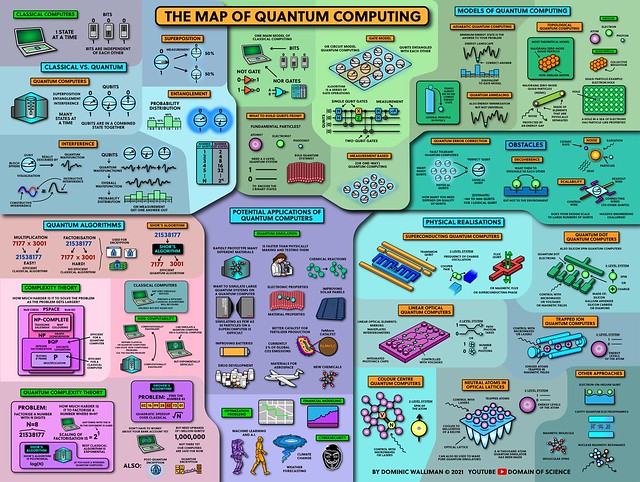
2021-12-06: Quantum Computing Overview. A really good overview of the field of quantum computing with a clear explanation of how they work, why people are excited about quantum algorithms and their value, the potential applications of quantum computers including quantum simulation, artificial intelligence and more, and the different models and physical implementations people are using to build quantum computers like superconducting devices, quantum dots, trapped ions, photons or neutral atoms, and the challenges they face.
2023-02-23: Quantum Error Correction breakthrough
Here we report the measurement of logical qubit performance scaling across several code sizes, and demonstrate that our system of superconducting qubits has sufficient performance to overcome the additional errors from increasing qubit number. We find that our distance-5 surface code logical qubit modestly outperforms an ensemble of distance-3 logical qubits on average, in terms of both logical error probability over 25 cycles and logical error per cycle ((2.914 ± 0.016)% compared to (3.028 ± 0.023)%). To investigate damaging, low-probability error sources, we run a distance-25 repetition code and observe a 1.7 × 10⁻⁶ logical error per cycle floor set by a single high-energy event (1.6 × 10⁻⁷ excluding this event). We accurately model our experiment, extracting error budgets that highlight the biggest challenges for future systems. These results mark an experimental demonstration in which quantum error correction begins to improve performance with increasing qubit number, illuminating the path to reaching the logical error rates required for computation.
2023-06-19: It might be possible to work around noise, making quantum computing practical.
IBM physicist Abhinav Kandala conducted precise measurements of the noise in each of their qubits, which can follow relatively predictable patterns determined by their position inside the device, microscopic imperfections in their fabrication and other factors. Using this knowledge, the researchers extrapolated back to what their measurements — in this case, of the full state of magnetization of a 2D solid — would look like in the absence of noise. They were then able to run calculations involving all of Eagle’s 127 qubits and up to 60 processing steps — more than any other reported quantum-computing experiment. The results validate IBM’s short-term strategy, which aims to provide useful computing by mitigating, as opposed to correcting, errors. Over the longer term, IBM and most other companies hope to shift towards quantum error correction, a technique that will require large numbers of additional qubits for each data qubit.
TraceNoizer generates clones from your databody in order to disinform those who are spying on you.
my friend rat is onto something.
 Gregor J. Rothfuss