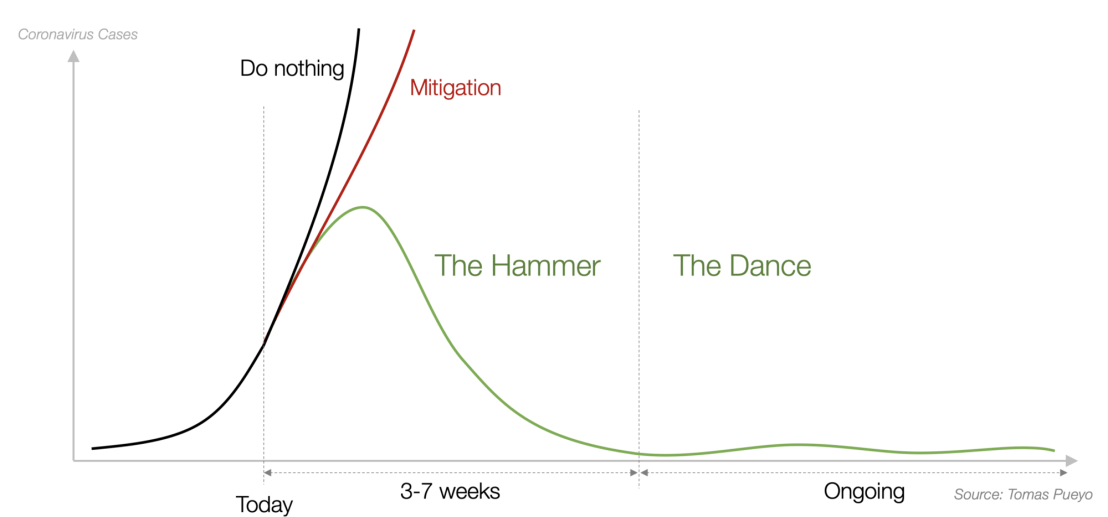
If you hammer the coronavirus, within a few weeks you’ve controlled it and you’re in much better shape to address it. Now comes the longer-term effort to keep this virus contained until there’s a vaccine.
Sapere Aude
Tag: policy
If you hammer the coronavirus, within a few weeks you’ve controlled it and you’re in much better shape to address it. Now comes the longer-term effort to keep this virus contained until there’s a vaccine.
Most important was Taiwan’s experience battling the SARS outbreak in 2003, followed by the swine flu in 2009. In the middle of the worst of the outbreak in 2003, the current vice president, Chen Chien-jen, was appointed minister of health and won widespread praise for taking quick and decisive action. The threat of SARS put Taiwan on high alert for future outbreaks, while the past record of success at meeting such challenges seems to have encouraged the public to accept socially intrusive technological interventions. The government’s special powers to integrate data and track people were only allowed during a crisis.
The failures are fractal, hence I’ll collect different takes from different perspectives.
The United States, long accustomed to thinking of itself as the best, most efficient, and most technologically advanced society in the world, is about to be proved an unclothed emperor.
the pandemic outed 100Ms as dumb fucks, not really news, but still depressing.
the United States underperformed across the board, and its errors compounded. The dearth of tests allowed unconfirmed cases to create still more cases, which flooded the hospitals, which ran out of masks, which are necessary to limit the virus’s spread. Twitter amplified Trump’s misleading messages, which raised fear and anxiety among people, which led them to spend more time scouring for information on Twitter. Even seasoned health experts underestimated these compounded risks.
Also, this analysis is far too kind on the establishment: so many institutional failures and inertia at the CDC and FDA that have nothing to do with this narrative.
The following piece argued that all the pandemic planning was a waste of time.
The failure of the United States government to respond to the coronavirus was not a failure of foresight. It was a failure to create a coherent strategy and to provide clear lines of authority to implement it. To prepare for the next pandemic, we need to end our current proliferation of planning mandates and overlapping agency authorities (such as that of the Assistant Secretary for Response and Preparedness), strengthen the pandemic response ability of one agency (preferably the Centers for Disease Control and Prevention), and reform our current National Emergency Act to allow clear delegation of emergency power. Only by examining our current failures and rectifying them, most importantly, by combining authority, responsibility, and accountability in the right hands, can we make sure that our next Pandemic Preparedness Act is not an embarrassment to its name.
We also lost a lot of process knowledge to be able to pivot quickly:
US factories are as productive as ever but they’ve lost the process knowledge needed to retool quickly in a crisis.
COVID-19 crisis reveals paralytic nature of America’s regulatory order:
We need an immediate intervention to break America free from its bureaucratic addiction.
States can’t even redirect 0.3% of their budget:
States and local public health officials have warned for months that they would need more than $8B in additional funding to stand up the infrastructure needed to administer vaccines. Total state and local spending is about $3.7 trillion, $2.3 trillion from the states alone. $8B is how much of that? Our states cannot come up with 0.3% of their budgets to meet the greatest emergency in our lifetimes?
Meanwhile, alcohol producer can’t make sanitizer:
Worse yet, the FDA reversed course, announcing additional restrictions that effectively prevent any sales, even though ethanol companies had already produced and shipped millions of liters of high-grade alcohol for hand sanitizer.
here’s how things went with contact tracing:
But the effort was frustrated as the CDC’s decades-old notification system delivered information collected at the airports that was riddled with duplicative records, bad phone numbers and incomplete addresses. For weeks, officials tried to track passengers using lists sent by the CDC, scouring information about each flight in separate spreadsheets. “It was insane”
How much bearing does my experience have on what is happening now in the WHO COVID-19 response? I don’t know. You have to make up your own mind about this. But having seen the sausage being made, I am all too aware that the organization can be steered by political considerations. And that definitely increases uncertainty about what is happening on the ground.
Could information be made less lumpy? Can we develop methods that allow institutions to have all the information they need to provide import services, without requiring so much other information come along for the ride?
The federal government is a lumbering giant, but both Democratic and Republican administrations have understood the importance of moving faster. With reforms to NEPA’s implementing regulations, perhaps we will get a step closer to the action-oriented attitude of decades past.
2023-07-13: It’s all Ralph Nader’s fault
Across the country, NIMBYs and status-quo defenders exploit procedural rules to block new development, giving us a world where it takes longer to get approval for a single new building in San Francisco than it did to build the entire Empire State Building, where so-called “environmental review” is weaponized to block even obviously green initiatives like solar panels, and where new public works projects are completed years late and billions over budget—or, like California’s incredible shrinking high-speed rail, may never be completed at all.
Inevitably, such a complex set of dysfunctions must have an equally complex set of causes. It took us decades to get into this mess, and just as there’s no one simple fix, there’s no one simple inflection point in our history on which we can place all the blame.
But what if there was? What if there was, in fact, a single person we could blame for this entire state of affairs, a patsy from the past at whom we could all point our censorious fingers and shout, “It’s that guy’s fault!”
There is such a person, suggests history professor Paul Sabin in his new book Public Citizens: The Attack on Big Government and the Remaking of American Liberalism. And he isn’t isn’t a mustache-twirling villain—he’s a liberal intellectual. If you know him for anything, it’s probably for being the reason you know what a hanging chad is.
That’s right: it’s all Ralph Nader’s fault.
The consequences of treating electricity as a right.
In poor countries the price of electricity is low, so low that “utilities lose money on every unit of electricity that they sell.” As a result, rationing and shortages are common.
as electricity generation decentralizes, who pays for the grid?
Nothing fails like success. Singapore has been spectacularly successful over the past half-century in achieving the goals its government set out and that the people overwhelmingly endorsed. But having crossed the finish line for victory at high speed, the place doesn’t seem to know what to do next except to keep on driving, pedal to the metal—which amounts to overdoing it on a higher level. Individual and social life both are pocked with unannounced tipping points, after which a productive course becomes counterproductive. Centralizing government management functions, for example, is a great idea until it isn’t, until increased transactional costs more than offset incremental efficiency gains.
Why do so many people feel that the Chinese can’t possibly be OK with their government or society? It seems that many in West deem the current Chinese government/society as wrong and that any “right-thinking” person would agree and join in the fight.
First, I’ll look at the gap in political culture between China and the liberal Western democracies, especially the United States. I’ll argue that there is little appreciation among most WEIRD individuals — that is, Western, Educated people from Industrialized, Rich, and Developed nations — for just how highly contingent political norms they take for granted really are from an historical perspective. I’ll sketch the outlines of the major historical currents that had to converge for these ideas to emerge in the late 18th century. Then, I’ll compare this very exceptional experience with that of China, which only embraced and began to harness those engines of Western wealth and power — science, industrialization, state structures capable of total mobilization of manpower and capital — much later. And late to the game, China suffered for over a century the predations of imperial powers, most notably Japan. Hopefully, I’ll show why it was that liberalism never really took hold, why it was that Chinese intellectuals turned instead to authoritarian politics to address the urgent matters of the day, and why authoritarian habits of mind have lingered on.
Next, I’ll argue that a lot of unexamined hubris lies not only behind the belief that all people living under authoritarian political systems should be willing to make monumental sacrifices to create liberal democratic states but also behind the belief that it can work at all, given the decidedly poor record of projects for liberal democratic transformation in recent years, whether American-led or otherwise. It’s important to see what the world of recent years looks like through Beijing’s windows, and to understand the extent to which Beijing’s interpretation of that view is shared by a wide swath of China’s citizenry.
Finally, I’ll look at the role of media in shaping perspectives of China in the Western liberal democracies and in other states. A very small number of individuals — reporters for major mainstream media outlets posted to China, plus their editors — wield a tremendous amount of influence over how China is perceived by ordinary Anglophone media consumers. It’s important to know something about the optical properties of the lens through which most of us view China.
Should the Left embrace Robert Moses more?
Since the mid-1960s—really since the opening of the Verrazzano-Narrows Bridge connecting Brooklyn to Staten Island—no major new piece of public infrastructure has been built within the 5 boroughs of New York City
 Gregor J. Rothfuss