
A full-globe map of the “hot Jupiter” planet HD 189733b. The map reveals a “hot spot” that is offset from the substellar point (high noon) by 30 degrees. The offset may indicate jet stream winds of up to 10k kph.
wow. although, “map“, but still!
Sapere Aude
Tag: planets
A full-globe map of the “hot Jupiter” planet HD 189733b. The map reveals a “hot spot” that is offset from the substellar point (high noon) by 30 degrees. The offset may indicate jet stream winds of up to 10k kph.
wow. although, “map“, but still!
The instruments will be able to measure the small wobbles in stars and detect planets of 4 Earth masses up to 33LY away.
at 20LY, we need some relativistic craft to get there

Particles spewed from Saturn’s moon Enceladus are sandblasting neighboring moons, leaving them sparklingly bright
2008-03-25: Life on Enceladus?
Could microbial life exist inside Enceladus, where no sunlight reaches, photosynthesis is impossible and no oxygen is available? The answer appears to be, yes, it could be possible.
I invite you to imagine the day when we might journey to the saturnian system and visit the Enceladus interplanetary geiser park, just because we can.
2008-10-24: Cassini pictures 
Saturn’s tiny, icy moon Enceladus has recently been visited by NASA’s Cassini orbiter on several very close approaches – once coming within a mere 25 kilometers of the surface. Scientists are learning a great deal about this curious little moon. Only 500 kilometers wide, it is very active, emitting internal heat, churning its surface, and – through cryovolcanism – ejecting masses of microscopic ice particles into Saturnian orbit. Cassini has been orbiting Saturn for over 4 years now, and has provided some amazing views of tiny Enceladus, some collected here.
2022-11-11: Phosphorus predicted
Team members performed thermodynamic and kinetic modeling that simulates the geochemistry of phosphorus based on insights from Cassini about the ocean-seafloor system on Enceladus. They developed the most detailed geochemical model to date of how seafloor minerals dissolve into Enceladus’s ocean and predicted that phosphate minerals would be unusually soluble there.
“The underlying geochemistry has an elegant simplicity that makes the presence of dissolved phosphorus inevitable, reaching levels close to or even higher than those in modern Earth seawater. What this means for astrobiology is that we can be more confident than before that the ocean of Enceladus is habitable.”

the landscape of Mars might be sterile due to the presence of hydrogen peroxide. The planet is bleaching itself on a near-continual basis.

Bright new deposits seen in 2 gullies on Mars suggest water carried sediment through them sometime during the past 7 years.
Terraforming just got 1% easier 🙂 Also, in other news, what’s the big deal? Water has been found on mars for some time:
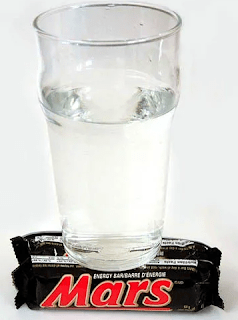
2007-03-16: Lots of water on Mars
Mars has enough water ice at its south pole to blanket the entire planet in more than 10m of water if everything thawed out.
2007-04-11: Extrasolar water atmospheres
We now know that water vapor exists in the atmosphere of one extrasolar planet and there is good reason to believe that other extrasolar planets contain water vapor
2011-10-26: First extrasolar water world? Gliese 581d.
2013-12-05: More detailed studies of extrasolar atmospheres
The presence of atmospheric water was reported previously on a few exoplanets orbiting stars beyond our solar system, but this is the first study to conclusively measure and compare the profiles and intensities of these signatures on multiple worlds. The 5 planets — WASP-17b, HD209458b, WASP-12b, WASP-19b and XO-1b — orbit nearby stars.
2013-12-26: Europa has a 201km high water vapor plume. Marked down as a prime tourism destination.
NASA’s Hubble Space Telescope has observed water vapor above the frigid south polar region of Jupiter’s moon Europa, providing the first strong evidence of water plumes erupting off the moon’s surface.
2014-09-11: Extrasolar ice
A team of scientists has discovered the first evidence of water ice clouds on an object outside of our own Solar System. Water ice clouds exist on our own gas giant planets — Jupiter, Saturn, Uranus, and Neptune — but have not been seen outside of the planets orbiting our Sun until now.
2014-11-23: Europa has an ocean 100km deep, with 3x as much water as earth. Looks like NASA is getting serious about a mission there. That mission will be a defining moment for this century: Imagine what will happen if they find life. See also this amazing overview picture:

2015-04-10: Looks like the Mars water estimates vary:
Mars has distinct polar ice caps, but Mars also has belts of glaciers at its central latitudes in both the southern and northern hemispheres. A thick layer of dust covers the glaciers, so they appear as surface of the ground, but radar measurements show that underneath the dust there are glaciers composed of frozen water. New studies have now calculated the size of the glaciers and thus the amount of water in the glaciers. It is the equivalent of all of Mars being covered by more than 1 meter of ice.
2016-11-28: There’s now about 12 of them in the solar system
Pluto is a wondrous world indeed. Another new finding makes it even more remarkable: evidence for a subsurface ocean of water. This had also been reported on previously by AmericaSpace, but the new update strengthens the case. A water ocean on Pluto? How is that even possible? Well, first it is a subsurface ocean, similar to ones on Jupiter’s moon Europa and Saturn’s moon Enceladus, among others. Temperatures on the surface are much, much too cold for liquid water (water ice is hard as rock and at lower latitudes near the equator, temperatures on Pluto can reach almost -200 degrees Celsius), but deep below the surface seems to be a different story.
2017-04-26: Most habitable planets are waterworlds
We find that most habitable planets have surfaces that are over 90% water. If Earth is indeed unusually dry for a habitable planet, then one might wonder what the mechanism was. Does the Solar system have some distinguishing feature that was responsible? For example, perhaps the low eccentricities and inclinations of Solar system planets are inefficient at promoting water delivery. It also appears feasible that the Earth has an unusually deep ocean basin. The gravitational potential associated with its surface fluctuations is much higher than any other body in the Solar system. In turn, this may suggest that the Earth has unusually strong tectonic activity, and consequently, an abnormally strong magnetic field.
2018-08-17: Another Mars water estimate
The radar investigation shows that south polar region of Mars is made of many layers of ice and dust down to a depth of ~1.5 km in the 200 km-wide area analyzed in this study. A particularly bright radar reflection underneath the layered deposits is identified within a 20 km-wide zone.
2018-08-18: More data on exoplanet water
Our data indicate that 35% of all known exoplanets which are bigger than Earth should be water-rich. These water worlds likely formed in similar ways to the giant planet cores (Jupiter, Saturn, Uranus, Neptune) which we find in our own solar system. The newly-launched TESS mission will find many more of them, with the help of ground-based spectroscopic follow-up. The next generation space telescope, the James Webb Space Telescope, will hopefully characterize the atmosphere of some of them. This is an exciting time for those interested in these remote worlds. This is water, but not as commonly found here on Earth. Their surface temperature is expected to be in the 200-500 Celsius range. Their surface may be shrouded in a water-vapor-dominated atmosphere, with a liquid water layer underneath. Moving deeper, one would expect to find this water transforms into high-pressure ices before we reaching the solid rocky core.
2018-12-29: Korolev crater 
ESA’s Mars Express mission recently photographed the Korolev crater on Mars, filled almost to the brim with water ice. When I first saw this image I thought, oh cute!, assuming the crater was maybe 10m across. But no, it’s 82km across and the thickest part of the ice is over 1600m thick.
2021-10-12: Exoweather:
JWST is a dream come true for exoplanet astronomers. It’s the most ambitious space telescope ever built. I like to say that the JWST will be 10000x better than the Hubble Space Telescope. A 10x bigger mirror, so with more light-gathering power you can observe things that are fainter; 10x more wavelength coverage — well into the infrared where Hubble stops. Having the infrared wavelength coverage will let us push to much cooler and thus potentially more habitable planets than we’ve been able to study before, and it helps us see through the clouds on these planets. There’s also 10x better stability, and 10x better spectral resolution. That means we can see the exact wavelengths in the planet’s color spectrum that are getting absorbed by molecules in its atmosphere, which lets us determine the chemical composition of atmospheres more precisely. There is no planet known where JWST will have the sensitivity required to detect biosignatures like this. Oxygen is really challenging to detect because the features are small compared to other molecules. For observable planets that are in the habitable zone of their stars, even if there is much more oxygen than is present on Earth, we would still need 10s of transits of the planet in front of the star to detect it. Any added difficulty, like clouds in the atmosphere or instrumental noise from JWST, would make it prohibitive. We would basically need to get lucky in every possible aspect to have a prayer of seeing oxygen, and in my experience exoplanets are always tougher than expected. I’m really optimistic that we’ll see some of the easier-to-observe molecules, particularly CO2. While that isn’t a biosignature, it’s still an important piece of the puzzle of habitability.
2023-05-13: About 20 Water Objects in the Solar System
Re-analysis of data from NASA’s Voyager spacecraft, along with new computer modeling, has led NASA scientists to conclude that 4 of Uranus’ largest moons likely contain an ocean layer between their cores and icy crusts. Their study is the first to detail the evolution of the interior makeup and structure of all 5 large moons: Ariel, Umbriel, Titania, Oberon, and Miranda. The work suggests 4 of the moons hold oceans that could be 10s of km deep.
awesome images. now do the whole planet, and then lets do an improved mars map 🙂
This project studies a new mission concept for planetary exploration, based on the deployment of a large number of small spherical mobile robots over vast areas of a planet’s surface and subsurface, including structures such as caves

Not since NASA’s Voyager 1 spacecraft saw our home as a pale blue dot from beyond the orbit of Neptune has Earth been imaged in color from the outer solar system.
In Saturn’s Shadow

2007-03-27: Hexagon on Saturn

Just a few months after the Cassini spacecraft imaged an eyeball-shaped storm at Saturn’s south pole, the orbiter has captured new images of this bizarre hexagon-shaped weather pattern at the north pole
Role players? 🙂
2013-10-17: Stunning indeed. Looking forward to the tourist trip there someday.

2013-12-31: Dayum, that’s pretty.

2013-12-31: Cassini crashing into Saturn. This should yield some amazing pictures.
 Gregor J. Rothfuss