Tag: planets

Venus

This video makes it look like Venus is much closer to the sun than it actually is (100M km) but still, well done.

2014-07-02: Colonizing Venus

If the thought of Thanksgiving Dinner on Venus gives you the heebie jeebies, you don’t even need to think about plunging into the roiling atmosphere with nothing but a cheap plastic heat shield and a thin balloon to save you from the crematorium that yawns down below. Dangle the bird into the depths of the Stygian hell, feast as someone who walks between worlds and lives on an airship that rides the hell born winds 48km above a surface so hot it glows visibly red.

2014-07-03: Venus is a good fraction of solid surface in the solar system.

2020-09-18: Phosphine on Venus

observations indicate a level of phosphine at 20 parts per billion. That may sound low, but it turns out that from what we currently know, on Venus it’s hard to make anywhere near that much. The phosphine was seen at altitudes of at least 50 km. The environment there is pretty hostile to phosphine, which would decompose fairly rapidly. They estimate that that it should all be gone in less than 1 ka at that level, and probably much faster. So something must be actively making it to keep the levels up. But what?

2021-01-14: Jupiter killed Venus?

we present the results of a study that explores the effect of Jupiter’s location on the orbital parameters of Venus and subsequent potential water-loss scenarios. We argue that these eccentricity variations for the young Venus may have accelerated the atmospheric evolution of Venus toward the inevitable collapse of the atmosphere into a runaway greenhouse state. The presence of giant planets in exoplanetary systems may likewise increase the expected rate of Venus analogs in those systems.

Proxima Centauri

The new planet we’ve found there is so very near our own that its night sky shares most of Earth’s constellations. From the planet’s broiling surface, one could see familiar sights such as the Big Dipper and Orion the Hunter, looking just as they do to our eyes here.

2012-10-19: Saturn as viewed from the moon vs Proxima Centauri viewed from Saturn

2020-04-25:

The proposal assumes a peak spacecraft velocity of 10% of the speed of light. Once launched out of Earth’s gravitational well, the remaining spacecraft is composed of 2 stages. The first stage accelerates the spacecraft to 0.1c, detaches from the second stage, and performs a smaller perpendicular burn to deflect its trajectory toward the Proxima Centauri AB binary system for a flyby of that solar system. The second stage decelerates a scientific payload and provides power and support during a decades-long period of exploration.

2022-03-15:

Why is it so difficult to detect planets around Alpha Centauri? Proxima Centauri is one thing; we’ve found interesting worlds there, though this small, dim star has been a tough target, examined through decades of steadily improving equipment. But Centauri A and B, the G-class and K-class central binary here, have proven impenetrable. Given that we’ve found over 4500 planets around other stars, why the problem here?

Proximity turns out to be a challenge in itself. Centauri A and B are in an orbit around a common barycenter, angled such that the light from one will contaminate the search around the other. It’s a 79-year orbit, with the distance between A and B varying from 35.6 AU to 11.2. You can think of them as, at their furthest, separated by the Sun’s distance from Pluto (roughly), and at their closest, by about the distance to Saturn.

The good news is that we have a window from 2022 to 2035 in which, even as our observing tools continue to improve, the parameters of that orbit as seen from Earth will separate Centauri A and B enough to allow astronomers to overcome light contamination. I think we can be quite optimistic about what we’ll find within the decade, assuming there are indeed planets here. I suspect we will find planets around each, but whether we find something in the habitable zone is anyone’s guess.

400b rogue planets

Japanese astronomers claim to have found free-floating “planets” which do not seem to orbit a star. They say they have found 10 Jupiter-sized objects which they could not connect to any solar system. They also believe such objects could be as common as stars are throughout the Milky Way. Using a technique called gravitational microlensing, they detected 10 Jupiter-mass planets wandering far from light-giving stars. Then they estimated the total number of such rogue planets, based on detection efficiency, microlensing-event probability and the relative rate of lensing caused by stars or planets. They concluded that there could be as many as 400b of these wandering planets, far outnumbering main-sequence stars such as our Sun

with this, my personal estimate for the drake equation goes to 8000.

Looking at the Kepler K2 data, the scientists documented 10s of short-duration microlensing events near the galactic core. Of these, 22 were previously detected during the OGLE and KMTnet ground-based campaigns, but 5 signatures hadn’t been seen before. Of these 5, 1 turned out to be a bound exoplanet, but the remaining 4 featured super-short microlensing events consistent with free-floating planets. 1 of the 4 candidate signatures was subsequently detected in ground-based data. The microlensing events, lasting for just several hours, suggest the discovery of unbound exoplanets no larger than Earth. It’s impossible to know what the conditions are like on these presumed rogue exoplanets, but they could be “cold, icy wastelands,” and, if similar in size to Earth, their surfaces would “closely resemble bodies in the outer Solar System, like Pluto.” The new paper suggests the presence of a large population of Earth-sized rogue planets in the Milky Way. It’s becoming clear that free-floating planets are common.

Planet X?

at 15k AU. meanwhile the supposed nemesis would be at 50k-100k AU.
2018-10-02:

A new extremely distant object far beyond Pluto with an orbit that supports the presence of an even-farther-out, Planet X. “These distant objects are like breadcrumbs leading us to Planet X. The more of them we can find, the better we can understand the outer Solar System and the possible planet that we think is shaping their orbits—a discovery that would redefine our knowledge of the Solar System’s evolution”

Notable Exoplanets

The 100s of exoplanets discovered to date are an extremely diverse group. Many are Jupiter-like gas giants, but some have a rocky surface. Many are extremely hot, orbiting close to their home star, but some are icy-cold. Some orbit massive stars, many times more brilliant than our Sun, others circle dim red dwarfs.

And yet, even in such an eclectic group, some exoplanets stand out from the crowd. These are planets that possess some unique feature that singles them out. Or they are typical planets that are better studied and better known than the others. To provide a taste of what these alien worlds are like, here is a selection of a few such notable exoplanets and what scientists know of them.

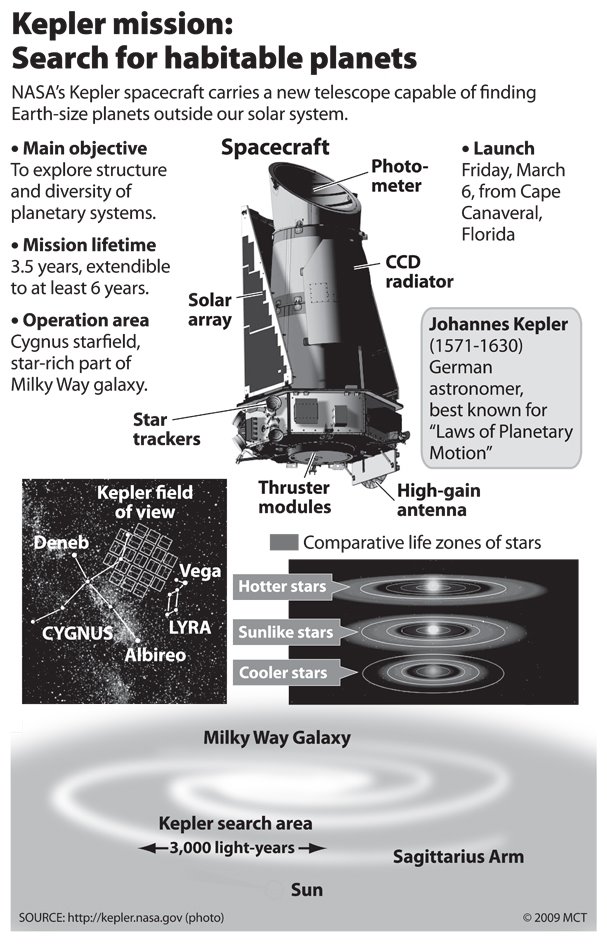
Kepler mission


Launched today. Will search an area of 3000 light years in our neighbor arm, the sagittarius arm, for earth-like planets. Expected haul, 500.
2010-07-26: After finding more planets in the first year of the Kepler mission than all previous efforts combined: “earth-sized planets are common in the galaxy”

2011-02-01: Transit requires the right inclination for detection, and is quite unlikely, which means there should be 10k as many planets out there than they found. about 12M.
2013-11-23: Using a solar sail approach. Clever

NASA outlines ingenious plan to resurrect the Kepler planet hunter. “K2” mission would use its solar panels as a pointing device.

2015-12-15: Really awesome visualization about all the solar systems yet discovered.

2021-10-27: The final haul was 2662.