How CMS fare over time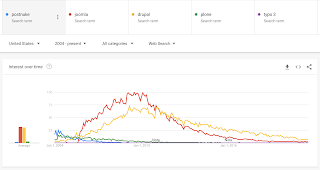
Tag: OSCOM
content wire interview
i recently did a new interview with paolo di maio of content wire.
Gregor J Rothfuss has been observing and working with content management tools for many years. We catch up with him over the internet to talk about open source, a subject increasingly recurring
How do you see the business model for OS developing?
In services, more and more. there are some excellent open source venture blogs that track this question in great detail: Open Source Strategies and AsayOs tools are not very usable. Why is that? Is it just still too early in their evolution?
This held true, traditionally, but has recently been true less and less. One reason is that software per se is no longer interesting, and increasingly, developers are aware of usability issues, and a nice UI can now be considered quite sexy. This is mostly due to some well-publicized web applications that utilize AJAX technologies. At first, OSS was often in catch-up mode and had to quickly fill in holes in functionality. now that functional parity to commercial products is being reached, the focus has often shifted to these more subtle qualities.Plus, more and more hackers understand the value of design, as exemplified by Apple who are taking geek toys and slapping nice UI on top, or Firefox, which is essentially a slimmed down Mozilla.
Only in its Firefox incarnation has full success come.
Content readability
opencms 60.83
plone 66.25
lenya 52.72
midgard 36.49
documentum 70.34
day no text, all images
interwoven “ill-formed tag”
from the flesch-kincaid readability test
Open source miscellanea
Matthias Stuermer of lots fame recently interviewed me on various open source topics. The transcript is now available.
marc canter on microcontent
marc canter gave a talk about microcontent to the berkman weblog group this evening (remotely over a free webx.com trial). it was most excellent, and while i had an idea what would be coming, i was still surprised by the scope of marc’s vision. this is something oscom should support, as it offers a migration path from content silos to new applications and services based on top of open source content. marc is evangelizing his ideas on a tucows-sponsored tour in Q1 2005.
michael radwin on web caching
Michael Radwin knows what he is talking about: Caching and Cache-busting for Content Publishers. highly recommended.
Daisy 1.0
Daisy is a comprehensive content management application framework, consisting of a standalone repository server accessible through HTTP/XML and a high-level (remote) Java API, and an extensive Daisy browsing and editing DaisyWiki application. Daisy is licensed under the commercially-friendly Apache License 2.0.
congrats to steven, bruno and crew. the feature set looks quite intriguing. i wish i could be at the cms shootout in ghent, arje teased me about it at oscom4. here’s to learning and sharing!
Rich web apps
Koranteng Ofosu-Amaah ported the halfbrain browser productivity applications to mozilla as part of his work at ibm. his post gives the necessary background to understand the state of rich web applications. (via loosely coupled i am thinking, maybe we should have someone from WHATWG at oscom.4?
CSS skins repository?
If standards conscious designers already follow conventions, then the stage is set. So I decided to look at forty designers’ sites to see what conventions were being used in common page elements like headers and banners, navigation, content and footers. Here’s what I found.
it makes a lot of sense to standardize on common container names like header, content, navigation. this allows to share CSS across sites and create a nice CSS skin repository. bergie, who pointed me to this, seems to agree. maybe OSCOM should set up a set of “recommended div elements” and start a CSS repository that uses them?
2006-10-15: nice. standardized css is something i have long worked for at OSCOM, somewhat in vain.
WYSIWYG editors
with the recent move of the kupu project (and impending one of the bitflux editor) under the oscom umbrella, we have created a new mailing list to discuss wysiwyg editors:
editors@oscom.org
for those interested, please sign up. and if your CMS / web application still uses earlier generations of editors, now would be a good time to migrate.
which wysiwyg editor should you use for your CMS or web application? there is currently no editor that supports both Mozilla and Internet Explorer and can handle both XHTML and arbitrary XML schemas. at the same time, there are countless “solutions” that produce horrible markup and should NOT be used. there are, however, excellent open source editors available that produce well-formed and valid XHTML or XML. note that both bxe and kupu are OSCOM projects, while Xopus is a proprietary product from Q42.
| XHTML | XML (arbitrary) | |
| Mozilla | BXE, Kupu | BXE |
| IE | Kupu | Xopus |
 Gregor J. Rothfuss