Tag: nyc

Night Life Clusters

Why would a lamp shop want to be located next to a whole lot of competition? Wouldn’t it be better to be the only lamp shop in the area? No, because clustering allows them to specialize. Sure, you’ll lose some customers because they can just go next door when you don’t have a lamp they want. But you’ll also gain customers from other stores. Having a big cluster means that when folks in the know want a lamp, they’ll head to your district; with such high traffic, the spillover effects more than make up for the disadvantages of not having a captive audience. As with lamps, so with bars.

how the east village became party district
Bed Bugs

A complete guide how to get rid of them. I hope i will never have to use this guide.
2015-05-28: Bed bugs were nearly eradicated in the days of DDT, but have since evolved resistance. They loom large in our fears.

But its dominance went through a hiccup in the 50 years following the Second World War. During this time, the bug was a mere phantom in the United States and parts of Europe, Asia and Australia, wiped out, in part, by DDT and other modern chemical marvels. The pest was so rare that it shrank in our collective memory until it seemed like it didn’t exist at all, save as a bogeyman in a nursery rhyme: Good night, sleep tight. Don’t let the bed bugs bite. Then, starting in the early 2000s or so, bed bugs descended like a plague on New York and other cities across the world. The exact story of their comeback isn’t clear, but the best version is this: not long after the DDT deluge, some of the bugs had evolved resistance to the insecticide – an evolutionary inevitability – and survived in pockets worldwide.

311 is not a joke

the service also helps city leaders detect patterns that might otherwise have escaped notice. After the first survey of 311 complaints ranked excessive noise as the number one source of irritation among residents, the Bloomberg administration instituted a series of noise-abatement programs, going after the offenders whom callers complained about most often (that means you, Mister Softee). Similarly, clusters of public-drinking complaints in certain neighborhoods have led to crackdowns on illegal social clubs. Some of the discoveries have been subtle but brilliant. For example, officials now know that the first warm day of spring will bring a surge in use of the city’s chlorofluorocarbon recycling programs. The connection is logical once you think about it: The hot weather inspires people to upgrade their air conditioners, and they don’t want to just leave the old, Freon-filled units out on the street.

The city as idea incubator

New York excels at creating those eclectic networks. Subcultures and small businesses generate ideas and skills that inevitably diffuse through society, influencing other groups. As the sociologist Claude Fischer put it in an influential essay on subcultures published in 1975, “The larger the town, the more likely it is to contain, in meaningful numbers and unity, drug addicts, radicals, intellectuals, ‘swingers’, health-food faddists, or whatever; and the more likely they are to influence (as well as offend) the conventional center of the society.”

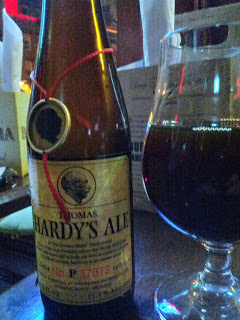
Thomas Hardy’s Ale

this is without doubt the best beer in the world. i would be very surprised if i tasted better than this in my lifetime.

Scarce, subtle and complex, Thomas Hardy’s Ale is the beer enthusiast’s equivalent of rare cognac. Bottle-conditioned to mature in the bottle like fine wine, this old ale/barley wine will improve with age for at least 26 years (and we’re still counting!). Not for the faint of palate, especially when young and brash, maturity brings an elegance of flavors unmatched by any other beer—if you have the patience to cellar it for at least 10 years.

2012-03-15: Tasting the 2004 vintage.

Midtown without avenues

The goal, walk from the Empire State Building, on West 33rd Street, to Rockefeller Center, on West 48th, without ever setting foot on 5th or 6th Avenue—to knife through tall buildings in a single bound, or at least in stepwise forays. A writer for this magazine accomplished the feat in 1956, and a photographic attempt appeared on our Web site last year. A recent lazy Friday seemed like a good time to try the experiment again.

Equipment: sneakers, jeans, a polo shirt, and a purposeful, slightly preoccupied air (Yes, I have important business here). Starting time: 16:00, when doormen are dreaming of the weekend. Expectations of success: low. The last 50 years has stripped midtown of spacious department stores such as Ohrbach’s and Stern’s, and fortified it with guards, visitors’ logs, and electronic-card-access gates.

how to get to central park from 33rd street without using avenues.

Trader Joe’s

Customers accept that Trader Joe’s has only 2 kinds of pudding or 1 kind of polenta because they trust that those few items will be very good. “If they’re going to get behind only 1 jar of Greek olives, then they’re sure as heck going to make sure it’s the most fabulous jar of Greek olives they can find for the price,” explains a former employee. To ferret out those wow items, Trader Joe’s has 4 top buyers, called product developers, do some serious globetrotting. Trader Joe’s biggest R&D expense is travel for those product-finding missions. Trade shows that feature the flavor of the moment “are for rookies”. Trader Joe’s doesn’t pick up on trends — it sets them.

This makes me want to check them out again. I dismissed them years ago because I was underwhelmed.

To do what they do, you can’t just hire the same people they hire. You have to emulate the private-label strategy. The real-estate strategy. The pricing. The quirky culture. And it’s often the soft things. Not just the kind of people you hire, but the way you train them and the culture you create. I mean, we can build a store that looks like a Trader Joe’s. But when we have people walk in, can they have the same experience? Well, that’s very hard to replicate.