You can get your exome sequenced for $1095. The exome is only 1% of the genome, but thought to harbor 85% of disease-relevant mutations.
Tag: medicine
Health Nucleus
This looks amazing, especially once it comes down a factor of 10 in price.
25K USD will buy you a sequencing of your genome, your microbiome and a scan of your brain and your blood. These prices are amazing if you consider what this would have cost just in consumables a few short years ago….sadly still way too expensive for me… maybe in 4-5 years time it will become cheap enough to do what I did with 23andme and get it done to all my family… let’s see
Personalized medicine
Each patient is a unique, dynamic system and at the molecular level diseases are heterogeneous even when symptoms are not. In just the last few years we have expanded breast cancer into first 4 and now 10 different types of cancer and the subdivision is likely to continue as knowledge expands. Match heterogeneous patients against heterogeneous diseases and the result is a high dimension system that cannot be well navigated with expensive, randomized controlled trials. As a result, the FDA ends up throwing out many drugs that could do good.
Exercise Pills
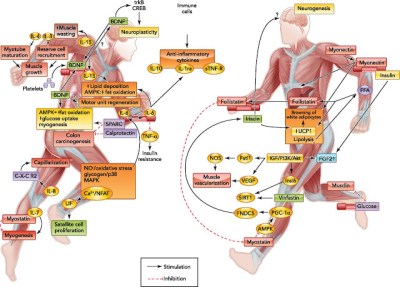
Everyone knows that exercise improves health, and ongoing research continues to uncover increasingly detailed information on its benefits for metabolism, circulation, and improved functioning of organs such as the heart, brain, and liver. With this knowledge in hand, scientists may be better equipped to develop “exercise pills” that could mimic at least some of the beneficial effects of physical exercise on the body. But a review of current development efforts ponders whether such pills will achieve their potential therapeutic impact, at least in the near future.
The frat nursing home
this is very clever. nursing homes and frat houses do have a lot in common.
More retirement and nursing homes are asking college students to move in, an arrangement that benefits everyone.
Human Virome
a new method that uses this phage mixture to test blood samples for over 200 species and 1000 strains of virus at a time. The team speculates that their technique, named VirScan (VEERscan), could one day become a near-universal test for viral infections using just one drop of a patient’s blood, replacing one-off tests for specific types of virus. Very common infections, like rhinoviruses and herpesviruses, come up regularly in VirScan, while more exotic viruses are found rarely if at all. “Sure enough, for many common viral infections we’re detecting them at pretty high levels. And for some viruses like CMV [one of the herpesviruses], which is known to infect 50% of the population, that is in fact what we saw.” VirScan could be brought into a number of research areas where virome-wide sequencing, or targeted viral tests, have not given us the full picture. Wylie, for instance, is curious what antibodies would be found in a large study of children, a major focus of her own research on the virome. “You’re actually developing your immune repertoire at that time. It would be interesting to see that history of what children had been exposed to, and what might be missing from the common pathogens in a child… We have to realize we’re a bit changed after these exposures, and this is one method of looking broadly at that.” Kula hopes that VirScan can shine a light on mysterious diseases like chronic fatigue syndrome and Kawasaki disease. Some experts suspect these illnesses are caused or exacerbated by viruses, but those suspicions are hard to confirm when no one knows which virus to look for. With VirScan, this is no obstacle.
Veteran mental health
For every active duty soldier killed in combat, 22 veterans died by their own hand.
“Look at the people who go to the military. Who are they, for the most part? They aren’t well-adjusted in the first place. If you want to send people to the military who don’t come back with trauma, send well-adjusted people. But well-adjusted people don’t want to go to war.”
Eradicating Guinea Worms
I hope the last Guinea worm dies before I do
so far the worm has been reduced from millions of cases in the 80s to 17 so far this year.
Jehovah Witnesses changing Medicine
He had performed 4 or 5 surgeries on Jehovah’s Witnesses but this had been one of the largest. “It’s very stressful as a surgeon, dealing with a tumor that has the potential for massive bleeding and knowing you don’t have the option of transfusion. It’s like being a trapeze artist with no safety net.”
C8
DuPont and the Chemistry of Deception
A man-made compound that didn’t exist 100 years ago, C8 is in the blood of 99.7% of Americans, as well as in newborn human babies, breast milk, and umbilical cord blood. A growing group of scientists have been tracking the chemical’s spread through the environment, documenting its presence in a wide range of wildlife, including Loggerhead sea turtles, bottlenose dolphins, harbor seals, polar bears, caribou, walruses, bald eagles, lions, tigers, and arctic birds. Although DuPont no longer uses C8, fully removing the chemical from all the bodies of water and bloodstreams it pollutes is now impossible. And, because it is so chemically stable — in fact, as far as scientists can determine, it never breaks down — C8 is expected to remain on the planet well after humans are gone from it.
2021-09-03: C8 effects
For 6 disease categories, the Science Panel concluded that there was a Probable Link to C8 exposure: diagnosed high cholesterol, ulcerative colitis, thyroid disease, testicular cancer, kidney cancer, and pregnancy-induced hypertension.
 Gregor J. Rothfuss