We now know that water vapor exists in the atmosphere of one extrasolar planet and there is good reason to believe that other extrasolar planets contain water vapor
2011-10-26: First extrasolar water world? Gliese 581d. 2013-12-05: More detailed studies of extrasolar atmospheres
The presence of atmospheric water was reported previously on a few exoplanets orbiting stars beyond our solar system, but this is the first study to conclusively measure and compare the profiles and intensities of these signatures on multiple worlds. The 5 planets — WASP-17b, HD209458b, WASP-12b, WASP-19b and XO-1b — orbit nearby stars.
2013-12-26: Europa has a 201km high water vapor plume. Marked down as a prime tourism destination.
NASA’s Hubble Space Telescope has observed water vapor above the frigid south polar region of Jupiter’s moon Europa, providing the first strong evidence of water plumes erupting off the moon’s surface.
A team of scientists has discovered the first evidence of water ice clouds on an object outside of our own Solar System. Water ice clouds exist on our own gas giant planets — Jupiter, Saturn, Uranus, and Neptune — but have not been seen outside of the planets orbiting our Sun until now.
2014-11-23: Europa has an ocean 100km deep, with 3x as much water as earth. Looks like NASA is getting serious about a mission there. That mission will be a defining moment for this century: Imagine what will happen if they find life. See also this amazing overview picture:
2015-04-10: Looks like the Mars water estimates vary:
Mars has distinct polar ice caps, but Mars also has belts of glaciers at its central latitudes in both the southern and northern hemispheres. A thick layer of dust covers the glaciers, so they appear as surface of the ground, but radar measurements show that underneath the dust there are glaciers composed of frozen water. New studies have now calculated the size of the glaciers and thus the amount of water in the glaciers. It is the equivalent of all of Mars being covered by more than 1 meter of ice.
Pluto is a wondrous world indeed. Another new finding makes it even more remarkable: evidence for a subsurface ocean of water. This had also been reported on previously by AmericaSpace, but the new update strengthens the case. A water ocean on Pluto? How is that even possible? Well, first it is a subsurface ocean, similar to ones on Jupiter’s moon Europa and Saturn’s moon Enceladus, among others. Temperatures on the surface are much, much too cold for liquid water (water ice is hard as rock and at lower latitudes near the equator, temperatures on Pluto can reach almost -200 degrees Celsius), but deep below the surface seems to be a different story.
2017-04-26: Most habitable planets are waterworlds
We find that most habitable planets have surfaces that are over 90% water. If Earth is indeed unusually dry for a habitable planet, then one might wonder what the mechanism was. Does the Solar system have some distinguishing feature that was responsible? For example, perhaps the low eccentricities and inclinations of Solar system planets are inefficient at promoting water delivery. It also appears feasible that the Earth has an unusually deep ocean basin. The gravitational potential associated with its surface fluctuations is much higher than any other body in the Solar system. In turn, this may suggest that the Earth has unusually strong tectonic activity, and consequently, an abnormally strong magnetic field.
The radar investigation shows that south polar region of Mars is made of many layers of ice and dust down to a depth of ~1.5 km in the 200 km-wide area analyzed in this study. A particularly bright radar reflection underneath the layered deposits is identified within a 20 km-wide zone.
Our data indicate that 35% of all known exoplanets which are bigger than Earth should be water-rich. These water worlds likely formed in similar ways to the giant planet cores (Jupiter, Saturn, Uranus, Neptune) which we find in our own solar system. The newly-launched TESS mission will find many more of them, with the help of ground-based spectroscopic follow-up. The next generation space telescope, the James Webb Space Telescope, will hopefully characterize the atmosphere of some of them. This is an exciting time for those interested in these remote worlds. This is water, but not as commonly found here on Earth. Their surface temperature is expected to be in the 200-500 Celsius range. Their surface may be shrouded in a water-vapor-dominated atmosphere, with a liquid water layer underneath. Moving deeper, one would expect to find this water transforms into high-pressure ices before we reaching the solid rocky core.
ESA’s Mars Express mission recently photographed the Korolev crater on Mars, filled almost to the brim with water ice. When I first saw this image I thought, oh cute!, assuming the crater was maybe 10m across. But no, it’s 82km across and the thickest part of the ice is over 1600m thick.
JWST is a dream come true for exoplanet astronomers. It’s the most ambitious space telescope ever built. I like to say that the JWST will be 10000x better than the Hubble Space Telescope. A 10x bigger mirror, so with more light-gathering power you can observe things that are fainter; 10x more wavelength coverage — well into the infrared where Hubble stops. Having the infrared wavelength coverage will let us push to much cooler and thus potentially more habitable planets than we’ve been able to study before, and it helps us see through the clouds on these planets. There’s also 10x better stability, and 10x better spectral resolution. That means we can see the exact wavelengths in the planet’s color spectrum that are getting absorbed by molecules in its atmosphere, which lets us determine the chemical composition of atmospheres more precisely. There is no planet known where JWST will have the sensitivity required to detect biosignatures like this. Oxygen is really challenging to detect because the features are small compared to other molecules. For observable planets that are in the habitable zone of their stars, even if there is much more oxygen than is present on Earth, we would still need 10s of transits of the planet in front of the star to detect it. Any added difficulty, like clouds in the atmosphere or instrumental noise from JWST, would make it prohibitive. We would basically need to get lucky in every possible aspect to have a prayer of seeing oxygen, and in my experience exoplanets are always tougher than expected. I’m really optimistic that we’ll see some of the easier-to-observe molecules, particularly CO2. While that isn’t a biosignature, it’s still an important piece of the puzzle of habitability.
2023-05-13: About 20 Water Objects in the Solar System
Re-analysis of data from NASA’s Voyager spacecraft, along with new computer modeling, has led NASA scientists to conclude that 4 of Uranus’ largest moons likely contain an ocean layer between their cores and icy crusts. Their study is the first to detail the evolution of the interior makeup and structure of all 5 large moons: Ariel, Umbriel, Titania, Oberon, and Miranda. The work suggests 4 of the moons hold oceans that could be 10s of km deep.
NASA wants to land a human crew on Mars in the 2030s. But to succeed with such an ambitious, expensive, long-timescale project, the agency needs a roadmap that inspires confidence that it really can send people to the Red Planet. Firouz Naderi, director of Solar System Exploration at NASA-JPL, has a budget-conscious idea: Let’s land on Phobos first.
They’re on the run from a vicious fungus that has already wiped out as many as 120 species of amphibians in Central America.
2007-01-02: Tomentella is a brain-eating fungus that creates zombie ants. it does not get much better than this.
2008-09-27: This remains one of my favorite TED talks of all time. mycelium++
2011-12-24: Psychedelic Santa Claus. The origins of this most holy of retail holidays. Praise GDP!
Although most people see Christmas as a Christian holiday, most of the symbols and icons we associate with Christmas celebrations are actually derived from the shamanistic traditions of the tribal peoples of pre-Christian Northern Europe. The sacred mushroom of these people was the red and white amanita muscaria mushroom, also known as “fly agaric.” These mushrooms are now commonly seen in books of fairy tales, and are usually associated with magic and fairies. This is because they contain potent hallucinogenic compounds, and were used by ancient peoples for insight and transcendental experiences. Most of the major elements of the modern Christmas celebration, such as Santa Claus, Christmas trees, magical reindeer and the giving of gifts, are originally based upon the traditions surrounding the harvest and consumption of these most sacred mushrooms.
2013-11-27: Fungi are vicious. Using poisons and flesh-dissolving enzymes (think: mycological “meat” tenderizers), they can defend their turf from incursions by other fungi.
Battles between mushrooms don’t make a sound, but they’re violent. Good fighters can kill the less-good ones and take over their territories. There are battles royal going on all the time.
Combat between fungal individuals is a bit like war between heaps of spaghetti. The main bodies of fungi are networks of long, thin strands called hyphae that insinuate themselves into anything they can eat: tree trunks, plant roots, dung and so on. Defending a food source or wresting a few more millimeters of turf away from a rival can prolong life. So fungi don’t let a lack of teeth, claws or eyes diminish their ferocity. Boddy studies toadstool-forming basidiomycetes, a group rife with combatants that poison opponents or release enzymes that dissolve their flesh.
The picture below may give you a hint about how the bird’s nest fungus got its name. But what it doesn’t show you is the rather fascinating love life that they have, and what this might tell us about where our own sexual preferences come from.
Bird’s nest fungi live in places like rotting trees, dung piles, mulched woodpiles, nursery pots, and various other places; they’ve done quite well in human habitats, and so several species are thriving. When it first sets up shop, a fungus will grow out long filaments all through the body of whatever it’s growing on, gradually digesting it with enzymes that transform wood (or whatever) into simple sugars. The fungus keeps growing until it touches a prospective mate: at this point, the 2 fungi will grow into each other, exchanging not just DNA but entire cell nuclei. The resulting “dikaryotic” (“2-nuclear”) fungus then grows the fruiting bodies that give it its name: little cups with spores in them that look like eggs in a bird’s nest.
These spores aren’t firmly attached: in fact, they’re designed to fly. When a raindrop hits a cup, it will propel the spores outwards (using the cup as a ramp) in all directions. The spores trail long, sticky filaments behind them, which get caught on branches; the (very lightweight) spores then wind around the branch grappling-hook style, leaving them firmly attached and ready to start their new life. The parent, meanwhile, will keep manufacturing more bird’s nests for as long as it has the food and water to keep going.
There’s just one catch: because the spores get distributed by rain, they don’t fly very far, and that means that children of the same parents will end up close by. This means that the fungus has to have some way to avoid inbreeding. (Inbreeding causes bad mutations to build up, in the sort of way that dubious X-Files episodes parodied, and that makes the fungus less able to survive. The non-silly version of this is called “inbreeding depression”
The fungi achieve this by being very picky about their mates. Humans come in 2 genders, and these are our “mating compatibility groups.” These fungi, on the other hand, use what’s called a “tetrapolar mating system.” What it means is this: instead of their being one category of gender, each fungus has 2 kinds of gender, with the poetic names “MAT-A” and “MAT-B.” 2 fungi can only mate if both their MAT-A and MAT-B genders are different. And each of these doesn’t just come in 2 varieties – they can have 10s, or even 100s.
(For what comes next, if you want to know the details I highly recommend this paper)
Take Cyathus stercoreus, the “dung-loving bird’s nest” (don’t you love fungus names?), which is one of the most widespread of the bird’s nest fungi. It has 39 different possible MAT-A’s, and 24 MAT-B’s. This means that there are a total of 936 (39×24) different genders, and an arbitrary fungus will be able to mate with 874 (38×23) of them. The children of this mating will be one of 4 possible genders (getting their MAT-A’s and MAT-B’s independently from each parent), and each child would only be physically able to mate with one in 4 of its siblings – the ones which have both a different MAT-A and MAT-B. That means that there’s a 25% chance of successful mating with a relative, compared to a 94% chance with a random fungus it meets in the street. (Or rather, “in a pile of dung,” but that seems a little less romantic) (Unless you’re a fungus)
But to maintain 936 different genders, you need a lot of fungi, and in species that don’t have as many individuals around, we indeed find that the number of distinct genders goes down in time, as various MAT-A and -B variations are no longer present. Cyathus striatus, the fluted bird’s nest, only has 3 MAT-A’s and 11 MAT-B’s – giving strangers only a 61% chance (2×10/3×11) of being able to mate, with siblings still having that 25% chance. And in fact, C. striatus has been showing increased trouble breeding.
There’s one other important difference between fungi and people: these 100s of different genders (the technical term is “mating compatibility groups”) don’t have any differences in their large-scale physical shape. To tell the genders apart, you need genetic testing.
This may give us a hint as to how gender started out in the first place. At the simplest end, we have asexual reproduction: creatures that divide via mitosis and leave it at that. Next, we have creatures that can penetrate each other’s cell walls and exchange nuclei, like these fungi do; that gives them the advantages of cross-breeding. Compared to them, every asexual species is suffering from permanent inbreeding depression, as each creature only “mates” with itself. Then you see the development of things that quickly kill off any attempt to mate with excessively similar creatures, like this system of genders. You could easily imagine the next stage: the genetic variation between the genders starts to get used in building the physical structure of the creature. This opens up the possibility of different genders specializing in various ways, including in parts of the reproductive process – and the rest, as they say, is (pre)history.
But even we mammals haven’t given up on the old systems of genders! Studies in a wide range of species have shown that everything from butterflies to rats will actively avoid mating with anything that smells too much like them. Scents come from a variety of sources, but significantly, many of these scent components are inherited. What we have is a collection of genetic variants that make people who are too closely related to us not smell like prospective mates. This doesn’t physically prevent mating, but as you’ll have noticed above, even the fungi’s rather elaborate system only reduces the inbreeding rate to 25%; an imperfect system is a lot better than no system at all.
So the next time you smell your relatives, think about the mating habits of fungi, and how your pattern of scents may well be the evolutionary remnant of a system of 1000s of different genders that let our earliest ancestors know their kin.
Many thanks to John Baez for the original article (shared below) which sparked my curiosity with its talk of “mating compatibility groups.” Who would have known that fungi could do that? Well, apart from mycologists, I guess.
2014-02-06: MOMA PS 1 will have a mushroom tower this summer. beats a cloud.
opening in late june, 2014 the scheme integrates biological technologies alongside advanced computer-based engineering. using a pioneering method of bio-design, the structure is formed entirely of organic matter. through diverting the natural carbon cycle, the scheme requires no energy, and produces zero CO2 emissions.
2014-12-16: The Mushroom Man. 6000 species in a garage.
Herbarium Rooseveltensis Amanitarum may contain more distinct species than any university or museum. I have well over 6000 collections of Amanita alone
After a year-and-a-half long voyage aboard the International Space Station, a group of fungi collected from Antarctica has proven its ability to withstand harsh, Mars-like conditions. 60% of the cells remained intact, providing new insight for the possibility of life on Mars.
The implications of the Wood Wide Web far exceed this basic exchange of goods between plant and fungi, however. The fungal network also allows plants to distribute resources—sugar, nitrogen, and phosphorus—between one another. A dying tree might divest itself of its resources to the benefit of the community, for example, or a young seedling in a heavily shaded understory might be supported with extra resources by its stronger neighbors. Even more remarkably, the network also allows plants to send one another warnings. A plant under attack from aphids can indicate to a nearby plant that it should raise its defensive response before the aphids reach it. It has been known for some time that plants communicate above ground in comparable ways, by means of airborne hormones. But such warnings are more precise in terms of source and recipient when sent by means of the myco-net.
Imagine emerging into the sun after 17 long years spent lying underground, only for your butt to fall off. That ignominious fate regularly befalls America’s cicadas. These bugs spend their youth underground, feeding on roots. After 13 or 17 years of this, they synchronously erupt from the soil in plagues of biblical proportions for a few weeks of song and sex. But on their way out, some of them encounter the spores of a fungus called Massospora.
Ask an entomologist what makes a bee a bee, and you’ll likely get some version of “bees are just wasps that went vegetarian.” New research shows that isn’t true. Bees are actually omnivores, and their meat is microbes. This finding may open a new window on why bees are in trouble: Anything that disrupts the microbial community in a bee’s food, whether it is high heat linked to climate change, fungicides or another stressor, could be causing developing bees to starve.” “For most people, the idea that microorganisms can qualify as meat is radical. In the past 4 years, Steffan has published a series of papers laying out evidence that microbes are an important part of a variety of food webs, including those that involve bees. Their findings confirm that fungi, bacteria and other microscopic players can fit anywhere in the food web, upending our vision of predator and prey, carnivore and herbivore—and what makes a bee a bee.”
there is some indication that this fungus can migrate to the pancreas, where it is implicated in the pathogenesis of pancreatic ductal adenocarcinoma, the most common kind of pancreatic cancer (95%), as deadly as an 88 millimeter shell to the head.
Why Don’t Humans Have Chestnut-Style Blights and White Nose-Style Syndromes? fungi are responsible for 72% of the local extinctions of animals and 64% among plants. White nose syndrome in bats and Dutch elm disease are 2 high-profile examples of extremely deadly fungal diseases gaining wider ranges through global trade. While each fungus itself is unique, many fungal pathogens share several special abilities that make them especially lethal. Fighting off fungus may be 1 reason why our body temperature is fastened at 37° C.
2020-04-02: Fungus Meat. This is of course not new. Quorn has been around since the 80s.
Fast-growing meshworks of mycelial filaments can replicate meat’s texture, and it’ll eat pretty much any carbon source, including waste from various industrial processes. Decades ago, British-based Quorn was the beginning of this idea, but this year the number of startups planning to put fungus-based alternative proteins in stores and on plates is mushrooming.
2020-08-10: Fungi emit 8x as much CO2 as humanity.
fungal decomposition is one of the largest sources of CO2 emissions, emitting 85 gigatons every year. In 2018, the combustion of fossil fuels by humans emitted 10 gigatons.
the fungus coordinated its trading behavior across the network. Kiers identified a strategy of “buy low, sell high.” The fungus actively transported phosphorus — using its dynamic microtubule “motors” — from areas of abundance, where it fetched a low price when exchanged with a plant root, to areas of scarcity, where it was in higher demand and fetched a higher price. By doing so, the fungus was able to transfer a greater proportion of its phosphorus to the plant at the more favorable exchange rate, thus receiving larger quantities of CO2 in return.
2020-09-27: Saving the Bees with fungi. Adding a 1% extract of amadou and reishi to bees’ sugar water reduced deformed wing virus 80x. 2021-05-18: Fungus problemsolvers
Mycelium not only grows into economical networks, it also reshapes itself in response to its environment. From a block of colonised wood, teeming hyphae initially grow out in all directions in search of more food. But when 1 part of the network finds something new to consume – another block of wood, for instance – the rest of the mycelium stops searching, withdraws from fruitless areas and begins thickening the links to the new food source. What’s more, if the hyphae that connect the original block of wood to the newly discovered one are stripped away, and the 2 blocks are placed in a new container to prevent the re-establishment of old pathways, the regrowing mycelium will nevertheless start out of the original block in the direction of the other one: it appears to ‘possess a directional memory, although the basis of this memory is unknown’.
With a decentralized body that grows independently at every extremity, how does a fungus know when to change itself? When a hyphal tip discovers a tasty block of wood, how is this information conveyed to the rest of the network-body? Through chemical transport, perhaps? Fungi are known to produce and respond to chemicals that can act as cues, and mycelial networks transport water and nutrients rapidly through their hyphae in microtubules, which function hydraulically and are highly pressure-sensitive. They can also direct the flow towards particular areas: when it is time to produce a mushroom, for instance, the mycelium propels water into the growing fruit, sometimes under great pressure. A fruiting stinkhorn mushroom can crack through asphalt, exerting a force sufficient to lift 130 kg.
Surveillance that identifies serious fungal infections is patchy, and so any number is probably an undercount. But 1 widely shared estimate proposes that there are possibly 300M people infected with fungal diseases worldwide and 1.6M deaths every year—more than malaria, as many as tuberculosis. Just in the US, the CDC estimates that more than 75K people are hospitalized annually for a fungal infection, and another 8.9M people seek an outpatient visit, costing about $7.2B a year. For physicians and epidemiologists, this is surprising and unnerving. Long-standing medical doctrine holds that we are protected from fungi not just by layered immune defenses but because we are mammals, with core temperatures higher than fungi prefer. The cooler outer surfaces of our bodies are at risk of minor assaults—think of athlete’s foot, yeast infections, ringworm—but in people with healthy immune systems, invasive infections have been rare. The best counter to the ravages of fungi is not treatment but prevention: not drugs but vaccines. Right now no vaccine exists for any fungal disease. But the difficulty of treating patients long term with toxic drugs, combined with staggering case numbers, makes finding 1 urgent. And for the first time, 1 might be in sight if not in reach.
fungi lack the functionally important terminal sialylation of the glycans that occurs in mammalian cells. So, without engineering, filamentous fungi, despite their other advantages, are not the most suitable microbial hosts for production of recombinant human glycoproteins for therapeutic use. Nevertheless, strategies to prevent proteolysis have already met with some success and new scientific information being generated through genomics and proteomics research will extend the biomanufacturing capabilities of recombinant filamentous fungi, enabling them to express genes encoding multiple proteins, making filamentous fungi even better candidates to produce proteins and protein complexes for therapeutic use
2022-11-14: How Batrachochytrium dendrobatidis spread widely in amphibians
Since the 1970s, the chytrid fungus Batrachochytrium dendrobatidis (Bd) has spread globally amongst amphibian populations, wiping out entire species and decimating others. While the fungus maintained a consistent set of housekeeping genes, Bd tailored the expression of other genes to each host, allowing it to pursue multiple infection strategies. For example, in more-vulnerable species, genes essential for attaching to and invading leukocytes, cells that defend a host from pathogens, were upregulated. In more-resistant species, genes promoting quicker reproduction, perhaps to evade or overwhelm a host’s defenses, were elevated.
Should we do it? Well, that gets down to a question that we’ve never had to face on Earth before: the distinction between nature and life. On Earth there is no meaningful distinction between nature and life, even in the remotest, coldest deserts.
We see that distinction for the first time when we look beyond the Earth, when we look at the moon. There’s nature; there’s no life. When we look at Mars, we also see nature, probably no life. It’s different from the moon, and we lack the word that distinguishes between something that’s dead, and something that was never alive. The moon was never alive. Mars is dead. The question in my mind is – should we bring it back to life?
In a talk at the NASA Planetary Science Vision 2050 Workshop at the agency’s headquarters, Green presented simulations, models, and early thinking about how a Martian magnetic field might be re-constituted and the how the climate on Mars could then become more friendly for human exploration and perhaps communities.
It consisted of creating a “magnetic shield” to protect the planet from those high-energy solar particles. The shield structure would consist of a large dipole—a closed electric circuit powerful enough to generate an artificial magnetic field.
Simulations showed that a shield of this sort would leave Mars in the relatively protected magnetotail of the magnetic field created by the object. A potential result: an end to large scale stripping of the Martian atmosphere by the solar wind, and a significant change in climate.
“The solar system is ours, let’s take it. And that, of course, includes Mars. But for humans to be able to explore Mars, together with us doing science, we need a better environment.”
2024-04-25: Mars is a lot more challenging for life than I realized
There are 5 primary obstacles that life must overcome to survive on Mars: radiation, toxins, temperatures, atmosphere, and water. Water, and its lack of availability to lifeforms, would be the prevailing reason why nothing could grow on Mars. All liquid water on Mars has a water activity below 0.5. There are no known lifeforms that could survive in this water, as the high salt concentration would quickly suck the liquid out of cells. Unlike the organisms that can survive extreme radiation, toxins, temperature, and low pressure, there are no known adaptations that life on Earth has evolved to get around the water problem.
Liftport Inc. is a different kind of high-tech startup. Our mission is to build a vital and highly profitable infrastructure for off-world industry. Our first project is the Space Elevator, which will revolutionize space exploration and utilization – first, in the neighborhood of the Earth, and then throughout the solar system. The Space Elevator is a key enabling technology for any work done off the planet, whether in near-earth orbit, at geosynchronous distances, or far beyond the moon. The era of violently blasting things (and people) into space on top of wasteful, dangerous rockets is almost over. In 15 years, we will get there quietly, reliably, safely, and at a fraction of the cost. the lift date is July 1st, 2018.
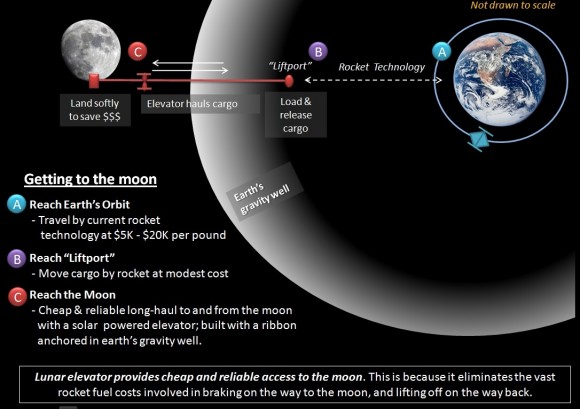
2006-10-03: CNT strength is, of course, on the critical path. 2006-10-26: Java applet (with annoying IE only check) to play with SE parameters: CNT strength, climber payload, etc. 2019-08-25: A lunar space elevator should be possible in a few years as it doesn’t require exotic new materials. It would save lots because braking to the surface is a significant factor.
It is true that science can be done in the space station. But science can also be done dressed in a clown suit atop a large Ferris wheel. The argument ought to be over where is the best place for it. Performing experiments in microgravity does not require a $100B platform. Moreover, much of the work that can genuinely be done only on the station is justified through another magnificently circular leap of logic. Research into the effects of microgravity on human health and the growth of soybeans, for instance, is useful only in the context of a manned mission to Mars.
It doesn’t pay to lift humans out of earth’s gravity well. Billions each year could instead be spent on research and development for cheaper transport options, spurring the advent of a commercial space industry. 2006-10-24: Our Non-Expeditions to the Moon and Mars
President Bush is right. The space shuttle and the space station deserve termination. The true heart of his proposal is the elimination of these programs, and the substitution of robotic exploration.
Space exploration is fundamentally about the survival of the species, about ensuring better odds for our survival through the promulgation of the human species. But as we do it, we will also ensure the prosperity of our species in the economic sense, in a 1000 ways.
NASA is starting to take extinction events seriously and arguing for space missions as a hedge. About time. 2007-06-06: Future of NASA
Reducing the cost of space access is now being addressed by the private sector. NASA is now acting as a responsible potential customer of commercial launch services (COTS). The government has a poor record competing with the private sector in the arena of cost effectiveness. NASA spent many years and billions of dollars in pursuit of next generation launch technologies, with limited success. NASA has now wisely chosen to provide a market with exploration programs and to permit private enterprise to have a crack at making that affordable. In the meantime NASA is developing the Ares family of launch vehicles to provide the capabilities it requires to initiate the human exploration program until the market is able to offer cheaper alternatives. As for the International Space Station (ISS), it is essential that we learn how to truly live and work in space – not just pay visits. ISS is a vital international laboratory for learning how to build, live aboard, maintain, and operate a complex vehicle in space. The same is true for a lunar base that enables us to use the resources of space and assists our education in how to reach Mars. As for favored contractors, the COTS program and the market established by exploration will open new venues for many companies and communities around the world to participate.
nasa’s reply to allegations of suckiness by wired et al 2010-05-15: The New Space Frontier
Today, the President will articulate an ambitious and exciting new plan that will alter our destiny as a species. I believe this address could be as important as President Kennedy’s 1962 speech at Rice University. For the first time since Apollo, our country will have a plan for space exploration that inspires and excites all who look to the stars. Even more important, it will work.
NASA finally creates a real space industry. You know, with competition and stuff. 2012-03-03: Space exploration future .Beyond on a related note, getting into AMNH early without all the crowds makes it twice as awesome. 2012-05-27: Mars Drive
The reference mission design of the MarsDrive Consortium is discussed, which has been created to facilitate exploration of the red planet through methods that are both realizable and cost-sustainable with existing technology. This mission plan—known as Mars for Less—is predicated on the use of existing medium-lift launch vehicles. In this architecture, 25-ton propulsion stages are placed individually in low-Earth orbit, where they are mated to Mars-bound payloads and ignited at successive perigees to execute trans-Mars injection. Spacecraft follow conjunction-class trajectories to the red planet and utilize aerodynamic methods for orbital capture and descent. Return vehicles are fueled with methane/oxygen bipropellant synthesized primarily from Martian resources. Dispatching expeditions from orbit with individual, high energy stages—rather than directly from the Earth’s surface—allows for the division of mission mass into more manageable components, which can be launched by vehicles that exist today. This plan does not require the development of heavy-lift launch technology: an effective yet costly proposition that may otherwise hinder current space exploration initiatives. Without the need for heavy-lift boosters, piloted missions to Mars may be undertaken presently, and within the capabilities of private initiatives. It is argued that the mission design herein represents a more viable method of conducting early human Mars exploration than proposals which require heavy-lift launch vehicles—an alternative method by which the red planet can be opened to humanity.
Between the safety fetish and cover your ass problems with government funded spaceflight, private companies have a 100x cost advantage. What flag will they plant in the regolith?
Here is one such proposal 2013-02-27: Going to Mars in 2018? This will be the most awe-inspiring and profound event this quarter-century.
Inspiration Mars Foundation believes in the exploration of space as a catalyst for growth, national prosperity, knowledge and global leadership. History has shown that strong nations reap these benefits when they boldly follow a path rooted in curiosity and guided by technological innovation. In 2018, the planets will literally align, offering a unique orbit opportunity to travel to Mars and back to Earth in only 501 days. Inspiration Mars is committed to sending a 2-person American crew – a man and a woman – on an historic journey to fly within 160 km around the Red Planet and return to Earth safely.
2013-03-12: Mars Research Station. I salute this effort. Very often, things look silly to our eyes that become crucial for humanity later on.
In the vast open spaces of southern Utah, Reuters photographer Jim Urquhart recently paid a visit to the Mars Desert Research Station (MDRS). Built and operated by a space advocacy group called the Mars Society, the research facility is investigating the feasibility of human exploration of Mars, using the Utah desert’s Mars-like terrain to simulate working conditions on the red planet. Since 2000, more than 100 small crews have served 2-week rotations in the MDRS, conducting research in an on-site greenhouse, observatory, engineering area, and living space. Urquhart was able to accompany members of the Crew 125 EuroMoonMars B mission inside the MDRS facility, and on a simulated trip to collect Martian geological samples.
2014-02-18: Indian Mars Exploration. India’s Mars mission is 9x cheaper than a similar NASA one. I hope they succeed and put another nail into the coffin of bloated military-industrial complex projects.
While India’s recent launch of a spacecraft to Mars was a remarkable feat in its own right, it is the $75m mission’s thrifty approach to time, money and materials that is getting attention.
2014-10-31: Exploration is sacrifice, and we’d best re-learn that lesson.
I would like to share my deepest personal thoughts on today’s Virgin Galactic Accident. As you know, this is deeply meaningful to me, my family and friends.
Today, most importantly, my heart goes out to those who have lost loved ones, and the many at Virgin Galactic, Scaled Composites, the Virgin Group and the Mojave Spaceport who this accident deeply affects.
I urge all of us to keep something in mind. We are on the verge of opening the space frontier, one of the greatest endeavors of our species.
Many Americans forget that 500 years ago 1000s of European gave their lives to open the Americas, and 200 years ago, the early American’s risked their lives to open the west. This is what exploring is all about. We risk our lives for what we believe in. This is the American way, the explorer’s way.
I for one, am proud to be a Virgin Galactic client. I believe in the company, and know, without a doubt, that they will succeed, and I will fully trust them with my safety when my turn to fly materializes.
A far cry from the fierce Cold War Space Race between the US and the Soviet Union, exploration in the 21st century is likely to be a far more globally collaborative project. This spirit of trans-border ownership and investment seems set to continue. One key part of this is the Global Exploration Roadmap, an effort between space agencies like NASA, France’s Centre National d’Etudes Spatiales, the Canadian Space Agency, and the Japan Aerospace Exploration Agency, among many others, that is intended to aid joint projects from the International Space Station to expeditions to the Moon and near-Earth asteroids—and to reach Mars. On a recent trip to India’s space agency, Stofan recounted to me, she met with many Indian engineers who were just as excited as the Americans to get scientists up there, not only to explore, but also to begin nailing down the question of whether there was ever life on the red planet. It’s also clear that the next stage of space exploration will not only be more global, but will equally involve greater private and public partnerships. Companies like Space X are increasingly involved in NASA’s day-to-day operations
At 61, Dr Stone appreciates the limits of human exploration. 23 of his friends lost their lives on expeditions and he has personally recovered 7 bodies. Now Stone Aerospace is developing a team of robots to hunt for microbial life on Europa. The discovery of Europan life would, Dr Stone reckons, be “a pretty good contender” for one of the most momentous events in human history. That might satisfy most explorers, but not Dr Stone. He has founded the Shackleton Energy Company to process water on the Moon into oxygen and hydrogen for rocket fuel.
The possibility of applying the Space-X Falcon-Heavy booster to human exploration of the inner solar system is discussed. A human-rated Dragon command module and an inflatable habitat module would house and support the 2-4 person crew during a ~1 year interplanetary venture. To minimize effects of galactic cosmic rays, older astronauts should conduct the mission during Solar Maximum. Crew life support is discussed as is application of a ~1-km square solar photon sail. The sail would be applied to rendezvous with the destination Near Earth Object (NEO) and to accelerate the spacecraft on its return to Earth. An on-line NASA trajectory browser has been used to examine optimized trajectories and destinations during 2025-2026. A suitable destination with well established solar-orbital parameters is Asteroid 2009 HC.










 Gregor J. Rothfuss