Tag: mars
A magnetic shield for Mars
An inflatable structure can generate a magnetic dipole field at a level of perhaps 1 or 2 Teslas an active shield against the solar wind and allow the Martian atmosphere to thicken overtime. Mars atmosphere would naturally thicken over time, which lead to many new possibilities for human exploration and colonization. These would include an average increase of 4 °C, which would be enough to melt the carbon dioxide ice in the northern polar ice cap. This would trigger a greenhouse effect, warming the atmosphere further and causing the water ice in the polar caps to melt.
Earth seen from Mars
The Earth and Moon, as seen from Mars. That image was taken by the phenomenal HiRISE camera on board the Mars Reconnaissance Orbiter, which was more than 200M kilometers from Earth at the time. It’s actually a composite of a few separate images, processed to show the relative size and position of our planet and its moon.

30 days to Mars
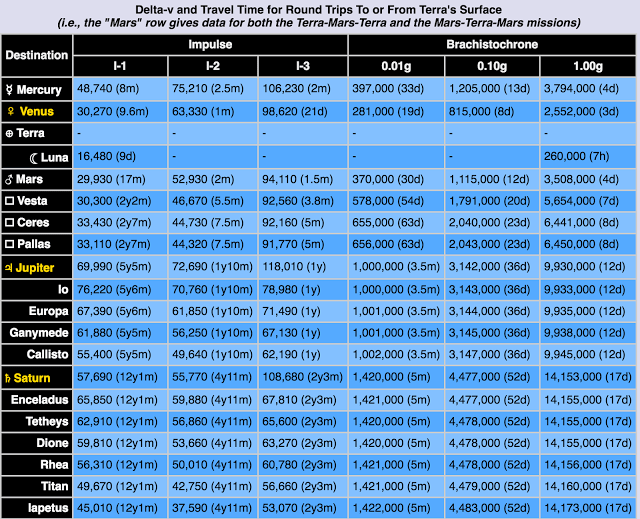
ProjectRho has round trip space mission times based on 3 types of rocket missions and 3 levels of constant acceleration. Constant acceleration could be achieved with an antimatter catalyzed fusion propulsion system like Positron Dynamics is developing
15 days 1 way to Mars with a constant 0.01 G acceleration and deceleration.
6 days 1 way to Mars with a constant 0.1G acceleration and deceleration.
2 days 1 way to Mars with a constant 1G acceleration and deceleration.
2022-02-19: It is also possible to get to Mars in 45 with Laser Thermal Propulsion: A Earth-based Laser heats up onboard propellant. This has very promising characteristics:
For lower velocity missions within the solar system, coupling the laser to the spacecraft via a reaction mass (i.e., propellant) is a more efficient way to use the delivered power than reflecting it off a lightsail. Reflecting light only transfers a tiny bit of the photon’s energy to the spacecraft, but absorbing the photon’s energy and putting it into a reaction mass results in greater energy transfer. The greater power that can be delivered results in greater thrust, so a more intense propulsive maneuver can be performed nearer to Earth. The closer to Earth the propulsive burn is, the smaller the laser array needs to be in order to keep the beam focused on the spacecraft, making it more feasible as a near-term demonstration of directed energy propulsion. The scaled-up version of our design (Mission Mars 2a) intended for crewed missions used a 40-ton spacecraft derived from the Orion capsule and European Service Module. The greater payload requires a more powerful (4 GW) laser to effectuate the same 45-day transit to Mars, but the laser array occupies the same 10-m footprint on earth.
The other mission we considered was a cargo mission (Mission Mars 2b). Robert Zubrin often makes the point that—even if advanced propulsion capable of high thrust and high specific impulse was available—he would still opt for a 6-month free-return trajectory and use the enhanced propulsion capability to bring more payload. So, the Mars 2b mission uses the performance of laser thermal propulsion to maximize the amount of cargo that could be brought to Mars with a Hohmann-like transfer, and shows that the payload could be increased by a 10x over what a Centaur upper stage—with the same mass of propellant—could throw to Mars.

Mars Biosafety
It’s looking more and more likely that Mars might already be inhabited—by Martians. Very tiny ones. Conley’s office serves to prevent NASA from doing to Martians what European explorers did to Native Americans with smallpox. Because Mars lacks Earth’s history of abundant life, it has that much more raw material for Earth’s bacterial stowaways to devour—should any of them, say, come into contact with water, find a niche they can survive in, and start to reproduce. “The whole planet is a dinner plate for these organisms. They will eat Mars.”
Colonizing Mars
this is seminal. the most inspirational thing you’ll watch this year.
we can go to mars in our lifetimes.
For immigrants, who will spend the rest of their lives on Mars, or even explorers who would spend 2.5 years on a round trip, the advantage of reaching Mars one-way in 4 months instead of 6 months is negligible — and if shaving off 2 months would require a reduction in payload, meaning fewer provisions could be brought along, then the faster trip would be downright undesirable.
Mars Ice House
this is an amazing concept, winner of a nasa challenge to build a mars habitat with mars materials. the team came up with a solution that involves 3D printing ice & regolith with robots.
Mars Roadmap
the martian was amazing, go see it. such a delight that such upbeat, yet accurate movies about the future continue to be made.
Read a fascinating and well-written popular article on NASA’s newly released “Roadmap to Mars.” It is so good to see progress in the bureaucracy adapting to ideas some of use were bruiting decades ago — like in-situ production – on Mars – of the water and fuel and oxygen astronauts will need, instead of expensively hauling them all from Earth. (Note this concept was largely absent from The Martian.) It also includes testing our methods with asteroid retrieval projects that could wind up benefiting humanity and Earth more than the Mars missions would! Certainly it is good to see the plan almost completely leave out our sterile/useless (for now) moon. Been there. There’s nothing (for now) there.
The Martian
Mars One
the only reality show i’ll ever watch, even though mars one is sadly full of shit
 Gregor J. Rothfuss