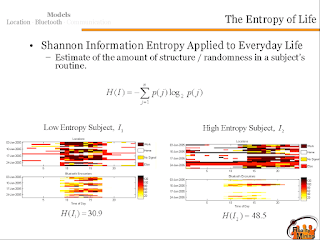
meet reality mining. nathan eagle has used a couple months worth of mobile tracking to model and predict behaviors in social networks. slides
Sapere Aude
Tag: locative
meet reality mining. nathan eagle has used a couple months worth of mobile tracking to model and predict behaviors in social networks. slides
Public Authoring in the Wireless City
Urban Tapestries is a framework for understanding the social, cultural, economic and political implications of pervasive location-based mobile and wireless systems.
this reminds me of jo walsh. like slapping a commercial label on her pioneering work. overlays to augment physical spaces, yummy!!
Montevideo, , UY
Amsterdam, , NL
Chantilly, Virginia, US
Ottawa, Ontario, CA
Newark, New Jersey, US
Redmond, Washington, US
Zurich, Zurich, CH
San Antonio, Texas, US
Foster City, California, US
Amsterdam, North Holland, NL
Pasadena, California, US
Princeton, New Jersey, US
Reston, Virginia, US
Fairfax, Virginia, US
Plano, Texas, US
Creve Coeur, Missouri, US
San Jose, California, US
Wellesley, Massachusetts, US
Milton, New South Wales, AU
Milton, , AU
Vaasa, Vaasa, FI
Palo Alto, California, US
Chelmsford, Massachusetts, US
are some of my recent visitors, per CAIDA. the mapping between IP addresses and coordinates is far from perfect though. this will not change until GPSML or similar services are baked into the internet infrastructure. collecting geographical data on the side and correlating it with your posts (and those of others, think neighborhood aggregators) strikes me as an interesting experiment in spatial serendipity.
There is a growing requirement for a standard way of sharing GPS location information between disparate systems, devices and users. For example, to transmit location data from a GPS-enabled client application (possibly running on a handheld device) to a central server running location-aware Web Services. Another example would be to enable users to share waypoints, routes and/or track logs more easily, regardless of their GPS device or application. Chaeron will submit the GPSml specification to the W3C for adoption as a standard once it stabilizes and is released in a final version.
adding location-awareness will allow the web to track the real world much better. it would allow to reduce the impedance mismatch in user interfaces, and allow the web to recede more into the (ubiquitous) background, where it belongs.
This paper describes our implementation of the Universal Location Framework, a technology that allows aggregating multiple location technologies, seamlessly transition between them, and exposes a single Application Programming Interface (API).
Today there are well-established technologies for position location such as Global Positioning System (GPS), cell phone triangulation using Enhanced Observed Time of Difference (E-OTD), and emerging technologies such as Digital TV (DTV) signals, Wifi, and so forth. The performance variation of these technologies with respect to the environment has been the main reason for their development and continued existence. ULF is addressing this issue by not being restricted to any specific technology. Instead, it uses a layered approach that allows integrating (fusing) multiple technologies.
intel’s research in location-aware computing seems to have resulted in JSR-179, which was approved a few weeks ago. with luck, it will be implemented shortly.
discovering blogs that are geographically close is an unsolved problem that may be solved by blogchalking.
wow. location-based services. i had always thought that the notion of m-commerce was rather silly, as in getting spammed with sms when you walk by a store. however, attaching metadata (so to speak) to any gps coordinates is really powerful. talk about blurring the lines between meatspace and cyberspace.

 Gregor J. Rothfuss