we show that it is possible to realize a backward scattering force which pulls a particle all the way towards the source without an equilibrium point
photons can pull, not just push.
Sapere Aude
Tag: laser
we show that it is possible to realize a backward scattering force which pulls a particle all the way towards the source without an equilibrium point
photons can pull, not just push.
femtosecond laser gear, handy gadgets that violate time-reversal symmetry by transmitting light in only 1 direction, optical-quality lithium niobate crystals (infrared beam in, green beam out)
One of those techniques, called optical trapping, uses a highly focused beam of light to capture and precisely position particles.
Multi-Generation Space Ships
the motivations, technology, and prospects for interstellar flight, while the balance deals with anthropological, genetic, and linguistic issues in crew composition for a notional mission with a crew of 200 with a flight time of 2 centuries.
2007-06-15: On the infeasibility of interstellar travel
We require the equivalent energy output to 400 megatons of nuclear armageddon in order to move a capsule of the gross weight of a fully loaded Volvo V70 automobile to Proxima Centauri in less than a human lifetime. That’s the same as the yield of the entire US Minuteman III ICBM force. Our entire planetary economy runs on 4TW. So it would take our total planetary electricity production for a period of 5 days to supply the necessary va-va-voom.
2009-02-01: Tau Zero Foundation
The Tau Zero Foundation is a volunteer group of scientists, engineers, entrepreneurs, and writers who have agreed to work together toward practical interstellar flight and to use this quest to teach you about science, technology, and our place in the universe.
2010-05-07: Project Icarus
To design a credible interstellar probe that is a concept design for a potential mission in the coming centuries.
2011-01-06: No Interstellar Travel Before 2200. About 10^18 Joules required, more than a Kardashev type I civilization.
2011-05-20: Star Children. It might make sense to start a religion to ensure long term space travelers retain their goals.
We are seeking ideas for an organization, business model and approach appropriate for a self-sustaining investment vehicle. The respondent must focus on flexible yet robust mechanisms by which an endowment can be created and sustained, wholly devoid of government subsidy or control, and by which worthwhile undertakings—in the sciences, engineering, humanities, or the arts—may be awarded in pursuit of the vision of interstellar flight
2013-04-25: Starship Century
Is this the century we begin to build starships?
yes
2014-03-12: Starship Century
Starship Century is a symposium coordinated by the new Arthur C. Clarke Center for Human Imagination in collaboration with Gregory and James Benford, presenting ideas from their anthology of science and science fiction. First 8 minutes most of them agree the era of interstellar starships will be 100-300 years away after there is lot of solar system development.
2015-10-21: Black hole drive
The petawatt Hawking radiation of γ-ray laser-created subatomic black holes (Schwarzschild Kugelblitzes or SKs) has been proposed as a propulsive and power source for interstellar starships. Production of a black hole requires concentration of mass or energy within the corresponding Schwarzschild radius. In familiar 3D gravity, the minimum such energy is 10^19 GeV, which would have to be condensed into a region of approximate size 10^-33 cm. This is far beyond the limits of any current technology; the Large hadron collider (LHC) has a design energy of 14 TeV. This is also beyond the range of known collisions of cosmic rays with Earth’s atmosphere, which reach center of mass energies in the range of 100s of TeV. It is estimated that to collide 2 particles to within a distance of a Planck length with currently achievable magnetic field strengths would require a ring accelerator ~1k light years in diameter to keep the particles on track.
2016-02-20: Interstellar Propulsion. A 100kg robotic craft could be sent to Mars in 3 days with the power levels that large rockets produce (50-100 GW)
2016-04-12: Starshot. This makes me proud of our civilization: We do stuff like this.
Milner wants his $100M to fund research that will culminate in a prototype of a probe that can beam images back to Earth. The images would arrive less than 5 years after the probe reached the star.
There are no official specs yet, but the probe would have a 2-megapixel camera, along with star-finders to help it get its bearings, after it boots up on the approach to Proxima Centauri. The probe will target one of the system’s 2 sunlike stars. It will be aimed at a planet (or planets) in the star’s habitable zone, the temperate region where oceans don’t boil or freeze, but instead flow, nurturing the kind of complex chemistry that is thought to give rise to life.
2018-08-14: Propellantless interstellar travel
Researchers propose a new mode of transport which relies on electric-field moderated momentum exchange with the ionized particles in the interstellar medium. While the application of this mechanism faces significant challenges requiring industrial-scale exploitation of space, the technological roadblocks are minimal, and are perhaps more easily addressed than the issues presented by light sails or particle beam powered craft. This mode of space travel is particularly well suited to energy efficient space travel at velocities less than 5% of light speed, and compares exceptionally well to light sails on an energy expenditure basis. It therefore represents an extremely attractive mode of transport for slow (~multi-century long) voyages carrying heavy payloads to nearby stellar neighbors. This could be very useful in missions that would otherwise be too energy intensive to carry out, such as transporting bulk materials for a future colony around Alpha Cen A, or perhaps a generation ship.
2020-02-21: Interstellar Probe, weighing a few grams, and getting there in 20 years.
2020-09-03: Mach Effect Propulsion. Jim Woodward is investigating mach effect thrusters as part of NASA NIAC. If successful, this will get us to .xc, making humanity interstellar.
2022-08-05: Bow Shock Deceleration
Deceleration at the destination system is a huge problem for starship mission planning. A future crew, human or robotic, could deploy a solar sail to slow down, but a magsail seems better, as its effects kick in earlier on the approach. Looking at the image below, however, suggests another possibility, one using the interactions between stars and the interstellar medium to assist the slowdown. The bow shock produces 3D structures, surfaces within which one can move while shedding speed, perhaps braking via a magsail. Each star would produce its own unique deceleration environment, allowing us to brake where possible along the bow shock, the astropause (cognate to the heliopause) and the termination shock.

They hope eventually to use the 2 megajoule laser of LLNL’s National Ignition Facility to achieve more than 1b atmospheres of pressure. The center of Jupiter is at 70m atmospheres.
Phased Array Optics
It’s now been over 15 years since cryonics pioneer, molecular nanotechnologist, and optics buff Dr. Brian Wowk came up with the super-cool idea of phased array optics. Essentially, the plan is to use a 2D array of micron-sized screens to emit light at the precise amplitude and phase necessary to create the illusion of a 3D image. This technology could be fantastically effective: even using binoculars or a telescope, a person looking at the screen would be able to see details “km away” (if the image were high enough resolution) even if the screen were right in front of their face. Outside of tapping into the optic nerve directly, this may be the most convincing display technology ever. The limits of optics. The only problem is that it would require a metric truckload of computing power, but it’s nothing that specialty nanocomputers won’t be able to handle, right? Here is a diagram of the apparatus:

2008-06-03: GLIMPSE
GLIMPSE (Galactic Legacy Infrared Midplane Extraordinaire) is a survey of the inner part of the Milky Way Galaxy in which we reside. The images come from the IRAC instrument on board the Spitzer Space Telescope. These surveys have 100x the sensitivity and over 10x the resolution of previous surveys, allowing us to see stars and dusty objects throughout most of the Galaxy for the first time.
2008-09-19: Space flux telescopes
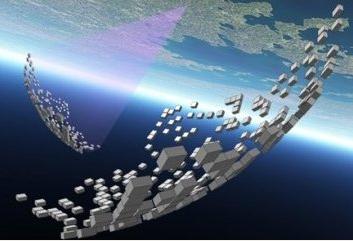
Holding the mirror pieces together magnetically seems the only practical way to reach the 40m+ diameter required to detect extrasolar planets directly
2009-06-11: The new refraction limit is wavelength / 20, a 10x improvement. This allows imagining of molecules with optical microscopes, and maybe also improvements for telescopes.
2013-12-09: DARPA MOIRE. The thickness of plastic wrap, each membrane serves as a Fresnel lens, which unfold in orbit. The diameter of 20 m would be the largest telescope ever made and gives it ~30x the light-gathering power of the HST.
2015-09-01: 3.2 Gigapixel
The US Department of Energy has approved the start of construction for a 3.2-gigapixel digital camera—the world’s largest—at the heart of the Large Synoptic Survey Telescope. Assembled at SLAC National Accelerator Laboratory, the camera will be the eye of LSST, revealing unprecedented details of the universe and helping unravel some of its greatest mysteries.
2016-08-15: LUVOIR
The Large Ultraviolet Optical Infrared Surveyor is a proposed space telescope that would be 5x as big and 100x as sensitive as the Hubble, with a 12m mirror, and would orbit the sun ~1.6m km from Earth. The revolutionary HDST space-based observatory would have the capability to find and study 10s of Earth-like worlds in detail. The 10 milliarcsec resolution element of a 12 meter telescope (diffraction limited at 0.5 micron) would reach a new threshold in spatial resolution. It would be able to take an optical image or spectrum at ~100 parsec spatial resolution or better, for any observable object in the entire Universe. Thus, no matter where a galaxy lies within the cosmic horizon, we would resolve the scale at which the formation and evolution of galaxies becomes the study of their smallest constituent building blocks—their star-forming regions and dwarf satellites. Within the Milky Way, a 12 m telescope would resolve the distance between the Earth and the Sun for any star in the Solar neighborhood, and resolve 100 AU anywhere in the Galaxy. Within our own Solar System, we would resolve structures the size of Manhattan out at the orbit of Jupiter
2017-04-08: Planet wide radio telescope
VLBI (Very Long Baseline Interferometry) now links radio telescopes spread across the globe into a telescope the size of our planet– extending the array to millimeter wavelengths achieved a further boost in resolving power. The result is a 10x increase in the sensitivity of the world’s millimeter VLBI networks.

2018-07-30: Adaptive optics Neptune
In astronomy, adaptive optics refers to a technique where instruments are able to compensate for the blurring effect caused by Earth’s atmosphere, which is a serious issue when it comes to ground-based telescopes. Basically, as light passes through our atmosphere, it becomes distorted and causes distant objects to become blurred (which is why stars appear to twinkle when seen with the naked eye).

2018-09-08: Imaging Oort Cloud objects
The most distant galaxies can be seen by our telescopes but smaller and closer objects in the Oort clouds cannot be seen. The Oort cloud objects are too faint to see with the James Webb Space Telescope, but it should be able to see bright galaxies and quasars even at 13B light years. Detecting Oort cloud dwarf planets would likely take a space telescope with an 11 kilometer mirror.
2019-03-21: Exoplanet Gigapixel Imaging
If we send a telescope to the solar gravitational lens (SGL) point on the opposite side of our sun then light from objects like exoplanets will be focused to provide 100B times more magnification. The Sun becomes a telescope that is 1.4M kilometers wide for the SGL regions.
We could resolve exoplanets around Proxima B to 450-meter resolution using a 1-meter telescope SGL mission. If there was an earth-sized planet around Proxima B, we could resolve to 800 megapixels. We would only be able to resolve 10 square kilometers at a time. The space telescope would have to roam around the einstein-ring image of the target object to assemble the full image. The image would need to be converted from an einstein ring back into the image of the exoplanet. A giant 1.3 kilometer focus line diameter space telescope would be able to resolve an entire einstein-ring image of an earth-sized exoplanet at 100 light years from the right SGL location.
2019-12-04: 1000km Space Telescopes

The 1000km baseline arrays would have over 400K times the light collection of the Hubble Space telescope.
2020-07-08: Gravity Lenses. If we send telescopes out to 4 light days we can use the gravity of the sun to amplify the power of telescopes by 100B times.
2021-05-14: Quantum Interferometry
A quantum hard drive at each telescope can record and store the wavelike states of incoming photons without disturbing them. After a while, you transport the hard drives to a single location, where you interfere the signals to create an incredibly high-resolution image. Not everyone thinks it’ll work. “In the long run, if these techniques are to become practical, they will require a quantum network”. Bartholomew counters that “we have good reasons to be optimistic” about quantum hard drives. “I think in a 5-to-10-year time frame you could see tentative experiments where you actually start looking at real [astronomical] sources.” By contrast, the construction of a quantum internet is decades from reality.

There are a bunch of things you need to do to get Laser Tag up and running so here follows the required equipment and setup instructions.
the next “OMG terrorism” project. write on walls with a laser, use laptop + projector for persistence
Using lasers, researchers have crafted a microscopic version of Rodin’s famous sculpture “The Thinker” 2x the size of a red blood cell at 20 μm high

put your facial hear into a dormant state with LASERS! everything is better with lasers.
A device that uses light to send hair follicles to sleep, making skin smooth for weeks at a time, without shaving or waxing, is being patented by Philips.
From the planetary society comes word that Cosmos 1, the first private solar sail craft is ready for launch on June 21, 2005. Solar sails have some very poetic capabilities. That is a remarkable 0.003c.
Ultimate space-manufactured solar sails will allow the possibility of Earth-Mars round trips with durations measured in months rather than years. The same technology may allow visits to the nearer stars at solar-system exit velocities higher than 1000 km /sec. The 1-way travel time to the Sun’s nearest interstellar neighbors (Proxima Centauri) will be ~1 ka for such spacecraft. Advances in laser and maser power-beaming technologies may eventually substantially reduce interstellar-voyage durations.
2020-01-10: Plans for 0.2c
$100m has been put into the Breakthrough Starshot project to push a sail up to 20% the speed of light and send an unmanned probe to Proxima Centauri in 20 years. There is progress on a stabilizing design for a sail to ride the laser beam
2020-06-26: Metamaterial sails
Extreme metamaterial solar sails as proposed here have the potential to shift the paradigm of space exploration enabling numerous low cost and high-speed missions to be launched anytime and anywhere. Such sails could gain accelerations over 60AU/yr when coupled to low mass spacecraft and dive to extreme proximity to the sun (just 2-5 solar radii). This velocity is 20x more than Voyager 1
 Gregor J. Rothfuss