If you’re looking for some of America’s best bourbon, denim and burgers, go to Japan, where designers are re-engineering our culture in loving detail. This movement of American style across the ocean to Japan and back to America with a Japanese twist is happening more frequently. The most famous example is probably Daiki Suzuki, who was design director for the quintessentially American brand Woolrich Woolen Mills and now produces his own menswear line—Engineered Garments, a Japanese-run American brand that manufactures its unique take on vintage Americana in New York and sells it in both Japan and the US One of his former employees, Shinya Hasegawa, now has a Brooklyn-based line called Battenwear that offers his interpretation of American outdoor wear from the ’60s to the ’80s. I had never encountered the brand in the States, but I found it in Kyoto.
Tag: japan
Japan Web Design Is Different
Go on a safari around Japan’s most popular sites and here’s what you can expect to find:
Dense tightly packed text
Tiny low-quality images
More columns than you can count
Bright clashing colors and flashing banners
Overuse of outdated technologies like Flash.
The theories for why this is are numerous.
Risk Avoidance – In general Japanese culture does not encourage risk taking or standing out from the crowd. Once a precedent has been set for things looking or behaving a certain way then everybody follows it, regardless of whether there is a better solution. Even Japanese subcultures conform to their own fashions and rules.
Consumer Behavior – People require a high degree of assurance, by means of lengthy descriptions and technical specifications, before making a purchasing decision – they are not going to be easily swayed by a catchy headline or a pretty image. The adage of “less is more” doesn’t really apply here.
Advertising – Rather than being seen as a tool to enable people Japanese companies often see the web as just another advertising platform to push their message across as loudly as possible. Websites ends up being about the maximal concentration of information into the smallest space akin to a pamphlet rather than an interactive tool.
Urban Landscape – Walk around one of Tokyo’s main hubs like Shibuya and you’re constantly bombarded with bright neon advertisements, noisy pachinko parlors, and crowds of rambunctious salary men or school kids. The same chaotic busyness of the streets seems to have spilled over to the web. Added to this, because physical space comes at a premium in Japan, none of it is wasted and the same goes for negative/white space on a webpage.

Tokyo Zoning

Tokyo is known for its oddly angled buildings such as the sloping roof’s on the row of buildings in the center of the picture. The slicing and angles come from natural lighting regulations – neighbors have the right to the same level of natural light with the new building, as what previously stood there. Builders optimize the interior size of the building by optimizing the meterage by taking up as much of that space as possible, even if it means slicing off corners to provide light-access.
Why Tokyo is the land of rising home construction but not prices
It was the rapidity of what happened to the house next door that took us by surprise. We knew it was empty. Grass was steadily taking over its mossy Japanese garden; the upstairs curtains never moved. But one day a notice went up, a hydraulic excavator tore the house down, and by the end of next year it will be a block of 16 apartments instead. Abruptly, we are living next door to a Tokyo building site. It is not fun. They work 6 days a week. Were this London, Paris or San Francisco, there would be howls of resident rage — petitions, dire warnings about loss of neighborhood character, and possibly a lawsuit or 2. Local elections have been lost for less. Yet in our neighborhood, there was not a murmur. “There is no legal restraint on demolishing a building. People have the right to use their land so basically neighboring people have no right to stop development.”
Torsted laver
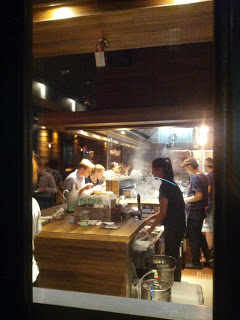
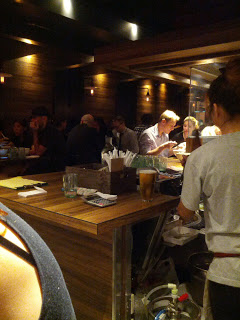
How can I resist a new ramen place with torsted laver on the menu?


Jiro dreams of Sushi
saw this a few days ago. the sushi at work doesn’t taste the same now 😦
between jiro passing away at some point and overfishing, we might be living through peak sushi.
Cocoron
Japanese style soba in a tiny space. Super delicious.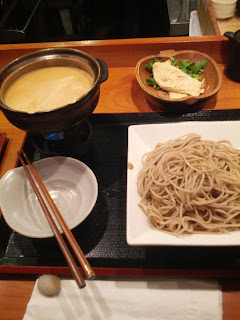

End of Japan
Japan now faces simultaneous threats to its infrastructure, its economy and its society. We have to ask seriously if Japan, as a nation, has the reserves of will necessary to weather this crisis.
Japan Earthquake Perspective
Japan is exceptionally well-prepared to deal with natural disasters: it has spent more on the problem than any other nation, largely as a result of frequently experiencing them. (Have you ever wondered why you use Japanese for “tsunamis” and “typhoons”?) All levels of the government, from the Self Defense Forces to technical translators working at prefectural technology incubators in places you’ve never heard of, spend quite a bit of time writing and drilling on what to do in the event of a disaster.
Decibel
Manba
An underground youth culture in Japan with distinctive music, fashion and make-up, where the skin is darkened using tanning products is spreading worldwide. Young people in the UK have been learning about the intricacies of ‘manba‘ by making friends on the other side of the world using social networking sites and learning how to re-create the style through videos on YouTube.
paging bruce sterling for OMG globalization commentary
 Gregor J. Rothfuss