Tag: images

Engram

Almost all neuroscientists base their search—for the physical basis of memory (the engram)—on the assumption that temporal-pairing causes learning. They are dedicated to this assumption—even though, as Rescorla pointed out 50 years ago, experimental attempts to define temporal-pairing have always failed. This failure is as striking now as it was 50 years ago. Anything that gets neuroscientists to abandon the idea that temporal-pairing is a useful scientific concept is a step toward discovering the physical basis of memory. Each neuron contains billions of (almost) incomprehensibly-tiny molecular machines. Molecular biologists have developed an astonishing array of techniques for visualizing/manipulating the actions of these little machines. These techniques will allow molecular biologists to follow the machines inside this huge neuron to the engram—to the tiny machine that encodes the experience-gleaned facts so that these learned/remembered facts can inform later behavior.

2021-11-19: This feels like a really big deal:

Biology feels different right now. New broadly enabling technologies and tools are driving forward progress in nearly every specific field at a rapid pace. The large scale adoption and application of a powerful set of common tools has created a virtuous cycle of further technology refinement and engineering. The rate of iteration is increasing, and previously intractable problems are now within reach. While RNA-seq and MPRAs are both valuable approaches, they come with some limitations. Fundamentally, each measurement represents a single static slice of a dynamic process which is only inferred by attempting to piece together the slices. The quality of the reconstruction is limited by sampling density. What if we could measure these systems continually as they occurred in a way that didn’t require destructive sampling? Here, the fundamental idea is that “DNA is the natural medium for biological information storage, and is easily ‘read’ through sequencing.” This forms the basis for this new technology: ENGRAM (ENhancer-driven Genomic Recording of transcriptional Activity in Multiplex). The workflow of this technique is very similar to that of the MPRA introduced above, but with an important twist. Instead of destroying the cell and sequencing a ratio of barcodes, the transcription event is recorded by the insertion of a barcode into a locus of DNA in the cell via prime editing. They went further and showed that they could effectively multiplex this technique by reading out all 3 signals in response to stimulants in a single population of cells. Even more, they showed a proof-of-concept for reading out the order in which events occurred.

Xenobots

The researchers let the cell clusters assemble in the right proportions and then used micro-manipulation tools to move or eliminate cells — essentially poking and carving them into shapes like those recommended by the algorithm. The resulting cell clusters showed the predicted ability to move over a surface in a nonrandom way.

The team dubbed these structures xenobots. While the prefix was derived from the Latin name of the African clawed frogs (Xenopus laevis) that supplied the cells, it also seemed fitting because of its relation to xenos, the ancient Greek for “strange.” These were indeed strange living robots: tiny masterpieces of cell craft fashioned by human design. And they hinted at how cells might be persuaded to develop new collective goals and assume shapes totally unlike those that normally develop from an embryo.

2021-11-29: And now they reproduce

The same team that built the first living robots (“Xenobots,” assembled from frog cells — reported in 2020) has discovered that these computer-designed and hand-assembled organisms can swim out into their tiny dish, find single cells, gather 100s of them together, and assemble “baby” Xenobots inside their Pac-Man-shaped “mouth” — that, a few days later, become new Xenobots that look and move just like themselves. And then these new Xenobots can go out, find cells, and build copies of themselves. Again and again. “These are frog cells replicating in a way that is very different from how frogs do it. No animal or plant known to science replicates in this way. We’ve found Xenobots that kinematically replicate. What else is out there?”

2023-07-04: Interview with Michael Levin about the amazing latent abilities of cells. This seems to be true recursively.

A big theme of your work has been that organisms have latent abilities—that the behavior we see in nature is contextual and that, by altering the circumstances, you coax them to do totally different things. What are some examples?

We are lulled into thinking that frog eggs always make frogs, and acorns always make oak trees. But the reality is that once you start messing around with their bioelectrical software, we can make tadpoles that look like other species of frogs. We can make planaria that look like other species of flatworms across 150 million years of evolutionary distance—no genetic change needed, same exact hardware. The same hardware can have multiple different software modes.

You can look at frog skin cells and say, “All they know how to do is how to be this protective layer around the outside. What else would they know how to do?” But it turns out that if you just remove the other cells that are forcing them to do that, you find out what they really want to do—which is to make a xenobot and have this really exciting life zipping around and doing kinematic self-replication. They have all these capacities that you don’t normally see. There’s so much there that we haven’t even begun to scratch the surface of.

Some object to speaking of what the cells “know” or “want” to do. Do you think that a concern about being anthropomorphic or anthropocentric has hindered research in this?

Incredibly so. I love to make up the words for this stuff because I think they need to exist—“teleophobia.’’ People go screaming when you say, “Well, it wants to do this.” People are very binary because they’re still carrying this pre-scientific holdover. Back in before-science times, you could be smart like humans and angels, or you could be dumb like everything else. That was fair enough for our first pass in 1700, but now we can do better. You don’t need to be at either of these endpoints. You could be somewhere in the middle. When I say this thing “wants to do XYZ,” I’m not saying it can write poetry about its dreams. It doesn’t necessarily have that kind of second-order metacognition; it doesn’t know what it wants. But it still wants.

Are the cells of our body continually measuring the payoff of cooperating vs. defecting, too?

Yes, but if you are a cell that’s connected strongly to its neighbors, you are not able to have these kinds of computations. “Well, what if I go off on my own? I could just leave this tissue. I could go somewhere else where life is better. I could set up my own little tumor.” You can’t have those thoughts because you are so tightly wired into the rest of the network. You can’t say, “Well, I’m going to ….” There is no I; there’s we. You can only have those thoughts, “What am I going to get?” when you’re not part of the group.

But as soon as there’s carcinogen exposure or maybe an oncogene that gets expressed, the electrical connection starts to weaken. It’s a feedback loop, because the more you have those thoughts, the more you’re like, “Well, maybe let me just turn that connection down a little bit. Now I’m really coming into my own. Now I’m out of here. I’m metastasizing.”

So a carcinogen would work in this case by disrupting the bioelectrical connections.

Exactly. What we’ve done in the frog system, and we’re now moving into human cells, is to show that [electrical weakening] happens, and that you can prevent it and prevent normalized tumors by artificially forcing the electrical connection. We can shoot up a frog with strong human oncogenes and then show that, even though those are blazingly strongly expressed, there’s no tumor because you’ve intervened. You’ve forced the cells to be in electrical communication despite what the oncogene is trying to get it to do.

2024-01-22: Basal cognition

Regular cells—not just highly specialized brain cells such as neurons—have the ability to store information and act on it. Now Levin has shown that the cells do so by using subtle changes in electric fields as a type of memory. These revelations have put the biologist at the vanguard of a new field called basal cognition. Researchers in this burgeoning area have spotted hallmarks of intelligence—learning, memory, problem-solving—outside brains as well as within them. Basal cognition offers an escape from the trap of assuming that future intelligences must mimic the brain-centric human model. For medical specialists, there are tantalizing hints of ways to awaken cells’ innate powers of healing and regeneration. “What we are is intelligent machines made of intelligent machines made of intelligent machines all the way down.”

Multimodal Neurons

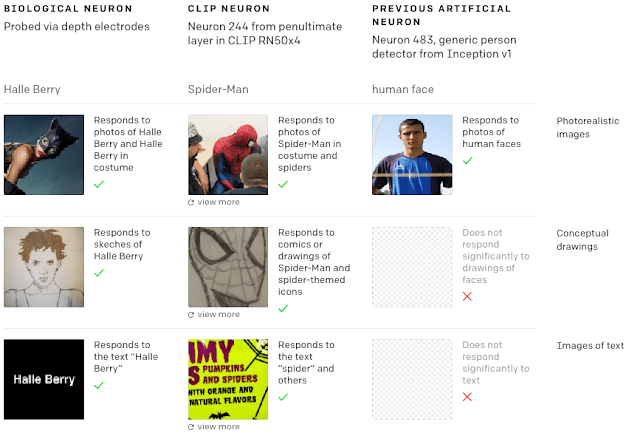
Using the tools of interpretability, we give an unprecedented look into the rich visual concepts that exist within the weights of CLIP. Within CLIP, we discover high-level concepts that span a large subset of the human visual lexicon—geographical regions, facial expressions, religious iconography, famous people and more. By probing what each neuron affects downstream, we can get a glimpse into how CLIP performs its classification.

Citi $900m mistake

Last August, Citigroup Inc. wired $900M to some hedge funds by accident. Then it sent a note to the hedge funds saying, oops, sorry about that, please send us the money back. Some did. Others preferred to keep the money. Citi sued them. Yesterday Citi lost, and they got to keep the money. I read the opinion, expecting to learn about the New York legal doctrine of finders keepers—more technically, the “discharge-for-value defense”—and I was not disappointed. But I was also treated to a gothic horror story about software design. I had nightmares all night about checking the wrong boxes on the computer.

See, the “don’t actually send the money” box next to “PRINCIPAL” is checked, but that doesn’t do anything, you have to check 2 other boxes to make it not actually send the money.

Amazon logistics

This video covers some, but not all, of the marvel that is Amazon package delivery. Recent innovations include having people on foot / bikes in dense cities to avoid vans getting stuck in traffic, and other things.

2021-03-09: I noticed a few recent improvements.

  • There are now tons of last km delivery people with karts and bicycles
  • They will actually bring the package to your door and ring, solving both the lobby storage and theft issues
  • They’ll take a picture of the delivery if you’re not around.
  • They have an up to the minute tracker on their site.

Can you imagine USPS doing any of these?


2021-11-24: Amazon is now running circles around everyone.

Knopfler says Amazon’s prices were “phenomenal,” $4000 to ship a container from China compared with the $12000 demanded by other freight forwarders. Amazon also simplifies the process since it oversees the shipment from China to its US warehouses. Other services have lots of intermediaries where cargo swaps hands, presenting opportunities for miscommunication and delays. “It’s a 1-stop-shop from Asia to Amazon. It reduces the gray areas where the shipping process might fail.”

2022-07-27: The first Rivian Amazon vans are shipping. The amount of customization is impressive. Logistics is all about little 2% savings here and there.

2022-12-14: Progress in warehouse automation.

The company’s workforce more than doubled during that period, to exceed 1.6m as of early this year. The vast majority of those employees were added in Amazon’s sprawling logistics operation, which delivers packages to e-commerce customers. Amazon has been struggling to manage the size and morale of that group of employees, some of whom have grown restless over the demands of their highly repetitive jobs. The company in October beat back an attempt to unionize a facility in New York state by a nascent labor group.
One of Amazon’s solutions to these issues is robots that could make the roles that many of these workers now occupy obsolete

Recycling robots

Although labor costs vary by region, recycling workers make around $25K per year. But the robots are far more productive than humans, with an ability to pick up 80 pieces of material per minute versus 40, so each machine can handle the work of at least 2 employees, while freeing those workers to do other jobs at the recycling center. Add in other employment costs, such as training expenses, workers’ comp and PPE, and just 2 employees could cost a facility at least $70K a year, meaning the hefty price tag for the robots should be repaid within 3 to 4 years. It can help the facilities get the cleanest, best streams. AMP is making a lot of headway cleaning up the end bales that are sold and getting them to be sold for a higher value.”

Rethinking designs

Some fun entrants:


Amsterdam’s Smart System of Underground Garbage Bins

Liquid-Filled Window Absorbs Heat During the Day, Releases It at Night
2021-11-05: A bit more on underground trash systems:

While the wave of waste tubes hasn’t materialized, Roosevelt Island’s experience gives us reason to believe that the concept is more than a pipe dream. After 45 years, the island’s waste system is still humming along. It breaks down only occasionally, when residents shove a toaster oven or a Christmas tree or some other oversized piece of trash down one of the cutes, according to chief engineer Al Digregorio. He says workers can usually clear those blockages out in a few hours.