Tag: images

BoJack Horseman history

The email from Raphael Bob-Waksberg to Lisa Hanawalt on March 22, 2010, was to the point: “Hey, do you have a picture of one of your horse guys, by himself? I came up with this idea for a show I’d like to pitch. Tell me what you think: BoJack the Depressed Talking Horse.” Lisa Hanawalt: I was like, “That sounds too depressing. Can you make something more fun and whimsical?” And he’s like, “What about The Spruce Moose and the Juice Caboose?” And I said, “Oh great, they can have cocktail waitresses called the Spicy Mice.” I think we should still make that show. For kids.

Health Data Scale

Fitbit has 150B hours of anonymized health data

Fitbit’s data confirms a lot of what cardiologists already know. But because the Fitbit data set is ridiculously huge, it unearthed some surprises, too. … The first observation from Fitbit’s data: Women tend to have higher resting heart rates than men.

Ancient Greece colors

Once upon a time, long before wars, natural disasters and erosion took hold of the ancient Greek statues, these ivory gems vibrated with color. Ancient Greek sculptors valued animated and pulsating depictions as much as they valued perfection and realism, and it has finally become fact that these artists utilized color in their creations. The stark white Parthenon once breathed in blues, yellows and reds, and—though it took 1000s of years for this to be solidified in art historical circles—now, scholars are finally able to display the ancient world with the same rainbow vitality it once possessed.

Kolmogorov Complexity

Now our understanding of our search for meaning is starting to come together. We abhor randomness and love patterns. We are biologically programmed to find some patterns that explain what they see. But we can never be certain that the pattern we’ve identified is the right one. Even if we could somehow be assured that we haven’t made a mistake, and we are exhibiting a computer-like perfection, there may always still be a deeper truth to unearth. This tension helps drive our love of literature, theater, and the cinema. When we read a novel, or watch a play, the author or director is presenting us with a sequence of events that has a common theme, pattern, or moral. Literature, plays, and the cinema offer us a delightful escape from the usual unintelligible, meaningless chaos that we find in the real world around us. Really good literature goes further, and leaves us with the possibility of many interpretations. We come face to face with the incomputability of the Kolmogorov complexity.

2022-04-10:

Since time-bounded Kolmogorov complexity is computable, a natural next question is how hard it is to compute. And this is the question that Liu and Pass proved holds the key to whether one-way functions exist. Suppose you’ve set your sights on a less lofty goal than calculating the exact time-bounded Kolmogorov complexity of every possible string — suppose you’re content to calculate it approximately, and just for most strings. If there’s an efficient way to do this, then true 1-way functions cannot exist. In that case, all our candidate 1-way functions would be instantly breakable, not just in theory but in practice. “Bye-bye to cryptography”.

Conversely, if calculating the approximate time-bounded Kolmogorov complexity is too hard to solve efficiently for many strings, then true 1-way functions must exist. If that’s the case, their paper even provides a specific way to make one. The 1-way function that they describe in their paper is too complicated to use in real-world applications, but in cryptography, practical constructions often quickly follow a theoretical breakthrough. And if their function can be made practical, it should be used in preference to the candidate 1-way functions based on multiplication and other mathematical operations.

Ancient Footprints

Dinosaurs, elephants, and giraffes were all exciting enough. More personal than stone tools, more dynamic than skeletal remains, human footprints create an unparalleled link to the distant past. The analysis of preserved human and animal footprints—known as ichnology, from the Greek word for track—allows us to imagine people not so different from us, standing, running, and playing, 100s or 1000s or even millions of years ago. “Tracks are more exciting than body fossils. They can tell a story.”

Hours of 3D photogrammetry work reveal the tracks of ancient humans on the South African coast.
Human tracks encode a startling amount of information, enough for scientists to create a brief, but illuminating, biography of a person or group of people. The average person takes an estimated 224m steps over the course of a lifetime. When preserved, footprints are a library of clues about a human’s activities, speed of travel, height, weight, and sometimes even sex. They are, however, remarkably rare in the archaeological record. In the past few years, researchers have found them in unexpected places scattered around the world: modern beaches. Finding ancient footprints in such a dynamic environment seems counterintuitive. Is there anything more ephemeral, after all, than footprints in the sand? You’d think that the action of waves and wind would wipe footprints away quickly. But, in 2012, massive storms in Wales revealed fossilized forests—and the footprints of a child, facing a prehistoric sea. In 2013, researchers stumbled across the 800 ka tracks left behind by children and adults, a small family perhaps, playing on a windswept English beach. The following year, researchers working on British Columbia’s Calvert Island found footprints dating back to the earliest days of human presence in the Americas. The one thing they all have in common is proximity to the ocean.

2023-02-26: Towards more children in Archaeology

Finding evidence of Ice Age children is difficult. It’s not just that their small, fragile bones are hard to locate. To understand why we forget about them in our reconstructions of prehistory, we also need to consider our modern assumptions about children. Why do we imagine them as ‘naive’ figures ‘free of responsibility’? Why do we assume that children couldn’t contribute meaningfully to society? Researchers who make these assumptions about children in the present are less likely to seek evidence that things were different in the past.

But using new techniques, and with different assumptions, the children of the Ice Age are being given a voice. And what they’re saying is surprising: they’re telling us different stories, not only about the roles they played in the past, but also about the evolution of human culture itself.

Human bones are fragile things, but some are more fragile than others. The larger, denser bones of adults tend to be better preserved in the archaeological record than those of children, whose bones are more like a bird’s than an elephant’s: they are smaller, more porous and less mineralized, lack tensile and compressive strength, and may not be fully fused to their shafts (in the case of long bones). These skeletons are more vulnerable to both sedimentary pressure (when buried underground) and erosion from acidic soil and biodegrading organic matter. This is one of the main reasons why telling the stories of prehistoric children has been so difficult.

Land Use

Fascinating. So much land wasted for shitty burgers.

33% of US land is used for pasture — by far the largest land-use type in the contiguous 48 states. And 25% of that land is administered by the federal government, with most occurring in the West. That land is open to grazing for a fee. There’s a single, major occupant on all this land: cows. Between pastures and cropland used to produce feed, 41% of US land in the contiguous states revolves around livestock.

General Evolvable Brains

Those who are trying to improve such systems have long wondered: what is the secret of human general intelligence? In this post I want to consider we can learn about this from fact that the brain evolved. How would an evolved brain be general? if we are looking to explain a surprising generality, flexibility, and rapid evolution in human brains, it makes sense to consider the possibility that human brain design took a different path, one more like that of single-celled metabolism. That is, 1 straightforward way to design a general evolvable brain is to use an extra large toolbox of mental modules that can be connected together in many different ways. While each tool might be a carefully constructed jewel, the whole set of tools would have less of an overall structure. Like a pile of logical gates that can be connected many ways, or metabolism sub-networks that can be connected together into many networks. In this case, the secret to general evolvable intelligence would be less in the particular tools and more in having an extra large set of tools, plus some simple general ways to search in the space of tool combinations. A tool set so large that the brain can do most tasks in a great many different ways.

2023-03-25: Intelligence is modular and extremely prevalent, for generous definitions of intelligence

One implication of this hierarchy of homeostatically stable, nested modules is that organisms became much more flexible while still maintaining a coherent ‘self’ in a hostile world. Evolution didn’t have to tweak everything at once in response to a new threat, because biological subunits were primed to find novel ways of compensating for changes and functioning within altered systems. For example, in planarian flatworms, which reliably regenerate every part of the body, using drugs to shift the bioelectrically stored pattern memory results in two-headed worms. Remarkably, fragments of these worms continue to regenerate two heads in perpetuity, without editing the genome. Moreover, flatworms can be induced, by brief modulation of the bioelectric circuit, to regrow heads with shape (and brain structure) appropriate to other known species of flatworms (at about 100 million years of evolutionary distance), despite their wild-type genome.

17th century food

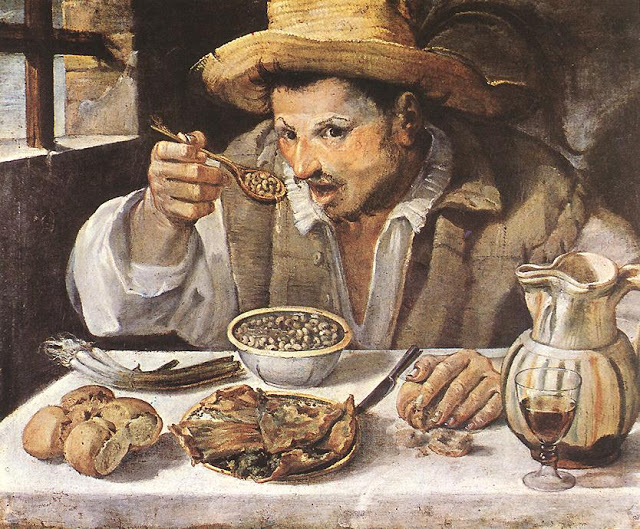
Most people in the early modern world—not just in Europe, but everywhere—were illiterate farmers and pastoralists whose diet was hyper-minimalist by contemporary standards. This is not to say that their food tasted bad, necessarily. But it was clearly very simple, and very starch-heavy. From China to Europe to sub-Saharan Africa, gruels and stews made out of staple grains or legumes were the daily fare. Italian farmers weren’t eating eggplant parmesan or spaghetti with meatballs. They were typically eating either boiled beans or grains, day after day after day. The acute eyes of Bruegel the Elder captured one example of this universal food of the premodern peasantry. In Bruegel’s The Harvesters, a team of peasants is taking a break for a mid-day meal which seems to consist entirely of bread and bowls of what I am guessing is a wheat-based gruel, something akin to Cream of Wheat. The jugs they’re drinking out of probably contain small beer.

Cheetah Robot

MIT’s Cheetah 3 robot — an upgrade to the Cheetah 2, can now leap and gallop across rough terrain, climb a staircase littered with debris, and quickly recover its balance when suddenly yanked or shoved — all while essentially blind. The 40 kg robot is intentionally designed to do all this without relying on cameras or any external environmental sensors. The idea is to allow it to “feel” its way through its surroundings via “blind locomotion,” (like making your way across a pitch-black room), eliminating visual distractions, which would slow the robot down.