after an unfortunate hiatus, some fans have brought the original flava back. i give you.. supergreg!!
Tag: images
Quines
:quine: /kwi:n/ /n./ [from the name of the logician Willard van Orman Quine, via Douglas Hofstadter] A program that generates a copy of its own source text as its complete output. Devising the shortest possible quine in some given programming language is a common hackish amusement.
<xsl:stylesheet version=”1.0″ xmlns:xsl=”http://www.w3.org/1999/XSL/Transform”>
<xsl:output method=”xml” encoding=”utf-8″ />
<xsl:variable name=”s”></xsl:variable>
<xsl:template match=”/”>
<xsl:value-of select=”substring($s,1,148)” disable-output-escaping=”yes” />
<xsl:value-of select=”$s” />
<xsl:value-of select=”substring($s,149)” disable-output-escaping=”yes” />
</xsl:template>
</xsl:stylesheet>
quite amusing, yet ultimately boring as it always reconstructs only itself. it would be cool to add in some mutation, but apparently the problem is not so easy to solve:
It may be that the problem is not amenable to being solved by evolutionary methods. There may be too many local maxima, which give fair to middling scores, but no good way to step from a local maximum to the global maximum without ever getting a lower score.
It may be that the randomprog and mutate functions produced too many offspring with syntax errors or other obvious problems, so that it would have taken longer to generate an optimum solution that I had patience.
JohnnyVon, being rooted more firmly in the (simulated) world of physics and biology, might fare better.
JohnnyVon is an implementation of self-replicating machines in continuous 2D space. 2 types of particles drift about in a virtual liquid. The particles are automata with discrete internal states but continuous external relationships. Their internal states are governed by finite state machines but their external relationships are governed by a simulated physics that includes Brownian motion, viscosity, and spring-like attractive and repulsive forces. The particles can be assembled into patterns that can encode arbitrary strings of bits. We demonstrate that, if an arbitrary “seed” pattern is put in a “soup” of separate individual particles, the pattern will replicate by assembling the individual particles into copies of itself. We also show that, given sufficient time, a soup of separate individual particles will eventually spontaneously form self-replicating patterns. We discuss the implications of JohnnyVon for research in nanotechnology, theoretical biology, and artificial life.

etoy.tanks are in town
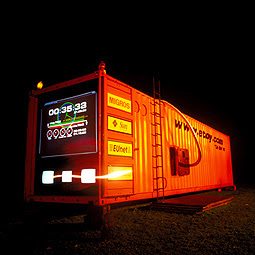
today, july 10th, the etoy.CORPORATION will place 2 etoy.TANKS prominently in the heart of zurich’s most vibrant center. agents from throughout the world tune in to supervise the performance and ensure security for the valuable cargo. in addition there will be airborne support to guarantee smooth execution of this logistically challenging and meticulously planned operation.
historical FOAF

Mark Lombardi (1951-2000) draws on the major political and financial scandals of the day to create large-scale linear diagrams that at first glance look like celestial maps; a closer reading reveals the intricate web of connections that lurk beneath current headlines.
puzzle pieces
.jpg)
.jpg)

i’m spending my weekend at the KAYWA office. there is lots to do before the moblogging conference: texts need to be written, designs to be finished, helpful explanations drawn, claims formulated. lots of fun. here is a teaser:
Founded by a group of weblog enthusiasts in 2003, KAYWA offers products that make publishing on the Internet effortless, mobile and personal. Kaywa believes in the power of weblogs to fundamentally change communication patterns and social networks. It is our mission to help this transition towards a more expressive Internet by creating products that empower users to publish. With KAYWA, users can finally write back.
lunch with mark woodward

.jpg)
.jpg)
thanks mark.
I recently attended the OSCOM 3 Conference at Harvard, and it was superb. There is more BPI (brainpower per inch) at Oscom than any conference I’ve ever attended.
Next xopus
,imagWe at Q42 have been extremely busy making Xopus ready for release. At
this moment we feel confident we have a worthy beta version. At the end
of this week we will ship this beta to you and others.
congrats guys, i’m looking forward to trying it out.
UPDATE sjoerd has a picture of the debugging process. next time im there, i will urge these guys to try CVS 🙂 oh, and cool debugging technique.
Farm life
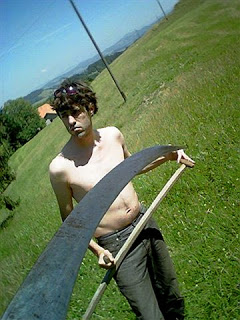
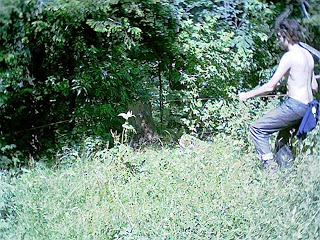
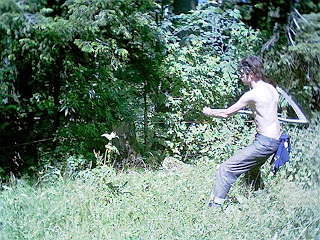
we spent saturday at a farm.



local exploring
i keep being surprised by what zurich has to offer. being raised here, i would think i have kinda seen it, but no. on friday i was at rieter park, a lavish park overlooking lake zurich.
followed by a swim under the fountain at the enge harbor. very relaxing, and keeps visits to a massage therapist away 🙂
chicken run
via roland
The PH2000 mechanical chicken harvester can catch 150 birds a minute
 Gregor J. Rothfuss