Tag: images

Comparametrics

image stitching and correction algorithms

A particular class of functional equations, called comparametric equations, is introduced as a basis for quantigraphic image processing. Comparametric equations are fundamental to the analysis and processing of multiple images differing only in exposure. The well–known “gamma correction” of an image is presented as a simple example of a comparametric equation, for which it is shown that the underlying quantigraphic function does not pass through the origin.

For this reason it is argued that exposure adjustment by gamma correction is inherently flawed, and alternatives are provided. These alternatives, when applied to a plurality of images that differ only in exposure, give rise to a new kind of processing in the “amplitude domain” (as opposed to the time domain or the frequency domain).

Sakku

via etoy and bernhard comes word of a new messenger bag with solar panels. while not powerful enough to charge your laptop, it will do fine with your other gadgets.

what is especially interesting to me is that sakku is a swiss startup. i have outlined before why switzerland is going down the drain. in fact, i sometimes tell smug swiss people that i am an economic refugee. all the more uplifting if a startup is ignoring the naysayers and delivering a cool product.

Linkedin

Recently, I have been spending some time on linkedin. Of all the social networks out there, it has the most appeal to me: There is less nonsense on it, and people are motivated to use it for work. Bergie had this link to an essay on linkedin as a platform play that I wanted to comment on.

full public profile

There’s still a tragically high barrier to entry: without logging in to LinkedIn, you can only view a summary of the profile. This is total crap: it doesn’t make it easy for me as a user to extend the reach of LinkedIn. I’d love send that URL as my resume to people, but if they have to create an account to log in to LinkedIn, I’m not going to do it.

My public linkedin profile is already in the top 20 google results for my name. Making this more full-fledged would allow people to better take charge of their public image on the internets (something increasingly important)

show linkedin data elsewhere

For example, it’d be awesome if there was a JavaScript include that would list people’s endorsements of you. I’m sure people would love to put that in their blogs. And it’d be great for the coders out there if all the data in LinkedIn could be retrieved with simple REST calls that returned simple, XML formatted data-documents.

Linkedin has a lot of (currently dormant) currency it could use to become an important platform for user ratings. Just like Ebay has its seller / buyer ratings, the endorsements are quite valuable, but are locked into Linkedin today. The system would need better ways to deal with people who game the system, but it is off to a terrific start.

linkedin RSS feeds

It’s frankly shocking that there aren’t LinkedIn feeds for events that occur in your social network. When someone gets a new job, you get an endorsement, someone else gets an endorsement, someone adds a new contact…all those activities that people may want to respond to are locked up in the system.

We are all busy, and who remembers to always go check the Linkedin homepage for new things happening? That’s so 1998.

company ratings

You could even imagine something like this: people can write in their experiences applying for jobs at different companies. When you ask LinkedIn to send you resume to a job, it could tell you people’s over-all feel for that company. That’s the kind of collective/emergent wisdom that only a hosted application like LinkedIn can do.

Companies are people too 🙂 Why not make it possible to see how a company is viewed overall?

company drill-downs

Speaking of hosted applications, LinkedIn could become the org-chart application for companies everywhere. Most large companies I’ve worked at had that funky applet you could go to in the intranet and pan through the org-chart. LinkedIn already has a ton of data that people have agreed to put in the clear. Instead of those boring, information skinny org-charts you’re used, LinkedIn could provide a much richer, and fatter org chart. Want to see endorsements that people have given Jane in IT? Does the fact that Jack has no endorsements mean you should avoid giving him The Big Project?

I am sure a lot of people are already using Linkedin to reverse engineer org charts from companies they do business with. Why not make this easier? If you are concerned about headhunters, offer a more competitive / attractive work environment. Is Linkedin listening? I’d sure like to see these things implemented. What do you think?
2006-12-04: LinkedIn, the MySpace for adults. Puff piece. They criticize the network spammers (mostly HR people), but offer no solution. They also think it is at a tipping point. I think so too. Much preferred over the crappy german xing

An investment from Hoffman would be the last piece of angel funding the startup needs. Now the 2 entrepreneurs must find people to help take their company to the next stage. “We are looking for a set of advisers who really understand the arc that a startup goes through. We need to identify who in our network can help us.”

2006-12-18: in which linkedin kills the headhunter middleman

They have an amazing job posting service where you can post the job on LinkedIn for around $150 and then it gives you the option of sending the not to people on your contact list. For someone like me that means I get to send to my best contacts easily.

2007-01-15:
2008-01-05: LinkedIn Data Export. This worked great with gmail import. Now I have updated contact info for my whole network. Gmail did a nice merge for email addresses I already had.
2013-09-07: LinkedIn Spam. On the “thought leadership” spam that has infected linkedin. I’m still waiting for linkedin to be useful someday. It has been years now. I liked this comparison:

standing around on garish hotel ballroom carpet with a plastic cup of cheap chardonnay in one hand and a stack of business cards in the other.

2013-10-25: LinkedIn MITM email.

LinkedIn Intro is a new service by LinkedIn, adding inline data to all your iOS emails. “But how can they read my emails?!” you ask: you use the best encryption money can buy! Well, you just need to install one little security certificate… after all, how much of a a bad idea can it be? LinkedIn are well-known for their good security practices!

2022-10-20: And now it’s all fake accounts, the eventual fate of all social networks.

On October 10, 2022, there were 576562 LinkedIn accounts that listed their current employer as Apple Inc. The next day, 50% of those profiles no longer existed. A similarly dramatic drop in the number of LinkedIn profiles claiming employment at Amazon comes as LinkedIn is struggling to combat a significant uptick in the creation of fake employee accounts that pair AI-generated profile photos with text lifted from legitimate users.

Yahoo

What moron would expire news article URLs when disk space is plentiful and cheap? Apparently Yahoo doesn’t want me to use del.icio.us. The sad thing, just as with their RSS mess, is that they have people working for them who know better. That place needs it’s own mini. Too many clueless middle managers.
2006-09-29: The red tape saga at Yahoo continues.

“NOW let’s just pause for a second.” It is the 4th pause for thought that Terry Semel, chairman and chief executive of Yahoo!, has requested in 10 minutes. He is trying to marshal various arguments to prove that his firm, the world’s largest internet company by visitors to its website, has a coherent and winning strategy compared with Google, a phenomenally successful search engine. With only slightly bigger revenues, Google has 3.5x the market value of Yahoo!. 2x in 3 months Wall Street has dumped the shares of Yahoo! and widened the gap.

2006-10-09: Good article on the many problems at Yahoo.

But the problems at Yahoo go beyond advertising. From video programming to social networking — areas of interest to users and advertisers alike — the company is losing its initiative. And each time a product fails in the market or is late, Yahoo loses some ability to do more deals and hire more talented employees. The shares are down 38% this year, sending some employees out the door in search of better shots at stock market wealth.

2006-10-14: Who indeed

I think the better buyer is a media company. News Corporation is the one that most comes to mind. Rupert has shown that he’s serious about the Internet and that he is not afraid to make big bets. It would be highly dilutive since News Corp itself has a $65B market cap, but it might be accretive to earnings given that News Corp trades at a higher EBITDA multiple than Yahoo! now. The one reason I think its most unlikely is that News Corp has shown an interest in working closely with Google and buying Yahoo! would take them in an opposite direction.

2006-11-23: Heh. Snark at the incompetence manifest in the manifest.

The latest example from Yahoo!, the world’s largest internet company by some measures, reverses the trend. Brad Garlinghouse, a manager just senior enough to be noteworthy, has put forth a “Peanut Butter Manifesto”, which was helpfully “leaked” to the Wall Street Journal. It was meant as part St Crispin’s Day speech to rally the troops, part corporate analysis of Yahoo!’s many troubles, part turnaround plan—and, it seems, part publicity stunt. But it turned out to be a redundant series of platitudes, split infinitives, clichĂ©s and mixed metaphors.

2006-12-03: Problems not just with monetization, but basic search, still:

Y! may have 28% of all Internet searches, but for some reason Y! does not generate 28% of Internet traffic.

2006-12-07: Cultural conflict

The story about Braun taking a big corner conference room at Y! HQ and turning it into an office (when even Jerry Yang has a cube out amongst the ‘rank and file’) is a totally rich illustration of SoCal vs NoCal, uh, charm.

2006-12-11: “leaked” like peanut butter?

Facebook flatly rejected the $1B offer, looking for far more. Yahoo was prepared to pay up to $1.62B, but negotiations broke off before the offer could be made.

2007-01-18: Time for Plan B at Yahoo. Funnily self-referential
2007-02-25: +1

At Yahoo, the marketers rule, and at Google the engineers rule. And for that, Yahoo is finally paying the price.

2007-04-19: Nice 1 page summary of an endless list of problems.
2007-06-11: 80 VPs? That’s crazy, and 70 too many.

Yahoo disputes the notion that it is losing people at an unusual rate, saying that it had named 80 vice presidents worldwide this year

2007-07-25: Now there’s a surprise. I am puzzled why good people like Micah Dubinko can stand the nonsense over there.

My time at Yahoo! wasn’t super productive – I had a lot of ideas, but zero ability to get them implemented

2007-09-12: Oy. Talk about a preference for pain.

I’m not going to lie to you, it’s rough going right now. We get smacked around by the media. It’s been a while since we had a really big, notable win. I think morale at the company is low, the future uncertain and the food still sucks (although, I’ve had worse). But despite that, we had a record turnout for our last internal hack day. We had so many people with ideas that we had to completely change the format of the event because the campus could no longer scale to meet our demands. There is still plenty fight in this company and we have no shortage of asses to kick. So lace up all you Yahoo!’s
the ass won’t kick itself.

2007-10-03: 50? Try 500. No wonder they can’t get anything done.

People at Yahoo figure out the average number of employees per VP. The number seems to be around 50.

2007-10-06: Could be worth as much $45 per share with a dramatic overhaul that would include outsourcing its paid search, cutting staff by 25% and restructuring its graphic display advertising.
2007-11-30: I especially liked the one about the 300 VPs.

2007-12-11: Traffic down

web search queries on Yahoo! were down 10% from November 2006

2008-02-01: Comarketing

Think about it… Yahoo doesn’t mean keyboards. They didn’t do plastics or ergonomic research or think of some insight about key travel distance. The message was that Yahoo was willing to put their name on anything.

2008-02-15: I think its related to education levels. Dumb people can’t tell if they are getting crap results.

Yahoo is strong in “struggling societies,” “blue collar backbone,” and “remote America,” where as Google obtains higher use in “small town contentment,” “affluent suburbia,” and “upscale America.”

2008-04-21: Simple features take 2 years to launch indeed.
2008-07-01: Can I haz flickr / del.icio.us?

Microsoft is trying to put together a sort of take-over coalition where Microsoft would get Yahoo’s search while AOL or News Corp would acquire other parts of Yahoo. However, it doesn’t seem all that likely.

Post-sourceforge world

People have asked the question “What if SourceForge disappeared?? for years now, but I have to wonder if we should be asking this question again. Now, SourceForge has its warts, but it’s ultimately a beneficial service. And, even if they did disappear, it’s highly unlikely that the open source movement would be handicapped for any real length of time. But here’s why I ask the question:

phil goes into some more detail, wondering whether GOOG or YHOO might be prepared to take over. Maybe the woes of sourceforge can bring some long-needed fresh air though:

I think that the problem with SourceForge is that they are providing 1999-era functionality based on a business model that really is not much more than an afterthought after the collapse of their hardware business. Consequently, the core functionality in the SourceForge project hasn’t changed all that much in the past 6 years. All the projects on SourceForge are effectively partitioned
 we don’t see any tools for figuring out code reuse possibilities or anything particularly innovative.

3 years ago, i researched the state of the art of open source production, and developed a matrix to map activities, actors and tools. To say that there are many areas of improvement in the way open source software is produced is an understatement. The obvious observation that there are a power laws in effect with regards to quality and popularity of a project makes me wonder what can be done to improve life for the countless small projects out there that have neither their act together code-wise, nor any audience. A recent study found that 81% of sourceforge projects are inactive, and only about 0.05% innovative.

A considerable subset of these projects deserves to do better on both fronts with the right tooling. Done correctly, a post-sourceforge integrated site could act as a large-scale lab for novel collaboration and software engineering techniques. Tool vendors might be willing to integrate their technology in return for widespread usage and name recognition, and the rest of us might finally break free of the anachronisms of mailing lists and other 1980s-era solutions.

Furthermore, the site could be made to emit statistical data for open source research. Most academic papers in the field already look at sourceforge anyway, if they had a way to get better data, they might actually arrive at some useful conclusions, including reuse patterns, social network analysis, and many more. Such a site could therefore be a down payment on discovering the finer points of peer production, slated to become ever more important in the larger economy.

Unconferences are so 2003

New York Times-bestselling author Thomas Barnett comes to Second Life in avatar form to speak on his Blueprint for Action– October 26, 11:30-13:00. He’ll address us from the floor of a virtual UN building, speaking to an audience, one hopes, that’ll include Residents from around the globe– those in the Functioning Core, those in the Seam states, and with luck, even those from the Non-Integrating Gap itself.

barnett is very interesting, and this setting doubly so. i’ll most likely be there (as Kichiro Kawabata).
kichiro kawabata

KAYWA still around


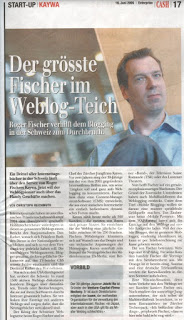
My former startup KAYWA got a nice puff piece in the june 16th issue of CASH, a swiss business magazine. Now if only they would not be so incompetent with keeping their customer data around. My 2003 burning man photo collection which I uploaded to their servers for promotional purposes is still missing after repeated emails to their CEO.