McCain’s staff used his template, but didn’t give Davidson credit. Worse, they use images that are on his server, meaning he has to pay for the bandwidth used from page views on McCain’s site. Davidson decided to play a small prank on the campaign this morning as retribution. Since he’s in control of some of the images on the site, he replaced one that shows contact information with a statement: Today I announce that I have reversed my position and come out in full support of gay marriage…particularly marriage between 2 passionate females.
Sun, which has its Blackbox containerized data center out on tour, is suddenly facing some tough competition in the burgeoning trailer park computing market. Rackable Systems is rolling out a copycat product called Concentro that may just outdo the original. Besides sporting a most excellent name – if Flash Gordon had a computer, it would be called Concentro – Rackable’s portable data center comes in a 12m shipping container, making Sun’s 6m model look downright wimpy, and it can be packed with 9600 processing cores or 3.5 petabytes of storage. Best of all is the interior. Check it out:
another “cluster in a container”. see also, microsoft is stealing a page from the sun playbook.
The Los Angeles Fire Department has has a Flickr account. It has some great photos including a car in a pool along with various on-scene photos. LAFD even geo-tags their photos so they can be seen on a map
Shining light on the biggest waste of taxpayer money ever. 2007-04-04: In celebration of the new annotated Google Maps, I have created 2 maps that show your taxes at work:
eliminating farm subsidies in the first world and liberalizing trade would produce annual benefits of $2.4t, with 50% of that accruing to the third world.
2008-06-10: Nice! They now have their own maps, starting with Sweden. Fight the pork.
The photographs indicate the way in which a cook marks his orders. These secret plate markers allow a Waffle House cook to simultaneously prepare multiple customer orders at once. Let me give you an example. If I were to order 3 scrambled eggs, dry wheat toast, and hash browns, the waitress would face the grill and yell out loud – “Mark: Triple scrambled dry wheat plate.” The cook would then quickly take a large dinner plate, turn it sideways, and place a tub of jelly upside down at the 6 o’clock position. The 6 o’clock position indicates scrambled eggs, and the jelly upside down means wheat toast. I am not sure how to mark “dry” for the toast, or how to indicate hash browns versus grits.
2C02 + 2e- + H20 -> C2O3H2 + O2 the product is a simple sugar that could be used in a variety of ways, and the removal of C02 from the atmosphere would be great for countering global warming.
If you seeded the algae with iron dust, you could radically accelerate the rate at which it consumed CO2. The money quote: “Give me a half tanker of iron, and I will give you an ice age.”
2011-01-23: Genocide carbon capture. The mongol conquest killed 40m people and reabsorbed 700m tons of CO2 due to reforestation. 2012-10-24: CO2 negative fuels. What Iron fertilization does for geoengineering the oceans, this contributes to carbon sequestration on land, with the following claims:
1% of planetary landmass to drive all cars
2% to bring net CO2 emission to 0 by 2030
bring 100M people out of extreme poverty
The crucial difference, this proposal makes revenues instead of the $30B / year the iron fertilization would cost.
2013-05-10: Geoengineering is no longer a theory, for better or worse.
In a large ocean eddy west of Haida Gwaii the project has replenished vital ocean mineral micronutrients, with the expectation and hope it would restore 10K square kilometers of ocean pasture to health. Indeed this has occurred and the waters of the Haida eddy have turned from clear blue and sparse of life into a verdant emerald sea lush with the growth of a 100M tons of plankton and the entire food chain it supports. The growth of those tons of plankton derives from vast amounts of CO2 now diverted from becoming deadly ocean acid and instead made that same CO2 become ocean life itself.
2014-07-10: The first planet we’ll terraform will be our own.
Once you know what plankton can do, you’ll understand why fertilizing the ocean with iron is not such a crazy idea
2014-10-09: Greening deserts are very bad for the oceans 2014-12-13: For Geoengineering
it’s not perfect and there are some things it won’t do. Turning down the sun does nothing for ocean acidification. But it looks like it can cut 80% of the total variation in climate, which is really stunning.
the deserts are becoming more green and are producing less dust. This is driving the steady reduction of iron into the oceans by ~1% per year. 42% more CO2 in the atmosphere means that plants in the desert need to breathe less and keep more water. Less dust from the desert means less iron into the ocean. Iron shortage in the ocean is the key factor that is reducing algae and plankton in the ocean.
Engineers have designed enzyme-functionalized micromotors the size of red blood cells that rapidly zoom around in water, remove CO2, and convert it into a usable solid form. The proof-of-concept study represents a promising route to mitigate the buildup of carbon dioxide
2017-08-01: 9% Ocean kelp farm. Now that’s geoengineering:
There is a proposal to use 9% of the ocean’s surface for massive kelp farms. The Ocean surface area is 360m km2. This would offset all CO2 production and provide 0.5 kg of fish and sea vegetables per person per day for 10b people as an “incidental” by-product. 9% of the world’s oceans would be equivalent to 4.5x the area of Australia.
These methods will be faster to scale than complicated and industrial intensive carbon capture at coal and natural gas plants and factories and creating massive national and global pipelines to move the captured gas into underground storage.
Suberin has a lot of unique properties that could make it useful for storing CO2 from the atmosphere. It’s primarily composed of CO2 and it’s not biodegradable, which means it will last a few 1000 years. You need 5% of the world’s farmland growing highly-enriched suberin crops to fix 50% of all the CO2 that we’re putting up there.
The great Azolla boom was so successful that it lasted for 800k years, and is now known to paleobotanists as the “Azolla event.” Green plants suck up carbon dioxide; Azolla is particularly good at doing so. Over that period, it sequestered 10t tons of CO2 from the Earth’s atmosphere, or 200x the total amount of CO2 humans currently release into the atmosphere every year. The plant’s shape contains specialized little indents where it houses cyanobacteria, a form of blue-green algae that acts as a nitrogen fixer—that is, converting nitrogen in the atmosphere into a fertilizer. The fern hosts the bacteria, providing it with sugary fuel, and in doing so, helps make its own fertilizer.
Right now, the Salk team is at the beginning phases of this project. They’ve identified genetic pathways that control for the 3 traits they want to bring out in plants: increasing suberin, enlarging root systems, and making the roots grow down deeper into the ground. Now they will begin to test combining those 3 traits in a model plant called arabidopsis in the lab, before moving on to crop plants like corn, soybean and rice. They hope to have prototypes of souped up versions of major crops within 5 years, and are already in talks with agricultural companies to partner on testing them.
Scientists propose a framework for modifying AC units to suck in CO2 and spit out fuels for use in vehicles like cargo ships.
2019-05-02: What would it look like if a small group of billionaires took unilateral climate action through solar radiation management?
The Triumvirate, as the 3 billionaires came to be known, was used to having the world’s attention. 1 of them had led the charge to colonize Mars, landing 2 probes on the Red Planet and, almost as a sideshow, a crew on the moon in 2026. Another had cleverly engineered his way around the slowing of Moore’s law, and by 2029 owned 60% of the world’s server space. The 3rd had started with a social media platform before selling high and expanding into cars in the Philippines and Indonesia, simplified mobile payment systems in Africa, and other projects. Their extra-boardroom activities, alternately adulated and mocked across the world’s Twitter feeds, ranged from the absurdly dangerous (BASE jumping off an erupting volcano) to the simply absurd (Periscoped comparisons of McDonald’s fries in 63 countries).
From the time of the industrial revolution, humanity has generated 2.3t tons of CO2 and we now have 1t tons more CO2 in the atmosphere than there was around 1800. Where did the other 1.3t tons of CO2 go? 50% was absorbed into the soil and plant mass and 50% went into the ocean. Our CO2 problem would be 2x as bad if not for the soil, trees and ocean. By doubling the existing CO2 absorption process of the soil, plants and ocean we can offset the excess CO2 and other gases. This is not just the 50b ton per year amount generated by the vehicles, buildings and factories but the whole 1t tons.
Integrating SRM and other geoengineering methods under the UN Framework Convention on Climate Change (UNFCCC) regime can make those methods legitimate objects of global climate governance. The UNFCCC could also facilitate trust-building and surveillance measures to lessen the concern that a handful of the largest and richest countries might seize the reins of planetary modification. The convention and its associated regime would offer a framework for “climate-bargaining” between countries with the means and will to undertake geoengineering measures and those that lack sufficient resources or prove reluctant to undertake such activities. The UNFCCC and other institutions, such as the World Meteorological Organization, should play an important role in sharing information and best practices, serving as international clearinghouses for SRM and other geoengineering research. Project funders and national research organizations can also play an integral role by incentivizing adherence to codes of conduct for responsible SRM research.
Although solar geoengineering is typically conceived of as centralized and state-deployed, we explore highly decentralized solar geoengineering. Done perhaps through numerous small high-altitude balloons, it could be provided by nonstate actors such as environmentally motivated nongovernmental organizations or individuals. Conceivably tolerated or even covertly sponsored by states, highly decentralized solar geoengineering could move presumed action from the state arena to that of direct intervention by nonstate actors, which could in turn, disrupt international politics and pose novel challenges for technology and environmental policy. We conclude that this method appears technically possible, economically feasible, and potentially politically disruptive.
Today, after a rigorous search and review by a panel of independent scientific experts, we’re excited to announce our first purchases. Our request for projects garnered a wide range of negative emissions technologies which came in 2 broad categories.
2020-11-26: Lanternfish are the largest animal migration in the world, and removes 50% as much CO2 from the atmosphere as humanity emits from the burning of fossil fuels.
2020-11-27: Stripe is buying carbon removal to bring it down the cost curve. It needs to get at least 3x cheaper to scale. 2021-01-19: A snapshot of developments in carbon removal, with the typical NYT hand wringing and concern trolling thrown in:
“It’s a chicken-or-egg problem. The best way to bring down the cost is to start deploying these technologies at scale. But until there are actual customers, no one’s going to build them.”
To help break the impasse, Stripe announced in 2019 that it would begin spending at least $1M annually on carbon removal, without worrying about the price per ton initially. The goal was to evaluate companies working on promising technologies and offer them a reliable stream of income.
Over the last 20 years, supported by an army of volunteers, the project team has sown nearly 75M seeds. Around 36 km2 of coastal bays are now blanketed with eelgrass, which has improved water quality, increased marine biodiversity and helped mitigate climate change by capturing and storing CO2. Despite covering less than 0.2% of the ocean, it is responsible for 10% of the ocean’s ability to store CO2. It provides a vital habitat for marine life, boosts commercial fishing, helps purify water, protects coastlines and even traps and stores microplastics.
A new generation of soil studies powered by modern microscopes and imaging technologies has revealed that whatever humus is, it is not the long-lasting substance scientists believed it to be. Even the largest, most complex molecules can be quickly devoured by soil’s abundant and voracious microbes. The magic molecule you can just stick in the soil and expect to stay there may not exist. “Now it’s really clear that soil organic matter is just this loose assemblage of plant matter in varying degrees of degradation.” Some will then be respired into the atmosphere as CO2. What remains could be eaten by another microbe — and a third, and so on. Or it could bind to a bit of clay or get trapped inside a soil aggregate: a porous clump of particles that, from a microbe’s point of view, could be as large as a city and as impenetrable as a fortress. Studies of carbon isotopes have shown that a lot of carbon can stick around in soil for centuries or even longer. If humus isn’t doing the stabilizing, perhaps minerals and aggregates are.
Getting from 4000 tons a year to 5b tons quickly enough to help limit climate change may seem fanciful but there is an intriguing comparison with the world’s first commercial wind farm, which opened in 1980 on Crotched Mountain in New Hampshire. That project consisted of 20 turbines with a combined output of 600 kW. In 2020, the wind capacity installed around the world was 1.23m times larger, at 740 gigawatts. Increasing Orca’s annual output at the same rate would yield a CO2 removal capacity of 5b tons by around 2060. “That is exactly what climate science asks us to do to achieve climate targets”. The challenge will hinge on reducing costs, which are now $600-$800 per ton. Increased output could bring those costs down to $200-$300 per ton by 2030, and $100-$150 somewhere around 2035. DAC would already be competitive if it received the subsidies that helped electric vehicles and solar panels deploy and flourish. A fundamental difference from wind and solar power is that they were ultimately driven by the profit motive because once subsidies had helped to make them competitive they were producing a valuable asset: cheap electricity.
The growing resources available to support carbon capture technologies along with domestic and foreign policy changes and increasing levels of public support make it likely that we will see significant commercialization of carbon capture technologies in the next 10 years. Carbon capture technologies fill 1 of 2 roles: 1) reducing CO2 emissions from industrial processes, making them more carbon neutral, or 2) removing CO2 from the air, acting as a negative emissions technology (NET).
Large projects (>1 million tonnes of CO2 per year) that reduce emissions by capturing CO2 from industrial sources and non-utility power plants will be a steady but slow area of growth, given long project timelines and the large quantities of capital required (>$500m). With only the existing US tax credits to incentivize carbon capture, such projects will be led by large corporate entities (likely oil & gas majors), rather than electric power utilities or midsize companies.
At a carbon tax level of $50–60 per metric tonne of CO2, removing CO2 from the emissions of large industrial facilities could be cost-neutral with today’s technologies. Liquid amine scrubbing technologies will likely remain the technology of choice for CO2 capture from large industrial sources, unless there is significant process innovation around solid adsorbents or membranes. Svante, a leader in carbon capture process innovation, is a possible disrupter, and research continues into fluidized beds and other types of processes that could make CO2 capture with solid materials more cost effective for gases with high CO2 contents (5–30% CO2).
The cost of directly capturing CO2 from air has the potential to fall significantly due to innovations in solid materials for CO2 capture, material heating and cooling strategies, and optimization of carbonation technologies. This field is currently led by new companies rather than large established ones: specifically Climeworks and Carbon Engineering are currently deploying carbon capture plants. Business model innovation may enable “crowdsourcing” or corporate funding of capturing CO2 directly from the air if capture costs can be reduced to $100 per metric tonne or less. In all cases, the ability to site carbon capture systems near pipelines, storage sites or other CO2 users is critical.
If small scale CO2 capture plus utilization or chemical conversion technologies mature, CO2-to-products plays at smaller scales of 10k–100k metric tonnes of CO2 per year could become an area of rapid growth. These technologies require either very low capture costs ($40/tonne or less), or the ability to use non-pure CO2.
The ocean currently soaks up 30-40% of all humanity’s annual carbon emissions, and maintains a constant free exchange with the air. Suck the carbon out of the seawater, and it’ll suck more out of the air to re-balance the concentrations. Best of all, the concentration of carbon dioxide in seawater is 100x greater than in air.
Previous research teams have managed to release CO2 from seawater and capture it, but their methods have required expensive membranes and a constant supply of chemicals to keep the reactions going. MIT’s team, on the other hand, has announced the successful testing of a system that uses neither, and requires vastly less energy than air capture methods.
The team projects an optimized cost around US$56 per ton of CO2 captured – although it’s not fair to compare that directly against full-system direct air capture costs. The study cautions that this does not include vacuum degassing, filtration and “auxiliary costs outside of the electrochemical system” – analyses of which will have to be done separately. Some of these, however, could potentially be mitigated by integrating the carbon capture units in with other facilities, for example desalination plants, which are already processing large volumes of seawater.
2023-03-23: Another approach that can work with seawater
CO2 is relatively diluted in the atmosphere at 400 ppm. So big machines that require large amounts of energy are needed to both absorb and discharge the CO2. This new approach, using off-the-shelf resins and other chemicals, promises far greater efficiency and lower cost. The new hybrid absorbing material was able to take in 3x as much CO2 as existing substances. “To my knowledge, there is no absorbing material which even at 100k ppm, shows the capacity we get it in direct air capture of 400 ppm”. This new approach can remove CO2 for less than $100 a ton. With the addition of some chemicals the captured CO2 can be transformed into bicarbonate of soda and stored simply and safely in sea water.
What would it take to start making a serious dent in atmospheric CO₂? Say we shot for 80 gigatons of olivine a year, locking away 100 gigatons of the stuff when fully weathered. Unlike many proposals for carbon sequestration, olivine intervention is not contingent on undiscovered or nascent technology. Let’s take a look at the process through the lens of an increasingly small grain of rock.
Once a suitable olivine formation has been located, quarrying rock out of the formation is cheap. Even in high-income countries like Australia or Canada where mine workers make top-notch salaries, the cost of quarrying rock and crushing it down to gravel size is $3 / ton, and it requires very little energy. Since reversing global warming would entail the biggest quarrying operation in history, we might well expect costs to drop further.
Depending on the deposit, haul trucks might prove unnecessary; it may be most cost-effective to have the crusher and mills follow the front lines. The wonderful thing about paying people to mill rocks is that we don’t have to know for sure from our armchair; the engineers tasked with keeping expenses to a minimum will figure it out as they go.
What is quite certain is that the vast majority of that expense, both financially and in terms of energy, comes not from mining or crushing but from milling the crushed rock down to particle size.
Though there’s no way to know for sure until and unless the sequestration industry reaches maturity, a reasonable upper estimate for capital investment is $1.60 per ton of CO₂ sequestered, giving a total cost per sequestered ton of $9. The resulting bill of $900b per year might sound gargantuan – but it’s worth remembering that the world economy is a $100t / year behemoth, and each ton of carbon dioxide not sequestered is 20x as costly.
2023-06-19: For scale, you want a liquid process, not gas or solid.
Demand for direct air capture depends on government policy, “green” hydrogen prices, the success of point source capture, and the acceptance of more creative sequestration technologies. Government policy might encourage DAC with subsidies or by taxing carbon. The cheaper green hydrogen is, the more competitive chemicals will be. Point source capture is a direct substitute for DAC in providing chemical feedstock and sequestration if it becomes easier to permit wells. Potentially cheaper interventions like mineral weathering can replace carbon sequestration but aren’t acceptable chemical feedstock.
The carbon capture method depends heavily on project needs. Burying carbon is method-agnostic, while feedstocks need a certain quality and quantity. Solid sorbents will likely rule for small-scale applications, but traditional methods using big pipes and fans get more competitive as demand increases. Energy availability is also an influence. “Baseload” sources favor traditional methods, while solar PV works better with solid sorbent systems that can concentrate energy use during peak daylight hours.
Cheaper carbon capture encourages government policy and industrial adoption. $1000/ton is a non-starter. Chemicals become competitive at $50-$100/ton while capture and sequestration become cheaper than the cost of pollution. These prices are achievable, and climate change will be just another scare solved by human ingenuity.
Because the earth’s crust is thinner than usual along the rift, it has vast geothermal potential. The American government reckons Kenya alone could generate 10gw of geothermal power, 10x the amount it currently produces. A by-product of such power stations is plenty of waste steam, which can then be used to heat dac machines. Moreover, since close to 90% of Kenya’s power is renewable, the electricity these machines consume does not contribute to more global warming.
Capturing CO2 is just part of the process. Next it has to be safely locked away. The rift’s geology is particularly good for this, too. It has bands of porous basalt (a volcanic rock) that stretch across 1000s of km2. This makes the region “ideal” for carbon capture and storage. After CO2 has been sucked from the air it is dissolved in water (in the same way one would make sparkling water). This slightly acidic and bubbly liquid is then injected into the rock. There it reacts with the basalt to form carbon-rich minerals—in essence, rocks—which means the gas will not leak back into the atmosphere.
Regulations imposed in 2020 by the United Nations’s International Maritime Organization (IMO) have cut ships’ sulfur pollution by 80% and improved air quality worldwide. The reduction has also lessened the effect of sulfate particles in seeding and brightening the distinctive low-lying, reflective clouds that follow in the wake of ships and help cool the planet. By dramatically reducing the number of ship tracks, the planet has warmed up faster. That trend is magnified in the Atlantic, where maritime traffic is particularly dense. In the shipping corridors, the increased light represents a 50% boost to the warming effect of human carbon emissions. It’s as if the world suddenly lost the cooling effect from a fairly large volcanic eruption each year.
The Sedlec Ossuary also known as the Church of Bones is one of the most unusual chapels you will ever see. If you think that you saw everything in your life, think again! The Sedlec Ossuary is nothing spectacular in the outside. It is a small chapel located in Sedlec, in the suburbs of Kutna Hora, in the Czech Republic. You would think that it is just an average old medieval gothic church.
It’s now been over 15 years since cryonics pioneer, molecular nanotechnologist, and optics buff Dr. Brian Wowk came up with the super-cool idea of phased array optics. Essentially, the plan is to use a 2D array of micron-sized screens to emit light at the precise amplitude and phase necessary to create the illusion of a 3D image. This technology could be fantastically effective: even using binoculars or a telescope, a person looking at the screen would be able to see details “km away” (if the image were high enough resolution) even if the screen were right in front of their face. Outside of tapping into the optic nerve directly, this may be the most convincing display technology ever. The limits of optics. The only problem is that it would require a metric truckload of computing power, but it’s nothing that specialty nanocomputers won’t be able to handle, right? Here is a diagram of the apparatus:
GLIMPSE (Galactic Legacy Infrared Midplane Extraordinaire) is a survey of the inner part of the Milky Way Galaxy in which we reside. The images come from the IRAC instrument on board the Spitzer Space Telescope. These surveys have 100x the sensitivity and over 10x the resolution of previous surveys, allowing us to see stars and dusty objects throughout most of the Galaxy for the first time.
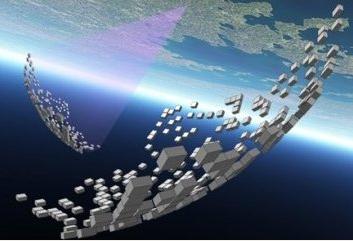
2008-09-19: Space flux telescopes
Holding the mirror pieces together magnetically seems the only practical way to reach the 40m+ diameter required to detect extrasolar planets directly 2009-06-11: The new refraction limit is wavelength / 20, a 10x improvement. This allows imagining of molecules with optical microscopes, and maybe also improvements for telescopes. 2013-12-09: DARPA MOIRE. The thickness of plastic wrap, each membrane serves as a Fresnel lens, which unfold in orbit. The diameter of 20 m would be the largest telescope ever made and gives it ~30x the light-gathering power of the HST.
The US Department of Energy has approved the start of construction for a 3.2-gigapixel digital camera—the world’s largest—at the heart of the Large Synoptic Survey Telescope. Assembled at SLAC National Accelerator Laboratory, the camera will be the eye of LSST, revealing unprecedented details of the universe and helping unravel some of its greatest mysteries.
The Large Ultraviolet Optical Infrared Surveyor is a proposed space telescope that would be 5x as big and 100x as sensitive as the Hubble, with a 12m mirror, and would orbit the sun ~1.6m km from Earth. The revolutionary HDST space-based observatory would have the capability to find and study 10s of Earth-like worlds in detail. The 10 milliarcsec resolution element of a 12 meter telescope (diffraction limited at 0.5 micron) would reach a new threshold in spatial resolution. It would be able to take an optical image or spectrum at ~100 parsec spatial resolution or better, for any observable object in the entire Universe. Thus, no matter where a galaxy lies within the cosmic horizon, we would resolve the scale at which the formation and evolution of galaxies becomes the study of their smallest constituent building blocks—their star-forming regions and dwarf satellites. Within the Milky Way, a 12 m telescope would resolve the distance between the Earth and the Sun for any star in the Solar neighborhood, and resolve 100 AU anywhere in the Galaxy. Within our own Solar System, we would resolve structures the size of Manhattan out at the orbit of Jupiter
VLBI (Very Long Baseline Interferometry) now links radio telescopes spread across the globe into a telescope the size of our planet– extending the array to millimeter wavelengths achieved a further boost in resolving power. The result is a 10x increase in the sensitivity of the world’s millimeter VLBI networks.
In astronomy, adaptive optics refers to a technique where instruments are able to compensate for the blurring effect caused by Earth’s atmosphere, which is a serious issue when it comes to ground-based telescopes. Basically, as light passes through our atmosphere, it becomes distorted and causes distant objects to become blurred (which is why stars appear to twinkle when seen with the naked eye).
The most distant galaxies can be seen by our telescopes but smaller and closer objects in the Oort clouds cannot be seen. The Oort cloud objects are too faint to see with the James Webb Space Telescope, but it should be able to see bright galaxies and quasars even at 13B light years. Detecting Oort cloud dwarf planets would likely take a space telescope with an 11 kilometer mirror.
If we send a telescope to the solar gravitational lens (SGL) point on the opposite side of our sun then light from objects like exoplanets will be focused to provide 100B times more magnification. The Sun becomes a telescope that is 1.4M kilometers wide for the SGL regions.
We could resolve exoplanets around Proxima B to 450-meter resolution using a 1-meter telescope SGL mission. If there was an earth-sized planet around Proxima B, we could resolve to 800 megapixels. We would only be able to resolve 10 square kilometers at a time. The space telescope would have to roam around the einstein-ring image of the target object to assemble the full image. The image would need to be converted from an einstein ring back into the image of the exoplanet. A giant 1.3 kilometer focus line diameter space telescope would be able to resolve an entire einstein-ring image of an earth-sized exoplanet at 100 light years from the right SGL location.
The 1000km baseline arrays would have over 400K times the light collection of the Hubble Space telescope.
2020-07-08: Gravity Lenses. If we send telescopes out to 4 light days we can use the gravity of the sun to amplify the power of telescopes by 100B times. 2021-05-14: Quantum Interferometry
A quantum hard drive at each telescope can record and store the wavelike states of incoming photons without disturbing them. After a while, you transport the hard drives to a single location, where you interfere the signals to create an incredibly high-resolution image. Not everyone thinks it’ll work. “In the long run, if these techniques are to become practical, they will require a quantum network”. Bartholomew counters that “we have good reasons to be optimistic” about quantum hard drives. “I think in a 5-to-10-year time frame you could see tentative experiments where you actually start looking at real [astronomical] sources.” By contrast, the construction of a quantum internet is decades from reality.







 Gregor J. Rothfuss