Tag: images

COVID-19 Designs


we’ll see lots of innovation like this. See also the design differences between quickly-evolving face shields:

Face shield donations are coming fast and furious these days. Ford, Apple, Prusa Research and Foster + Partners are just a few of the organizations pitching in with different designs, which have by necessity evolved rather quickly. Let’s look at the design changes.

First off, what’s needed with a face shield is a curved, transparent sheet that stands off of the face. All designs accomplish this by incorporating a forehead band that serves as both a spacer and, in concert with an elastic band, the thing that holds it onto the user’s head.

Speaking of face masks, too many people are still confused about masks, but these look awesome. And then there’s this personal protective suit. It includes in-suit booze and vaping supply systems, speakers and more. very dystopian cool

Or how about design changes for elevators:

Automatic UV Disinfecting When Cars are Empty

Titrating Quarantine

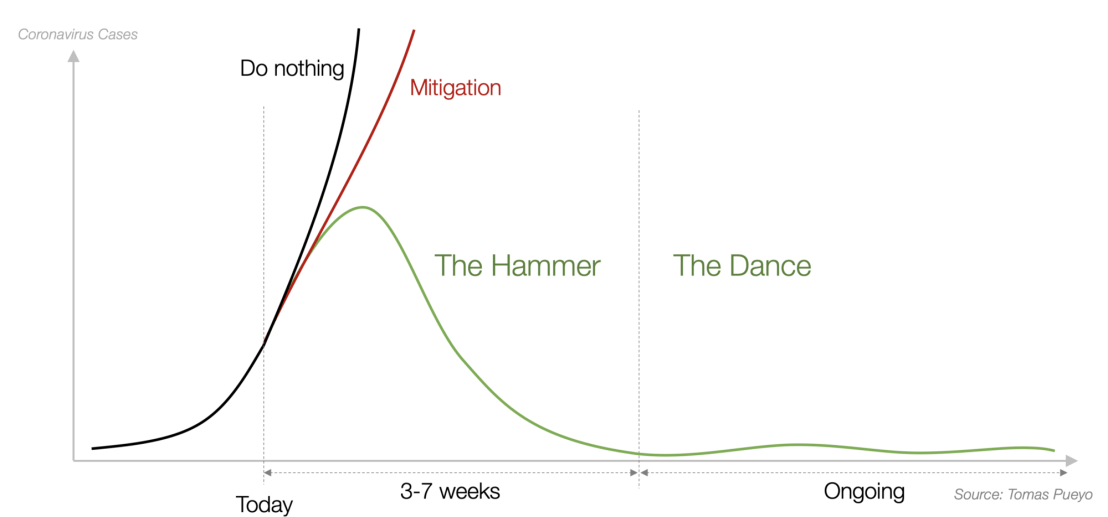
Last week I predicted that this might look like titrating quarantine levels – locking everything down, then trying to unlock it just enough to use available medical capacity, then locking things down more again if it looked like the number of cases was starting to get out of hand. This would eventually develop herd immunity without overwhelming the medical system. A paper argued for alternating periods of higher and lower quarantine levels based on how the medical system was doing:

A seesaw pattern of quarantine might work

Reonization galaxy

For 100s of millions of years after the Big Bang, the entire universe was a thick soup of hydrogen atoms swimming in total blackness. So dense was this cosmic goulash that the first light from the first stars in existence couldn’t penetrate it — the hydrogen fog simply absorbed and scattered the starlight in circles, trapping the universe in a cosmic dark age as ever more stars, galaxies and black holes slowly smoldered to life. That all changed after 500 ma, when a grand cosmic makeover called the epoch of reionization began. As ancient galaxies grew ever larger and radiated more powerful energy, they began to burn away the cosmic fog that surrounded them by ionizing hydrogen atoms into a plasma of free protons and electrons. Suddenly, light could travel across the cosmos — first through “bubbles” of plasma surrounding large galaxies, then farther and farther as multiple bubbles began to expand and overlap. The galaxy group, named EGS77, dates to 680 ma after the Big Bang and appears to be surrounded by 3 overlapping bubbles of plasma — meaning these pioneering galaxies may have been caught in the act of reionizing their corner of the universe and bringing the cosmic dark ages to an end.

Airplane Bunks

The plan is to have these pods in the Economy cabin, and “an economy-class customer on long-haul flights would be able to book the Economy Skynest in addition to their Economy seat. They would get some quality rest and arrive at their destination ready to go. This is a game changer on so many levels.”

bunk beds for the masses. it could be worse?

Urban Air Mobility

MVRDV is developing a plan for the future of Urban Air Mobility (UAM). The investigation tackles the integration of “flying vehicles” into our urban environments and envisions a comprehensive mobility concept. Addressing major questions like “How will these flying vehicles impact our urban environments? And how could they be leveraged to improve our cities?” MVRDV and Airbus are exploring the possibility of reconnecting territories through an accessible-for-all system. Avoiding the negative impact that comes with the introduction of new transportation modes into cities, the study imagines both short-term and long-term scenarios, in order to dodge any detrimental impacts from this disruptive technology.

East river swimming?

East river swimming could become a reality. The city’s rivers, harbors, and bays are cleaner than they’ve been since the Civil War.

“Why couldn’t we envision this kind of waterfront, not as an amenity in exchange for building, but for its own sake?” she asks. “This is the kind of waterfront we should have a lot more of, whether or not it’s residential.” 2 Trees representatives say the River Street plan addresses both of those concerns: It would help bring more life back to the waterfront by creating marshes, oyster beds, and feeding and nesting places for species such as Atlantic blue crab, blue fish, and mussels. And from a resiliency standpoint, the design of the public park would help stem flooding in the towers because its expanded soft shoreline and pier will break wave action and absorb flood waters, while the towers will keep sensitive electrical and mechanical equipment above the floodplain. The plan also could also help unlock new uses for the city’s waterfront, which advocates and city officials have called the “6th borough” because of its untapped potential. Even politicians gotten in on it: In 2011, then-Mayor Michael Bloomberg launched a plan for new waterfront parks and a ferry service, saying, “Our waterfront and waterways—what we are calling New York City’s ‘Sixth Borough’—are invaluable assets. And when our work is complete, New York City will again be known as one of the world’s premier waterfront cities.”

Fluid Equation Singularity

In the same way that eddies in a stream alter downstream currents, Elgindi’s work itself prompted a new round of mathematical discovery. In October 2019, Hou and Jiajie Chen adapted some of Elgindi’s methods to create a rigorous mathematical proof of a scenario closely related to the one in the 2013 experiment. They proved that in this slightly modified scenario, the singularity they’d observed forming in the Euler equations really does occur.

“They took Elgindi’s ideas and applied them to the scenario from 2013”. The circle was complete.

There’s still more work to be done, of course. Hou’s new proof has some technical qualifications that prevent it from establishing the existence of the singularity in the exact situation he modeled in 2013. But after a remarkable 6-year run and with renewed momentum, Hou believes he’ll soon surmount those challenges, too. “I think we’re very close”.

2022-04-12:

Now another group has joined the hunt. They’ve found an approximation of their own — one that closely resembles Hou and Luo’s result — using a completely different approach. They’re currently using it to write their own computer-assisted proof. The team’s answer looked a lot like the solution that Hou and Luo had arrived at in 2013. But the mathematicians hope that their approximation paints a more detailed picture of what’s happening, since it marks the first direct calculation of a self-similar solution for this problem. “The new result specifies more precisely how the singularity is formed. You’re really extracting the essence of the singularity,. It was very difficult to show this without neural networks. It’s clear as night and day that it’s a much easier approach than traditional methods.”