
to commemorate 50 years of the hague convention, verschluckung.de is asking 50 german artists to donate art for long-term storage (1500 years) in the archive of the german republic. as a citizen of the transnational republic, i am asked to donate an item for the collection. what would you pick?
Tag: history
HTML 1.0
sometimes when i am frustrated at the state of (x)html, it helps to consider how far we have come since HTML 1.0.
Kongo Gumi
Towards psychohistory
nobelist murray gell-mann of the santa fe institute gave a lecture on patterns in cultural anthropology today. gell-mann demonstrated how various phenomena in sociology, anthropology and history follow guttman scaling.Scaling is the branch of measurement that involves the construction of an instrument that associates qualitative constructs with quantitative metric units. Scaling evolved out of efforts in psychology and education to measure “unmeasurable” constructs like authoritarianism and self esteem. In many ways, scaling remains one of the most arcane and misunderstood aspects of social research measurement. And, it attempts to do one of the most difficult of research tasks — measure abstract concepts.
this discovery, which was long suppressed because it did not fit the prevailing ideology in anthropology, delivers some supporting evidence for the ideas expressed in asimov’s psychohistory, the premise that the development of societies can be modeled, and that public policy can be forecast by mathematical means.
with the end of anthropology likely, as indigenous tribes disappear from the face of the earth, new venues for research need to be found. gell-mann suggested acculturation and the study of migration as promising areas. closely related, a study of history by arnold toynbee is a seminal work that deserves more attention.
Beauty
There is a beauty of a peculiar kind in women, in which their countenance presents a transparency of skin, a light and lovely roseate hue, which is unlike the mere complexion of health and vital vigor – a more refined bloom, breathed, as it were, by the soul within – and in which the features, the light of the eye, the position of the mouth, appear soft, yielding, and relaxed. This almost unearthly beauty is perceived in women in those days which immediately succeed child-birth; when freedom from the burden of pregnancy and the pains of travail is added to the joy of soul that welcomes the gift of a beloved infant. A similar tone of beauty is seen also in women during the magical somnambulic sleep, connecting them with a world of superterrestrial beauty. A great artist (Schoreel) has moreover given this tone to the dying Mary, whose spirit is already rising to the regions of the blessed, but once more, as it were, lights up her dying countenance for a farewell kiss.
friedrich hegel in the philosophy of history, only to go on:
Such a beauty we also find in its loveliest form in the Indian World; a beauty of enervation in which all that is rough, rigid, and contradictory is dissolved, and we have only the soul in a state of emotion – a soul, however, in which the death of free self-reliant Spirit is perceptible.
promising. i got the book for $2. it is a lovely print from 1956 on acid-free paper. i wish all books were made to those specifications.
lean production
Paul Erdos, the most prolific mathematician of all time, defied the conventional wisdom that mathematics was just a young man’s game. For the last 25 years of his life, Erdos raced against the specter of old age to prove as many mathematical theorems as possible. “The first sign of senility, is when a man forgets his theorems. The second sign is when he forgets to zip up. The third sign is when he forgets to zip down.” Erdos never experienced the first sign. He managed to think about more problems than any other mathematician in history and could recite the details of all 1475 of the papers he had written or co-authored. Fortified by espresso and amphetamines, Erdos did mathematics 19 hours a day, 7 days a week. “A mathematician is a machine for turning coffee into theorems.” When friends urged him to slow down, he always had the same response: “There’ll be plenty of time to rest in the grave.”
i’m currently reading the man who loved only numbers. i dig erdos way of living out of a suitcase, something i aspire to as well. it takes lean production to entirely new levels.
Biography
My dad is sending me pieces of his biography by email as he writes them up. He never told me the full story of his life, so I am very intrigued to learn about it while I am 16000 km away. This means a lot to me.
on this day in 1660
I went out to Charing Cross, to see Major- general Harrison hanged, drawn; and quartered; which was done there, he looking as cheerful as any man could do in that condition. He was presently cut down, and his head and heart shown to the people, at which there was great shouts of joy. It is said, that he said that he was sure to come shortly at the right hand of Christ to judge them that now had judged him; and that his wife do expect his coming again. Thus it was my chance to see the King beheaded at White Hall, and to see the first blood shed in revenge for the blood of the King at Charing Cross.
some bloggers have more interesting experiences than others.
Plague
It was about the beginning of September, 1664, that I, among the rest of my neighbors, heard in ordinary discourse that the plague was returned again in Holland; for it had been very violent there, and particularly at Amsterdam and Rotterdam, in the year 1663, whither, they say, it was brought, some said from Italy, others from the Levant, among some goods which were brought home by their Turkey fleet; others said it was brought from Candia; others from Cyprus. It mattered not from whence it came; but all agreed it was come into Holland again.
I just finished Daniel Defoe’s a journal of the plague year.
2014-09-30: this is an awesome poster visualizing the plague, walking you through how real science is done, in an entertaining and informative way.

2015-10-06: Plague is one of the most virulent pathogens.
the acquisition of a single gene named pla gave Y. pestis the ability to cause pneumonia, causing a form of plague so lethal that it kills essentially all of those infected who don’t receive antibiotics. In addition, it is also among the most infectious bacteria known. “Yersinia pestis is a pretty kick-ass pathogen. A single bacterium can cause disease in mice. It’s hard to get much more virulent than that.”
2021-03-30: Pushing the Black Death origin back.
Monica Green published a landmark article, The 4 Black Deaths, in the American Historical Review, that rewrites our narrative of this brutal and transformative pandemic. In it, she identifies a “big bang” that created 4 distinct genetic lineages that spread separately throughout the world and finds concrete evidence that the plague was already spreading from China to central Asia in the 1200s. This discovery pushes the origins of the Black Death back by over 100 years, meaning that the first wave of the plague was not a decades-long explosion of horror, but a disease that crept across the continents for over 100 years until it reached a crisis point.
2022-02-16: Black Death mortality rates varied widely.
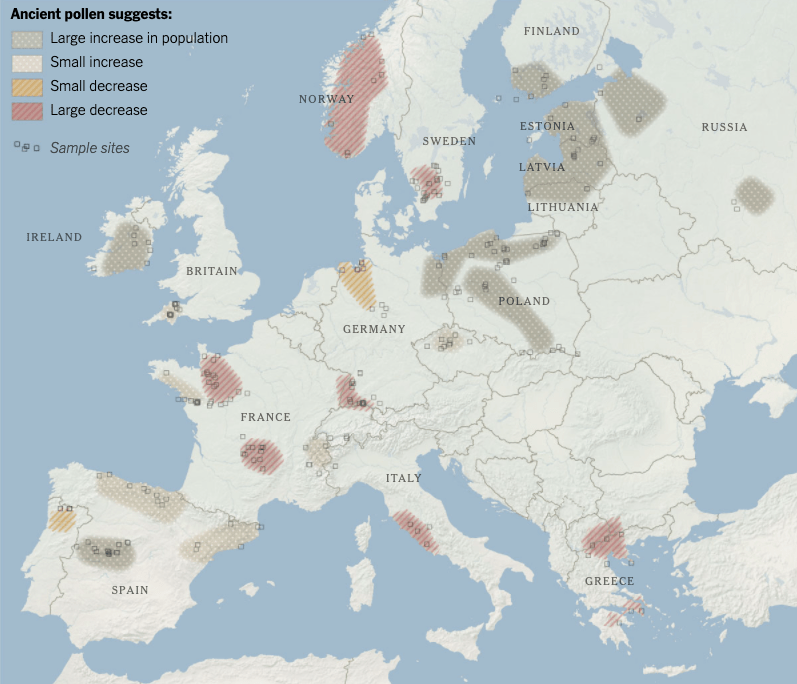
“The data is sufficiently widespread and numerous to make it likely that the Black Death swept away 65% of Europe’s population”. But those figures, based on historical documents from the time, greatly overestimate the true toll of the plague. By analyzing ancient deposits of pollen as markers of agricultural activity, researchers found that the Black Death caused a patchwork of destruction. Some regions of Europe did indeed suffer devastating losses, but other regions held stable, and some even boomed. It’s possible that the ecology of rats and fleas that spread the bacteria was different from country to country. The ships that brought Yersinia to Europe may have come to some ports at a bad time of the year for spreading the plague, and to others at a better time.
2022-08-12: The plague may have had a role in the collapse of Egypt’s Old Kingdom and the Akkadian Empire in Mesopotamia
During the late 3rd millennium BCE, the Eastern Mediterranean and Near East witnessed societal changes in many regions, which are usually explained with a combination of social and climatic factors. However, recent archaeogenetic research forces us to rethink models regarding the role of infectious diseases in past societal trajectories. The plague bacterium Yersinia pestis, which was involved in some of the most destructive historical pandemics, circulated across Eurasia at least from the onset of the 3rd millennium BCE but the challenging preservation of ancient DNA in warmer climates has restricted the identification of Y. pestis from this period to temperate climatic regions. As such, evidence from culturally prominent regions such as the Eastern Mediterranean is currently lacking. Here, we present genetic evidence for the presence of Y. pestis and Salmonella enterica, the causative agent of typhoid/enteric fever, from this period of transformation in Crete, detected at the cave site Hagios Charalambos. We reconstructed 1 Y. pestis genome that forms part of a now-extinct lineage of Y. pestis strains from the Late Neolithic and Bronze Age that were likely not yet adapted for transmission via fleas. Furthermore, we reconstructed 2 ancient S. enterica genomes from the Para C lineage, which cluster with contemporary strains that were likely not yet fully host adapted to humans. The occurrence of these 2 virulent pathogens at the end of the Early Minoan period in Crete emphasizes the necessity to re-introduce infectious diseases as an additional factor possibly contributing to the transformation of early complex societies in the Aegean and beyond.
Emoji
Emoji are characters invented by NTT DoCoMo for people to use in text messages. The most obvious example is the well-known smiley face, often encoded in ASCII as 🙂 and called an emoticon. Thus, emotion + ji gives emoji.
NTT DoCoMo invents new characters while we are stuck with 26. the wonders of language.
 Gregor J. Rothfuss