Tag: history

Dog domestication

Canines have had 36 ka to co-evolve with humans. Plenty of time for canines to domesticate humans as a food source, mainly via the cunning puppy dog eyes.
2012-12-06: How to make dogs from foxes in 8 generations (and “dragons” from foxes)

2018-12-15: This fictionalization of the domestication of wolves was surprisingly good.

2020-06-06: Foxes becoming dog-like

When the foxes moved from the forest to city habitats, they began to evolve doglike traits, potentially setting themselves on the path to domestication.

2022-02-08: Dog / Human co-domestication

Based on claims that dogs are less aggressive and show more sophisticated socio-cognitive skills compared with wolves, dog domestication has been invoked to support the idea that humans underwent a similar ‘self-domestication’ process. Dogs do not show increased socio-cognitive skills and they are not less aggressive than wolves. Rather, compared with wolves, dogs seek to avoid conflicts, specifically with higher ranking conspecifics and humans, and might have an increased inclination to follow rules, making them amenable social partners. These conclusions challenge the suitability of dog domestication as a model for human social evolution and suggest that dogs need to be acknowledged as animals adapted to a specific socio-ecological niche as well as being shaped by human selection for specific traits.
Digitized art

this is an extremely impressive effort. over 100k paintings in the UK have been digitized, out of 200k total. you’d have to visit 1000s of museums to get similar breadth, and most of these paintings are not on display anyway.

The most ambitious digitization project I’ve ever heard of is halfway to its goal of putting every single publicly owned oil painting (plus tempera and acrylic) in the United Kingdom online. A joint effort of the Public Catalogue Foundation and the BBC, Your Paintings now has 104K artworks by the likes of Degas and Rubens uploaded to the website out of an estimated 200K. It’s the first national online art museum ever attempted. Just to give you a sense of the scale, there are only 3000 paintings in the immense National Gallery.

Guédelon

A medieval castle is being built in France. There’s also a Youtube channel.

https://www.youtube.com/channel/UCy9Kti8oDm_wmbU7-yLRfog

2016-09-15: If you’re ever in this part of France, I highly recommend a visit to the slowest castle construction site in the history of the world.

Guédelon Castle is a project started in 1997 by Michel Guyot and Maryline Martin in the Burgundy region of France. The castle is styled on typical French medieval chateau-fort, modeled on designs from the 13th century, and is being built using techniques and materials available to masons and builders 800 years ago. The Guédelon project has now become a tourist destination, and employs dozens of workers. The castle is due to be completed in 2023.

Trust Issues

if you let interest compound for 100s of years, you get the wheat and chessboard problem. we also learn that ben franklin was an early cryogenist. his preservation medium: madeira wine.

Hartwick College didn’t really mean to annihilate the US economy. The college inherited a 1000-year trust that would not mature until the year 2936: a gift whose accumulated compound interest “could ultimately shatter the nation’s financial structure.” After decades in the courts, Holdeen’s economic Armageddon ended not with a bang, but with a whimper—and a dividend check.

Hartwick College got its 1000-year trust, still bearing its maturation date of 2936; the principal now stands at an impressive $9m. Rather than accumulating and compounding, though, the trust pays out $450k a year to the college.

Gardening at scale


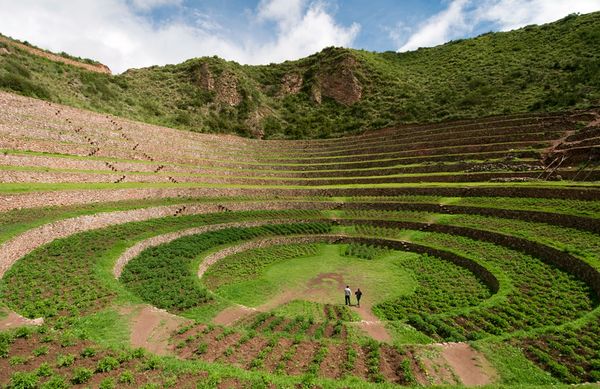
Large-scale agricultural experimentation by the incas, and how similar designs could be used to affect climate on a continental scale. There are some theories that this is exactly what happened in the amazon basin:

“Anthropologists now believe that the majority of the Amazon rain forest was managed by humans. There are many fruit and nut bearing trees in the Amazon, and this was probably due to human interference. They also used a unique form of burning in the Amazon, where they would stop the fields from completely burning so that there would be charcoal. Turns out the active carbon in charcoal bonds to organic elements and makes the soil as good or probably better than using fertilizer.” (from the excellent 1491 by Charles Mann)

The amazon basin has been terraformed on a large scale as far back as 2500 BP, supporting a population of 8M by the time the spaniards showed up in 1492. After that, it of course crashed.
2020-04-11: The large scale cultivation goes back much further.

We show that, starting at around 10 ka BP, inhabitants of this region began to create a landscape that ultimately comprised 4700 artificial forest islands within a treeless, seasonally flooded savannah. Our results confirm that humans have markedly altered the landscape ever since their arrival in Amazonia.

2022-06-02: Amazonian cities

Starting 1.5 ka BP, ancient Amazonians built and lived in densely populated centers, featuring 22m earthen pyramids and encircled by kilometres of elevated roadways. 2 of the urban centers each covered an area of more than 100 hectares — 3x the size of Vatican City. The lidar images revealed walled compounds with broad terraces rising 6m above ground. On one end of the terraces stood conical pyramids made of earth. People likely lived in the areas around the terraces and travelled along the causeways connecting the sites to one another. Lidar images found reservoirs in the settlements, perhaps indicating that this part of the world wasn’t always wet — an environmental shift that might have driven people away. But then again, steady pollen records reveal that maize was grown in the area continuously for 1000s of years, indicating sustainable agricultural practices.