there’s a sociological explanation why few people are willing to look at the evidence. They put their reputations at risk by doing so. Cold fusion is tainted, and the taint is contagious – anyone seen to take it seriously risks contamination. So the subject is stuck in a place that is largely inaccessible to reason – a reputation trap, we might call it. People outside the trap won’t go near it, for fear of falling in. ‘If there is something scientists fear, it is to become like pariahs’. People inside the trap are already regarded as disreputable, an attitude that trumps any efforts that they might make to argue their way out, by reason and evidence.
This work should produce data that will be of interest to people beyond the remaining cold-fusion believers, and similarly, the team’s work on heated metal powders and hydrogen required them to make advances in calorimetry that could also prove useful. And the hydrogen-saturated palladium electrode work led to new data about the effects of such high loading on the metal structure, and how to measure these reliably.
a device that would use a key piece of fusion equipment to convert light into particles with mass. It would do so by smashing photons together to create electrons and their antimatter counterparts, positrons. Physicists have never observed this process in the lab.
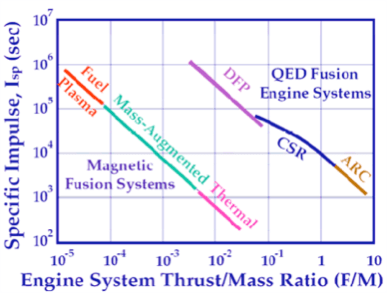
The path forward is to use regenerative (breeding) of isotopes that emit more protons for positron emissions. This regenerative approach will enable full scale antimatter catalyzed deuterium fusion propulsion. The Deuterium fusion propulsion will be able to achieve performance like other deuterium fusion rocket designs which is up to 10% of lightspeed and 100K+ ISP to millions of ISP
Inertial electrostatic confinement fusion provides a potential breakthrough in designing and implementing practical fusion power plants. This is a $5T / year market. 2007-04-27: inertial confinement is a lot more promising than magnetic confinement. Plus 1000x cheaper to build. This is very very exciting (and a $5t/ year market). 2008-01-15: Fusion power grows more quickly than Moore’s law. It has increased by a factor of 10000 in the last 30 years, and another factor of 6 is required for a power plant. ITER will be 500MW, 10x over the energy threshold. 2011-08-03: Mark Suppes:
Science. It works, bitches. Mark Suppes is one of my heroes. He lives in Brooklyn. His hobby: building his own bussard fusion reactor. He will very likely fail, but what if he succeeds? Here is a nice article on him. If you are behind in your fusion terminology, bussard reactors are an alternative design that doesn’t require 10s of billions to get if off the ground. The best introduction is this tech talk:
2014-04-12: Since the big science / consortium approach hasn’t worked so far, maybe a macgyver approach will.
Ivanov’s story is just one example of the serendipity involved in this small Canadian company’s rise to the forefront of a worldwide race to harness nuclear fusion, a race that has been going on fitfully, consuming $10Bs, for more than 50 years. (All existing reactors operate using nuclear fission, rather than fusion, which is a very different process.) Started in 2002 by a successful corporate scientist in the throes of a midlife crisis, General Fusion has already outlasted past private-sector attempts to commercialize fusion energy. Instead of petering out, it’s garnered the attention and respect of a small but growing cadre of scientists, energy executives and adventurous investors around the world.
If LPP is successful with their research and then successful with commercialization they will achieve commercial nuclear fusion at the cost of $400K-1M for a 5 megawatt generator that would produce power for about 0.3 cents per kwh instead of 6 cents per kwh for coal and natural gas. It would be a game changer. Their monthly reports have shown that there are many technical, material and theoretical challenges. LPP has shown a lot of grit and ingenuity to overcome challenges.
The Experimental Advanced Superconducting Tokamak (EAST) in Heifi, China was able to sustain plasma in the H-mode confinement regime for 102 seconds.
2019-02-17: Fusion Projects Use Misleading Power Terms
ITER has spent over $14B so far and will only reach some level of plasma energy gain for a few minutes at a time if everything works as planned. The condition of Q = 1, when the power being released by the fusion reactions is equal to the required heating power is called breakeven or scientific breakeven. Plasma breakeven can be 100x away from what is needed for a practical reactor.
As explained by Sabine Hossenfelder:
The Q-plasma also doesn’t take into account that if you want to operate a power plant, the heat that is created by the plasma would still have to be converted into electric energy, and that can only be done with a limited efficiency, optimistically maybe 50%. As a consequence, the Q total is much lower than the Q plasma. If you didn’t know this, you’re not alone. I didn’t know this until a few years ago either. How can such a confusion even happen? I mean, this isn’t rocket science. The total energy that goes into the reactor is more than the energy that goes into the plasma. And yet, science writers and journalists constantly get this wrong. They get the most basic fact wrong on a matter that affects 10s of billions of research funding. The plan is that ITER will generate 500 MegaWatts of fusion power in heat. If we assume a 50% efficiency for converting this heat into electricity, ITER will produce about 250 MegaWatts of electric power. That gives us a Q total of about 0.57. That’s 6% of the normally stated Q plasma of 10. Even optimistically, ITER will still consume 2x the power it generates. What’s with the earlier claim of a Q of 0.67 for the JET experiment? Same thing.
The Reactor Core of Commonwealth Fusion Systems. This Tokamak plasma fusion ring supports the steepest temperature gradient in the solar system (1 million degrees to room temp within 2mm)!
This third party analysis verifies our investment thesis; tokamak fusion is an engineering project, not a science project. If they can build it, the scientific community agrees on the performance that will result.
The tritium used in fusion experiments like ITER, and the smaller JET tokamak in the UK, comes from a very specific type of nuclear fission reactor called a heavy-water moderated reactor. But many of these reactors are reaching the end of their working life, and there are fewer than 30 left in operation worldwide. 20 in Canada, 4 in South Korea, and 2 in Romania, each producing about 100 grams of tritium a year. But now, with the help of AI-controlled magnets to help confine the fusion reaction, and advances in materials science, some companies are exploring alternatives. TAE Technologies is attempting to build a fusion reactor that uses hydrogen and boron, which it says will be a cleaner and more practical alternative to D-T fusion. It’s aiming to reach a net energy gain—where a fusion reaction creates more power than it consumes—by 2025. Boron can be extracted from seawater by the metric ton, and it has the added benefit of not irradiating the machine as D-T fusion does. It’s a more commercially viable route to scalable fusion power. But the mainstream fusion community is still pinning its hopes on ITER, despite the potential supply problems for its key fuel. “Fusion is really, really difficult, and anything other than deuterium-tritium is going to be 100x more difficult, 100 years from now maybe we can talk about something else.”
Project Orion: Atom bombs as propellants. Those 50s guys had balls. 2007-05-04: Project Pluto
SLAM’s simple but revolutionary design called for the use of nuclear ramjet power, which would give the missile virtually unlimited range. Air forced into a duct as the missile flew would be heated by the reactor, causing it to expand, and exhaust out the back, providing thrust. Pluto’s namesake was Roman mythology’s ruler of the underworld — seemingly an apt inspiration for a locomotive-size missile that would travel at near-treetop level at 3x the speed of sound, tossing out hydrogen bombs as it roared overhead. Pluto’s designers calculated that its shock wave alone might kill people on the ground. Then there was the problem of fallout. In addition to gamma and neutron radiation from the unshielded reactor, Pluto’s nuclear ramjet would spew fission fragments out in its exhaust as it flew by
2014-11-23: The reason the Philae lander died after 60h is because the ESA couldn’t fit it with a nuclear battery, too much paranoia in Europe. 2017-12-04: A 10kw nuclear reactor for space exploration from nasa. bravo, especially considering the silliness of esa restrictions on nuclear propulsion in space.
Pulsed Fission-Fusion should be able to achieve 15 kW/kg and 30K seconds of ISP. This will be orders of magnitude improvement over competing systems such as nuclear electric, solar electric, and nuclear thermal propulsion that suffer from lower available power and inefficient thermodynamic cycles.
Today’s push for nuclear power in space is a useful metric for measuring the seriousness of NASA’s—and the nation’s—lunar and Martian ambitions. In the context of human spaceflight, NASA has a well-known aversion to “new” (and thus presumably more risky) technology—but in this case, the “old” way makes an already perilous human endeavor needlessly difficult. For all the challenges of embracing nuclear power for pushing the horizon outward for humans in space, it is hard to make the case that tried-and-true chemical propulsion is easier or carries significantly less physical—and political—risk. Launching 10 International Space Stations’ worth of mass across 27 superheavy rocket launches for fuel alone for a single Mars mission would be a difficult pace for NASA to sustain. (That is more than 40 launches and at least $80b if the agency relies on the SLS.) And such a scenario assumes everything goes perfectly: sending help to a troubled crew on or around Mars would require 10s of additional fuel launches, and chemical propulsion allows very limited windows of opportunity for the liftoff of any rescue mission.
If, with a single technology, that alarmingly high number of ludicrously expensive launches could be cut down to 3—while also offering more chances to travel to Mars and back—how could a space agency that was earnest in its ambitions not pursue that approach? No miracles are necessary, and regulators and appropriators seem to agree that the time has come.
We can fly to Mars. Splitting atoms, it seems, is now the safest way to make that happen.


 Gregor J. Rothfuss