Tag: evolution

Eukaryogenesis

Genetic analysis places Loki squarely within the single-celled archaea. But it possesses an intriguing collection of genes that look as though they would be more at home in eukaryotes, rather like modern words dotting a medieval manuscript. In fact, Loki’s genetic machinery suggests that the organism might be able to engulf other cells, the first step in the creation of mitochondria. Even if Loki doesn’t solve the mystery of our ancient origins, its discovery shows just how much biological diversity remains to be unearthed. Perhaps the next discovery will be a eukaryote with no history of possessing mitochondria. Or perhaps it will be an archaeon with signs of a symbiotic bacterium living within.

2020-11-25: Viral nucleus origin?

A trove of giant viruses was recently sequenced from the very same deep-sea sediments where Lokiarchaeota were discovered. He hopes someone will test whether any of these viruses can infect archaea and, if so, whether they build viral factories similar to those made by the NCLDVs that infect eukaryotes. Demonstrating that would be “game over.”

2022-11-12: Syntropic eukaryogenesis

Today, at the microbial mats in the Atacama Desert and other sites throughout the world, scientists are investigating what the earliest eukaryotic cells may have looked like, the partnerships they may have struck up with other organisms, and how their molecular machinery might have functioned and evolved. Already, the discovery of the Asgards has solidified certain aspects of eukaryogenesis while raising new questions about others. “I think this is the most exciting development in biology right now. So much is being discovered and so many predictions are being met. Eukaryogenesis is arguably one of the most important events in the history of life, after the origin of life itself.” Many scientists have rallied behind the idea that the first eukaryotes evolved out of a syntrophy between an archaeal host and bacteria that somehow found their way inside to become the organelles, such as nuclei and mitochondria, that distinguish eukaryotes. The details of these relationships remain murky, but mitochondria provide the most tantalizing clues to their origin story. “There’s DNA in mitochondria that we can somewhat clearly connect or trace back to alphaproteobacteria”. There are contrasting hypotheses as to how the alphaproteobacterium would have gotten inside an archaeal host, however. In the eukaryogenesis version of the chicken-and-egg conundrum, scientists go back and forth on whether mitochondria would have been necessary to power the energetically expensive process of phagocytosis, or whether phagocytosis would have had to arise first as the means of ingesting the symbiotic partner. When it comes to the nucleus, the picture is much less clear. Hypotheses of its origin run the gamut from a bacterial endosymbiont within an amoeboid host to the remnants of a giant virus.


2023-06-19: Lokiarchaeota aren’t the the origin of eukaryotes, but are closely related.

Eukaryotes are placed as a well-nested clade within Asgard archaea and as a sister lineage to Hodarchaeales, a newly proposed order within Heimdallarchaeia, consistent with the 2 domain tree of life scenario. Using sophisticated gene tree and species tree reconciliation approaches, we show that analogous to the evolution of eukaryotic genomes, genome evolution in Asgard archaea involved significantly more gene duplication and fewer gene loss events compared with other archaea. Finally, we infer that the last common ancestor of Asgard archaea was probably a thermophilic chemolithotroph and that the lineage from which eukaryotes evolved adapted to mesophilic conditions and acquired the genetic potential to support a heterotrophic lifestyle.

Life 4.1 ga ago

life likely existed on Earth at least 4.1 ga ago — 300 ma earlier than previous research suggested. Life may have begun shortly after the planet formed 4.54 ga ago, and existed prior to the massive bombardment of the inner solar system that formed the moon’s large craters 3.9 ga ago. If all life on Earth died during this bombardment, then life must have restarted quickly

Biggest tree of life


this is amazing work, and very much a beginning:

the tree depicts the relationships among living things as they diverged from one another over time, tracing back to the beginning of life on Earth more than 3.5B years ago. 10Ks of smaller trees have been published over the years for select branches of the tree of life — some containing upwards of 100k species — but this is the first time those results have been combined into a single tree that encompasses all of life.


is another nice one.

Homo naledi

Homo naledi is a previously-unknown species of extinct hominin discovered within the Dinaledi Chamber of the Rising Star cave system, Cradle of Humankind, South Africa. This species is characterized by body mass and stature similar to small-bodied human populations but a small endocranial volume similar to australopiths. Cranial morphology of H. naledi is unique, but most similar to early Homo species including Homo erectus, Homo habilis or Homo rudolfensis. While primitive, the dentition is generally small and simple in occlusal morphology. H. naledi has humanlike manipulatory adaptations of the hand and wrist. It also exhibits a humanlike foot and lower limb. These humanlike aspects are contrasted in the postcrania with a more primitive or australopith-like trunk, shoulder, pelvis and proximal femur. Representing at least 15 individuals with most skeletal elements repeated multiple times, this is the largest assemblage of a single species of hominins yet discovered in Africa.

Black chickens

The Indonesian chicken breed known as Ayam Cemani takes ‘dark’ into an entirely different realm. Their feathers are black. Their skin is black. Cut open an Ayam Cemani and you’ll find black muscle anchored to black bones. Even their organs are black.

nothing crazy was involved in the making of these entirely black chickens.

Plankton evolves eye

A single-celled marine plankton has evolved a miniature version of an eye to help see its prey better. It’s an amazingly complex structure for a single-celled organism to have evolved. It contains a collection of sub-cellular organelles that look very much like the lens, cornea, iris and retina of multicellular eyes found in humans and other larger animals.

Hydrothermal Vents

the hydrothermal vents were a relic environment, one we believe resembles what the early conditions on Earth might have been. What we’re doing ultimately is trying to understand how life evolved on the planet. For all of their extremes of temperature, pressure, and other properties, deep-sea vents may have offered a relatively cozy refuge on the violent world of the early Earth. Our young planet was bathed in much stronger ultraviolet radiation from the sun because it hadn’t yet developed a protective ozone layer. That didn’t come along until after the evolutionary invention of photosynthesis pumped a steady supply of oxygen into our atmosphere. One big attraction is the presence of an ion gradient—a key ingredient in just about every known form of life—between the vent fluids and the seawater. The alkaline fluids are basic, with a pH (a measurement of acidity and alkalinity levels) of around 10 or 11, meaning they have a low concentration of protons. Seawater, with a pH of around 8, is less alkaline—that is, slightly more acidic—so it has more protons than the vent fluids. The vent would have acted as a natural hydrothermal reactor. Reactions between carbon dioxide and hydrogen, catalyzed by minerals found in the vents, can form a molecule known as pyruvate. Pyruvate is a precursor of many amino acids, which in turn can link together to create proteins.

Wolf Monkey societies

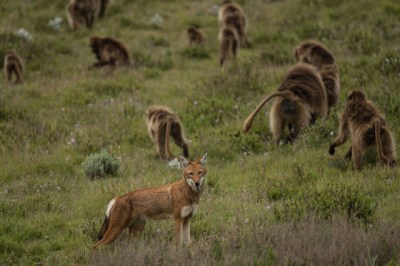
In the alpine grasslands of eastern Africa, Ethiopian wolves and gelada monkey are giving peace a chance. The geladas – a type of a baboon – tolerate wolves wandering right through the middle of their herds, while the wolves ignore potential meals of baby geladas in favor of rodents, which they can catch more easily when the monkeys are present.

The unusual pact echoes the way dogs began to be domesticated by humans.

When walking through a herd – which comprises many bands of monkeys grazing together in groups of 600 to 700 individuals – the wolves seem to take care to behave in a non-threatening way. They move slowly and calmly as they forage for rodents and avoid the zigzag running they use elsewhere.

This suggested that they were deliberately associating with the geladas. Since the wolves usually entered gelada groups during the middle of the day, when rodents are most active, he wondered whether the geladas made it easier for the wolves to catch the rodents – their primary prey.