Tag: egypt
Ancient Egyptian
thanks to coptic, we’re able to re-create egyptian phonetics.
Ancient Egyptian Baking
The fascinating thing for me as an archaeologist is that Blackley is not an archaeologist. He’s a baker. So he’s approaching this completely differently, and he’s coming up with answers to problems that only a baker would know.
see also the hairdresser doing historical research.
Great Pyramid in 2560 BCE
The current outer surface of the Great Pyramid at Giza is made of rough limestone blocks, colored a dark sandy brown from 100s of years of pollution and weathering. But when it was first built, there was a smooth layer of fine white limestone on the outside of the structure, all cut to the same angle and polished to a shine so bright it almost glowed.

Zooba
Nolita will soon be home to a popular Egyptian fast-casual restaurant serving street food — making it one of the few Manhattan restaurants dedicated to staples from the country. Zooba, which launched in Cairo and now has 6 locations, will be opening this summer at 100 Kenmare St
Non-african mummies
We found the ancient Egyptian samples falling distinct from modern Egyptians, and closer towards Near Eastern and European samples (Fig. 4a, Supplementary Fig. 3, Supplementary Table 5). In contrast, modern Egyptians are shifted towards sub-Saharan African populations. Model-based clustering using ADMIXTURE37 (Fig. 4b, Supplementary Fig. 4) further supports these results and reveals that the 3 ancient Egyptians differ from modern Egyptians by a relatively larger Near Eastern genetic component, in particular a component found in Neolithic Levantine ancient individuals36 (Fig. 4b). In contrast, a substantially larger sub-Saharan African component, found primarily in West-African Yoruba, is seen in modern Egyptians compared to the ancient samples.
2021-11-05: Mummification is also older than previously thought:
The preserved body of a high-ranking nobleman called Khuwy, discovered in 2019, has been found to be far older than assumed and is, in fact, 1 of the oldest Egyptian mummies ever discovered. It has been dated to the Old Kingdom, proving that mummification techniques 4 ka BP were highly advanced. The sophistication of the body’s mummification process and the materials used – including its exceptionally fine linen dressing and high-quality resin – was not thought to have been achieved until 1 ka later.

Human Pigments
see also, human skin used for book bindings.
Eugene Delacroix’s most famous painting, “Liberty Leading the People,” hangs in a revered spot in Paris’ Louvre Museum. Inspired by the 1830 Paris Uprising, it has been held up as an embodiment of the French national ethos, and most recently as a justification for the country’s controversial burkini ban.
But “Liberty Leading the People” may also have been literally painted with people.
From at least the 16th century until as late as the early 1900s, a pigment made from mummified human remains appeared on the palettes of European artists, including Delacroix. Painters prized “mummy brown” for its rich, transparent shade. As a result, an unknown number of ancient Egyptians are spending their afterlife on art canvases, unwittingly admired in museum galleries around the world.
Cairo Transit Mapping

Transport for Cairo (TfC) is mapping the city’s complex public transit systems—both formal and informal. The group’s ultimate goal isn’t just to draw a paper map of the system, but to eventually build mobile transit apps. All the data they’re collecting feed into the General Transit Feed Specification (GTFS), the standard format pioneered by Google to openly share public transit information among transit agencies and application developers. GTFS currently works for networks that run on fixed schedules, but TfC hopes to adapt the standard so that it works with Cairo’s informal transit system, as well.
The Sphinx
Exactly what Khafre wanted the Sphinx to do for him or his kingdom is a matter of debate, but Lehner has theories about that, too, based partly on his work at the Sphinx Temple. Remnants of the temple walls are visible today in front of the Sphinx. They surround a courtyard enclosed by 24 pillars. The temple plan is laid out on an east-west axis, clearly marked by a pair of small niches or sanctuaries, each about the size of a closet. The Swiss archaeologist Herbert Ricke, who studied the temple in the late 1960s, concluded the axis symbolized the movements of the sun; an east-west line points to where the sun rises and sets twice a year at the equinoxes, halfway between midsummer and midwinter. Ricke further argued that each pillar represented an hour in the sun’s daily circuit. Lehner spotted something perhaps even more remarkable. If you stand in the eastern niche during sunset at the March or September equinoxes, you see a dramatic astronomical event: the sun appears to sink into the shoulder of the Sphinx and, beyond that, into the south side of the Pyramid of Khafre on the horizon. “At the very same moment, the shadow of the Sphinx and the shadow of the pyramid, both symbols of the king, become merged silhouettes. The Sphinx itself, it seems, symbolized the pharaoh presenting offerings to the sun god in the court of the temple.” The Sphinx represents Khafre as Horus, the Egyptians’ revered royal falcon god, “who is giving offerings with his 2 paws to his father, Khufu, incarnated as the sun god, Ra, who rises and sets in that temple.” The Sphinx and the pyramids, epic feats of engineering and architecture, were built at the end of a special time of more dependable rainfall, when pharaohs could marshal labor forces on an epic scale. But then, over the centuries, the landscape dried out and harvests grew more precarious.
Roman mummies
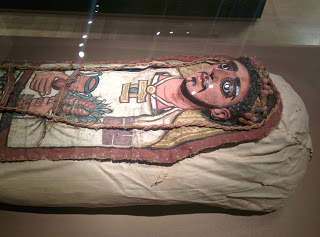
this egyptian mummy from the roman period reminds me of a certain lady from spain who “there, i fixed it” a painting. seen at the brooklyn museum, which has an amazing egyptian collection. mostly new kingdom, but also some middle and even some old kingdrom artifacts.
 Gregor J. Rothfuss