The central bank would undoubtedly capture dominant market share of utility or ‘narrow banking’, but only because the public sector is the least cost provider of the service. Without any subsidies, implicit or otherwise, the central bank is the cheapest, safest provider of these services in the market. Not only would the resulting banking system have much lower costs and greater efficiency, not only would it throw off 10s of billions of $ in revenue to government, it would be a safer, more rational system playing much better to the respective strengths of public and private sectors.
Tag: economics
Opendoor
There is a deeper reason why I am excited about Opendoor, and it too is related to how the company’s approach differs from Zillow’s and Redfin’s. While Zillow makes it easier to look for new houses, and Redfin promises to save sellers a few bucks, making it trivial to sell a house has the potential to fundamentally impact our economy at a time we desperately need exactly that. Many, including myself, have written about how globalization and technology are upending the job market; one particular challenge is that often new jobs are created in different geographic areas than where job seekers are located.
To that end the potential for Opendoor to dramatically increase liquidity in the housing market by buying direct from sellers is not just a business opportunity, but one with the potential to increase dynamism in the job market. Granted, it will take a long time for Opendoor to move into the towns where this sort of service is most needed, but the idea is very much a move in the right direction.
Mega Merger Consultants
why there’s far less competition than there should be:
Economists are leveraging their academic prestige with secret reports justifying corporate concentration. Their predictions are often wrong and consumers pay the price. While the impact of this wave of mergers is much debated, prominent economists suggest that it is 1 important reason why, even as corporate profits hit records, economic growth is slow, wages are stagnant, business formation is halting, and productivity is lagging. “Only the monopoly-power story can convincingly account” for high business profits and low corporate investment.
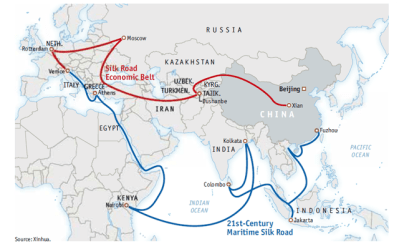
Cooperating with 1 Belt 1 Road?
The United States and Japan are the only G7 countries that have not signed up to be Asian Infrastructure Investment Bank (AIIB) members, a move viewed by Beijing as a sign of Washington’s mistrust of the Chinese government and its ambition to exert bigger regional influence. US membership of the AIIB and endorsing China’s efforts to revive trade routes along the ancient Silk Road, would be a big sign of goodwill from Washington to Beijing to pave the way for future agreements.
India’s Demonetization
85% of all currency in circulation has just been turned into coupons that can only be exchanged in specific places. Only 1% of India’s population pays income tax. India’s dilemma is that its high productivity sectors are taxed while its low-productivity sectors aren’t so valuable resources are trapped in low productivity sectors.
What are young men doing?
The average low-skilled, unemployed man plays video games an average of 12h. 22% of unemployed young men did not work the previous year either. These individuals are living with parents or relatives, and happiness surveys actually indicate that they’re quite content compared to their peers
large fractions of society are already doing what they would if UBI were here
Automation 2036
a nice summary if you have been living under a rock
My main assumptions for the next 20 years are:
- Automation will make more and more people unemployable
- No dystopia: Democracies will continue to function “reasonably”
- Some form of Universal Basic Income (UBI) will become common
- Minimum wage will probably disappear: Unions will fight a rear-guard action but in a sense, once you have UBI, much of the justification for minimum wage goes away. And even if “officially” it stays, people will simply become independent and do “consulting jobs” which are exempt from unions
- Capitalism will be alive and well: While UBI sounds a bit like socialism, and taxes will probably be higher, capitalism as we know it will continue.
- Automation will accelerate: Once UBI exists, why would somebody do unpleasant work? Well, if it pays very well, or it is challenging. So there will be a bigger push to automate things which are currently done by people on very low wage.
Also, once many / most people are on UBI, I think luddites / unions / special interest groups will find it harder to block further automation: People on UBI will look unkindly on a group suggesting that a service / product should stay expensive just so that group will keep their jobs. Will inequality grow? Depends on how you look at it: Income inequality will probably continue rising (even though taxes will be higher to finance UBI). But how about Quality-of-Life inequality? That’s a lot harder to measure. So what will everybody do?
- There will be cheap, good education
- People will have more fun
- Everybody will be an artist
- Religions / alternative / new-age stuff
- Helping others
Union endgame
If, nationally, this is the endgame for unions, a lot still hinges on how that endgame will be played. It’s useful to think in the brutally reductive terms of Wall Street. The gains to be made from the legacy business of picket lines are limited, but there is still plenty of capital built up for unions to spend in the legislative arena. That effort has already started. Not long ago, policy-makers talked about raising the minimum wage by $1 or $2 an hour. Now New York and California have approved a $15 hourly minimum wage, and Fight For $15 has gone national.
State-level regulations
the real problem are state-level regulations where things as trivial as hairdressers have to get certified, and the incumbents collect monopoly rents. there’s no party to nip that nonsense in the bud, despite claims to the contrary.
Instant Learning and the Next Economy
all of that earlier innovation is child’s play compared to what is now possible. With limited AGI, it will be possible to exponentially accelerate the gathering, improvement, and sharing of human understanding. Here’s how this is done in its most basic form (currently called cloud robotics): An AGI learns a task or a concept through experience (this is becoming very easy to do with model free deep learning, Big Data and Big Sim as I pointed out yesterday). That understanding is packaged, uploaded, and stored in the cloud. Any other AGI can download that understanding as needed. This is clearly a formula for radically accelerating the growth of human experience. A radical upgrade to the existing process.
 Gregor J. Rothfuss