Sinocity, a fictitious city in an imaginary Chinese province, reflects more reality of mid-sized Chinese cities than many will admit. The Sinocities Awards seeks to explore awards ways of dealing with this status quo of the near future.
2010-09-02: 1b city by 2040
Going to 2400 km/h in the 2030 to 2040 timeframe would enable 90% of China’s population to be 1 hour apart by low pressure maglev.
2015-04-02: City Hypergrowth. While not quite the fastest growing at 200k people / year vs Karachi at nearly 1m / year, these pictures of rapid transformation are still interesting.

Tim Franco captures the massive urbanization of Chongqing, which has been described as “the biggest city you’ve never heard of” and “China’s Detroit.”
2017-04-02: Megacity integration
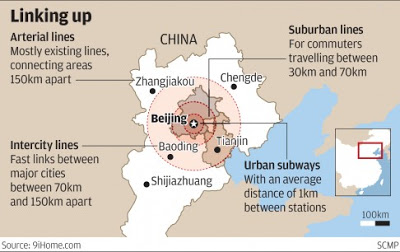
China is breaking the administrative barriers between Beijing-Tianjin-Hebei. This will enable coordinated development. Transportation, education, medical, economic, ecological services are moving towards integration in the cities which make up the 130M Jing-jin-ji megacity area.
2017-07-13: China Megacities
Chinese megacities are associated with the greatest migration in human history, namely the movement of several 100M people from the countryside into urban areas. This has created over 100 cities with a population of more than 1M. And while Westerners tend to see only the harmful effects of that transformation, it’s gone fairly smoothly. Wages and living standards have risen to create the biggest rapid boost in prosperity the world has seen, ever. Surely it’s worth taking a closer look at that.
If you spend a few days in these places, they will stand out as quite distinct. To suggest otherwise is actually to repeat a common Western imperialist meme about the Chinese, namely that they “are all the same” in some underlying manner. Observing and understanding diversity is a skill, and the Chinese megacities are one of the best places for cultivating this capacity.
2018-07-03: Faster commutes are key for integration
It seems clear that China will continue to leverage technology to enable faster commuting within city regions.
- more high-speed rail lines
- robotic buses
- robotic cars and ridesharing with high-speed roads and tunnels
- ultra-fast elevators to commute from skyscraper to skyscraper and to speed the last 300 meters.
China will do what takes to get the potential 50% GDP boost from truly efficient 1-hour connections.
2018-09-04: China Urbanism
China is creating 19 supercity clusters by strengthening the links between existing urban centers. The supercities will have 800m people and more than 80% of the country’s GDP in 2030. 287m people have moved from low-income agriculture to higher-income city industries, the largest population transfer in history. Another 40m people will migrate to cities by 2020 and the productivity gap will have more than halved since 2000.

 Gregor J. Rothfuss