extremophile microbe that can stand 500x radiation of a human, heat, cold, dehydration, vacuum and acid. uses dna repair to reassemble dead cells. could lead to cures for dead neurons
Tag: dna
Working on a biochemistry problem

It’s good to know my computer is actually just doing that, with near 100% efficiency, instead of being mostly idle. Plus, looking at the protein folds and wishing to be able to nudge the search algorithm closer to the lowest-energy state is quite mesmerizing. You also gotta admit that they do have a cool line for their advertising.
2023-08-09: A coda for BOINC
BOINC had some success. It enabled lots of science, and it got lots of people all over the world interested in science. Thanks to NSF, it paid my bills for 15 years, and it gave me freedom to do what I wanted, to travel, and to work with lots of great people. As a piece of software, BOINC is (mostly) beautiful, and I enjoyed designing and writing it.
But BOINC never fully achieved any aspect the vision I outlined earlier. There were moments when it seemed like it might: for example, the HTC and Suzuki projects, the Open Science Grid collaboration, the Anbince thing, and a dozen others. Each of these seemed, initially, like it might put BOINC “over the top”. But all the initiatives petered out, for reasons outside my control. The cycle of hope followed by disappointment, over and over, has worn me down.
Plague
It was about the beginning of September, 1664, that I, among the rest of my neighbors, heard in ordinary discourse that the plague was returned again in Holland; for it had been very violent there, and particularly at Amsterdam and Rotterdam, in the year 1663, whither, they say, it was brought, some said from Italy, others from the Levant, among some goods which were brought home by their Turkey fleet; others said it was brought from Candia; others from Cyprus. It mattered not from whence it came; but all agreed it was come into Holland again.
I just finished Daniel Defoe’s a journal of the plague year.
2014-09-30: this is an awesome poster visualizing the plague, walking you through how real science is done, in an entertaining and informative way.

2015-10-06: Plague is one of the most virulent pathogens.
the acquisition of a single gene named pla gave Y. pestis the ability to cause pneumonia, causing a form of plague so lethal that it kills essentially all of those infected who don’t receive antibiotics. In addition, it is also among the most infectious bacteria known. “Yersinia pestis is a pretty kick-ass pathogen. A single bacterium can cause disease in mice. It’s hard to get much more virulent than that.”
2021-03-30: Pushing the Black Death origin back.
Monica Green published a landmark article, The 4 Black Deaths, in the American Historical Review, that rewrites our narrative of this brutal and transformative pandemic. In it, she identifies a “big bang” that created 4 distinct genetic lineages that spread separately throughout the world and finds concrete evidence that the plague was already spreading from China to central Asia in the 1200s. This discovery pushes the origins of the Black Death back by over 100 years, meaning that the first wave of the plague was not a decades-long explosion of horror, but a disease that crept across the continents for over 100 years until it reached a crisis point.
2022-02-16: Black Death mortality rates varied widely.
“The data is sufficiently widespread and numerous to make it likely that the Black Death swept away 65% of Europe’s population”. But those figures, based on historical documents from the time, greatly overestimate the true toll of the plague. By analyzing ancient deposits of pollen as markers of agricultural activity, researchers found that the Black Death caused a patchwork of destruction. Some regions of Europe did indeed suffer devastating losses, but other regions held stable, and some even boomed. It’s possible that the ecology of rats and fleas that spread the bacteria was different from country to country. The ships that brought Yersinia to Europe may have come to some ports at a bad time of the year for spreading the plague, and to others at a better time.
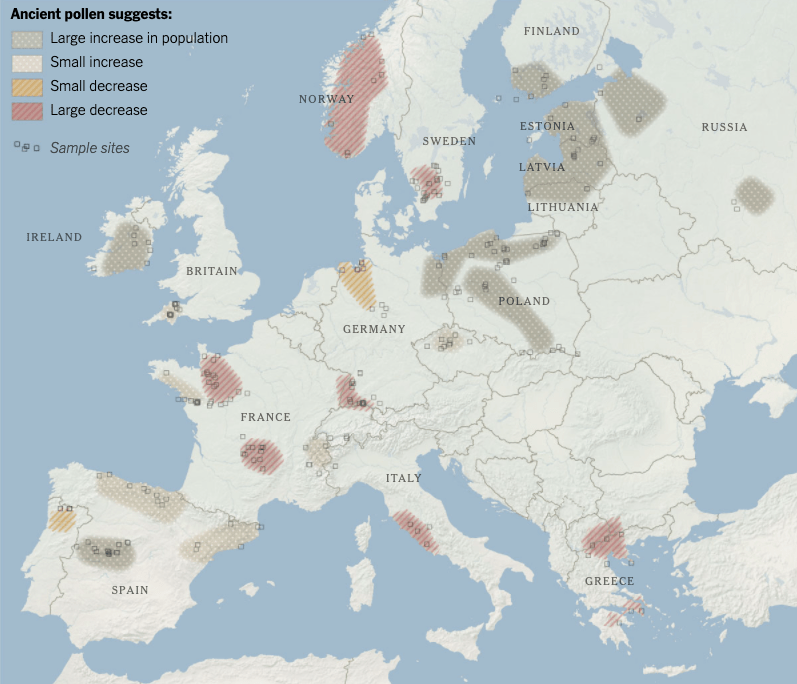
2022-08-12: The plague may have had a role in the collapse of Egypt’s Old Kingdom and the Akkadian Empire in Mesopotamia
During the late 3rd millennium BCE, the Eastern Mediterranean and Near East witnessed societal changes in many regions, which are usually explained with a combination of social and climatic factors. However, recent archaeogenetic research forces us to rethink models regarding the role of infectious diseases in past societal trajectories. The plague bacterium Yersinia pestis, which was involved in some of the most destructive historical pandemics, circulated across Eurasia at least from the onset of the 3rd millennium BCE but the challenging preservation of ancient DNA in warmer climates has restricted the identification of Y. pestis from this period to temperate climatic regions. As such, evidence from culturally prominent regions such as the Eastern Mediterranean is currently lacking. Here, we present genetic evidence for the presence of Y. pestis and Salmonella enterica, the causative agent of typhoid/enteric fever, from this period of transformation in Crete, detected at the cave site Hagios Charalambos. We reconstructed 1 Y. pestis genome that forms part of a now-extinct lineage of Y. pestis strains from the Late Neolithic and Bronze Age that were likely not yet adapted for transmission via fleas. Furthermore, we reconstructed 2 ancient S. enterica genomes from the Para C lineage, which cluster with contemporary strains that were likely not yet fully host adapted to humans. The occurrence of these 2 virulent pathogens at the end of the Early Minoan period in Crete emphasizes the necessity to re-introduce infectious diseases as an additional factor possibly contributing to the transformation of early complex societies in the Aegean and beyond.
Minimal life
Craig Venter has been given ethical approval and a government grant to build the first artificial bacterium. He plans to create a single-celled organism with the minimum number of genes to sustain life.
This could be the drosophila of proteomics by having an idealized organism that is as simple as it can possibly be. Even then, this organism will still be orders of magnitude more complex than cellular automata. Now that I have more time, I need to delve into a new kind of science


2008-09-12: Syn3.0
J. Craig Venter’s work to build an artificial bacterium with the smallest number of genes necessary to live takes current life forms as a template. Protocell researchers are trying to design a completely novel form of life that may never have existed.
2014-09-03: See also this talk on synthetic life:
We now know we can create a synthetic organism. It’s not a question of ‘if’, or ‘how’, but ‘when‘, and in this regard, think weeks and months, not years.
2016-03-26: syn3.0 update:
Venter’s team painstakingly whittled down the genome of Mycoplasma mycoides to reveal a bare-bones set of genetic instructions capable of making life. syn3.0 contains just 473 genes or 531k bp, smaller than any independently replicating organism discovered on Earth to date. it is unclear what 149 of these genes do. also not a single gene is shared across all of life
2016-10-16: syn3.0 isn’t minimal though. Symbionts / parasites need ~50% DNA:
With only 160k base pairs of DNA, the genome of Carsonella ruddi is less than 50% the size thought to be the minimum necessary for life. Carsonella lives inside a leaf-munching insect, called a psyllid. They have a symbiotic relationship. The bacteria’s sheltered life has allowed it to pare its genome down to the bare minimum. There are certain genes necessary for life that the bacteria’s genome lacks, but these are compensated for by its insect host.
2022-02-25: And now some new work blends Alife with minimal life:
The minimal cell the team modeled, JCVI-syn3A, is an updated version of one presented in Science in 2016. Its genome is designed after that of the very simple bacterium Mycoplasmas mycoides, but stripped of genes that were not essential for life. JCVI-syn3A gets by with 493 genes, but no one knows what 94 of those genes do except that the cell dies without them. To build the new model, the team took an abundance of findings from various fields and wove them together. They used flash-frozen, thin-sliced images of the minimal cell to position its organic machinery precisely. A massive protein analysis helped them sprinkle all the right known proteins inside, and a detailed analysis of the cell membrane’s chemical composition helped them place molecules correctly on the outside. A thorough map of the cell’s biochemistry provided a rulebook for the interactions of the molecules.
As the digital cell grew and divided, 1000s of simulated biochemical reactions occurred, revealing how every molecule behaved and changed over time. The simulations mirrored many measurements of living JCVI-syn3A cells in culture. But they also predicted characteristics of the cells that hadn’t yet been noticed in the lab such as how the cell portions out its energy budget and how quickly its messenger RNA molecules degrade, a fact that critically affects researchers’ understanding of how the cell regulates genes. With a complete enough model, the researchers should be able to get creative: They can see what happens if they prune biochemical pathways, drop in extra molecules or set the simulation in a different environment. The results should give more insights into which processes cells need to survive — and which they don’t. They might even offer glimpses into what the very first cells required billions of years ago.

2022-02-28: New Yorker writeup: Richard Feynman once quipped that biology would be easy if you could “just look at the thing!” We are nearly there. “All these questions that people have. I think you’re going to be able to say, ‘Let’s just do a tomogram.’ ”
Some biologists are now combining approaches. Their goal is to create an integrated view of life inside the cell, in the form of a computer simulation that puts the whole system into motion. In grad school, Villa studied under Klaus Schulten, who helped develop the field of whole-cell computational modeling. Klaus worked from the bottom up, favoring “all-atom” simulations, in which virtual atoms follow the laws of quantum mechanics, while Zan worked from the top down, with “kinetic” models that track the cell’s larger traffic patterns. By the 2010s, the state of knowledge had advanced enough for them to try building a hybrid model. Klaus died in 2016. But, last month, Zan’s group published a paper in Cell that outlined a computational model of JCVI-syn3A. The model drew on cryo-EM images from Villa’s lab and on a genetic inventory supplied by J.C.V.I. It included all 452 of JCVI-syn3A’s proteins, plus other cellular bits. In the simulation, these parts interact among themselves as they would in real life.
The software aims to simulate a world that’s very different from ours. If a cell were blown up to the size of a high-school gym, you wouldn’t be able to see across it. It would be filled with 10000s of proteins, most about the size of a basketball. Other biomolecules no bigger than your hand, and water molecules the size of your thumb, would fill the spaces between. (To scale, your whole body would be about the size of a ribosome.) The mixture would have the consistency of hair gel. In such a world, gravity would be virtually meaningless—you would be weightless, as if suspended in a ball pit. And everything would be moving. The mixture would buzz constantly; spend just a few seconds inside it and every medium-sized object around you would have explored every square inch of your body. It would feel like pandemonium, but it wouldn’t be.
2022-03-13: More on cryo-ET and why it is such a big deal.
cryo-ET has evolved tremendously over the past 20 years. Advancements in the field will continue in the years to come, significantly enhancing our knowledge of prokaryotic cell biology. Those enhancements include but are not limited to improved sample preparation workflows, advances in hardware and software, and the curation of the vast amount of data into publicly available resources. Depending on the collection scheme and chosen magnification, fast tomography could increase collection time per target by 50–75%, vastly multiplying the amount of data that can be collected per sample. Resources such as the Caltech Electron Tomography Database have laid the groundwork for building comprehensive collections of cryo-ET data. In turn, some of this information has been translated into resources such the Atlas of Bacterial and Archaeal Cell Structure. This open access, digital resource provides detailed information about the prokaryotic ultrastructure of 85 species, which can be used as a source for comparison of structures in different strains, education, and comparison of sample treatments.
There’s also other microscopy techniques that have lower resolution, but can create 3D movies:
By combining 2 imaging technologies into Multimodal Optical System with Adaptive Imaging Correction (MOSAIC), scientists can now watch in unprecedented 3D detail as cancer cells crawl, spinal nerve circuits wire up, and immune cells cruise through a zebrafish’s inner ear.
2023-07-15: Regaining fitness
We went into the study thinking JCVI-syn3B simply wouldn’t be able to contend with the “inevitable mutations [that are] going to hit one of those essential genes”. The team pitted JCVI-syn3B against the first-generation JCV10syn1.0 from which it was derived. Each strain grew for 2k generations. Although both strains rapidly mutated, JCVI-syn3B could flexibly modify its genes like JCV10syn1.0, even though the latter had far more genetic letters to tolerate random mutations. Both bacterial strains survived similar types of genetic changes—insertions, deletions, and the switching of genetic letters—without a hitch.
“The initial effects of genome reduction were quite large; they made the cells sick”. Their fitness dropped by 50%. Fast-forward 2k generations, and it was a different picture. The minimal cells bounced back, regaining a fitness rate similar to their non-minimal cousins. Despite harboring a bare-boned genome, they readapted to their surroundings and overcame initial genetic shortfalls. The minimal cells’ main lifeline seemed to be “metabolic innovation.” Rather than adapting themselves to slurp more nutrients from the surrounding broth, the cells instead increased their ability to synthesize molecular pieces of fat into an outer protective layer, without sacrificing the lipid molecules essential for regeneration.
 Gregor J. Rothfuss
