Tag: conferences

Accelerating change

The world is getting more complex at a rate we can’t cope with, it seems. The fabric of society needs to be updated. Collaboration needs to happen at deeper and broader levels, entire layers of abstraction need to be designed to fight complexity. Can massively parallel collaboration technologies help? I hope so, and David Gelernter thinks so as well.

His livestreams concept sounds like an advanced form of weblogs to me.
2003-08-03: Accelerating Change

I’m considering attending I will attend the Accelerating Change conference.

In both universal and human history, there is a special subset of events that have continually increased their speed and efficiency of change. Accelerating systems are regularly able to accomplish more with fewer resources; as a result, they avoid normal limitations to growth. Over the 20th century, several domains of technological development have accelerated, even during deep recession, driven primarily by the powerful new physical and economic efficiencies that they introduce into the human economy. Perhaps even more interestingly, looking ahead we can see no natural limit to specific accelerating physical and technological efficiencies.

2003-09-13: The mixer at Accelerating Change was mind blowing. A very diverse group of people at my table, from Todd who is a researcher with the Alcor life extension foundation to Michael Anissimov to Alex Jacobson who was at reorient too.
2003-09-14: The Accelerating Change conference is still going on. There is so much good material being presented, and not having wifi forces me to just write down the major points.
things to look up
Caloric Reduction
eintelligence.com
innovationwatch.com
openEEG.org
IPTQ.org
notions
3D computing makes slow circuits (brain) fast
exponential computing power applied to exponential problems leads to linear increases (speech processing etc). This is valuable
Is substrate-independent computation possible?
There are 1000 basic protein shapes. Think of it as the atomic table of proteins. All these are assembled with 1 protein
As computing power increases, the simulation becomes the reality
GP (genetic programming) is able to find patentable new solutions with 30 day runs on a 1000 node cluster.
AGI (Artificial General Intelligence) as a singularity trigger
One human life has ~1021 bytes of information
The universe has performed 10120 computations since the big bang
People to follow up with
Paul Boutin
Michael E. Muston
Steve Jurvetson
2003-09-15: Accelerating Change was without doubt one of the most inspiring conferences I attended the last couple years. It will take me weeks to digest the torrent of mind boggling, challenging notions I gathered in these 2 short days. The crowd was most excellent, to the point that I felt like a toddler among adults. The schmoozing was most excellent too. I conclude with some random notes (again, no time to write them up properly, alas)

cool stuff

tribe.net social networking
iawiki.net information architecture
danah boyd has a “net nanny” blog with netiquette rules
keith devlin writes awesome math books
stumbleupon.com social bookmarking
quantumtheology.com intersection of technological change and consciousness

notions to think about

there are more molecules in a drop of water than transistors ever built
brain circuitry is 10k times more efficient than CMOS
solid state lighting will reduce energy consumption for lighting by 50% worldwide
how much do you have to vertically integrate nanotech to have a product? can’t sell a speck of sand can you 🙂
Imago has a 3D atom imaging device
it should be possible to bootstrap new organisms starting from a minimal genome of 300 genes
technology enables more and more non 0-sum games
0-sum games do not communicate, while non 0-sum games rely on communication
there is a recognition stack for voice recognition that goes like this: phonetics – phonology – morphology – syntax – semantics – pragmatics
the nuance vocalizer 3.0 has achieved almost human levels of speech synthesis
computers outperform humans in certain voice recognition tasks (noisy environments)
tim o’reilly claims that NCSA was inspired to write mosaic by o’reilly pitches
the read / write ratio for wikis is approx. 20 / 1

stay in touch

terry frazier
ross mayfield
mila golynski
ramez naam
2003-10-23:

“Crackpots, too SciFi,” were the comments he kept getting from other nanotech entrepreneurs. “I still find it absolutely amazing that one early-adoption population considers another early adoption population a bit too ‘out there.’ “

Hm, I guess that makes me a double crackpot (or a kool aid drinker) for attending Accelerating Change. I’m ok with that though.
2004-09-18: I will be attending Accelerating Change 2004. This will be without doubt the best conference of the year again.
2004-11-06: Accelerating Change 2004 has begun. Last night was simply awesome (writeup over at terry frazier’s). It is not every day that you get to casually hang out with Larry Page, Sergey Brin and Doug Engelbart at the same time. Doug and Larry had a lot of fun playing with Roomba, and we had a discussion with Helen Greiner from iRobot about upcoming APIs for these autonomous robots. Pictures coming 🙂

This morning I am sitting in a presentation by Helen. She is talking about how her field, robotics, benefits from accelerating change. Roomba, their cleaning robot, sold 1M units already, with prime time advertising. Their vision is “Eliminate dangerous and repetitive tasks.”
She is showing movies from Afghanistan, with special ops soldiers sending robots into caves for reconnaissance, and Iraq, where robots defeat bombs remotely. One of these robots is about a 100k worth of equipment. She estimates the size of the autonomous robotics industry to be about $500M today, with their company increasing business 4x in the past year.
Now she is showing a movie with 10s of robots swarming in a room, only communicating with their closest neighbors. It looks surprisingly like an ant nest.
How can robotics tap into accelerating change? Moore’s law of course (Helen mentions CCD sensors as an example: what used to require extremely heavy computation for object recognition is now helped by advances in sensor quality). Getting OEM involved to grow the market, strategic relationships (iRobot developed $200 toy robots, brought it down to $18 by learning from their toy industry partners) She is showing a video of a velociraptor toy, complete with roars. Think Aibo, dinosaur style. Another strategic partnership: John Deere. Think robotic tractors.
Helen predicts that the aging population will drive demands for robotic elder care applications. “building on the beerbot idea, the robot that brings you a beer during the super bowl, build a robot to make sure people are sufficiently hydrated at all times.”
Entertainment: 33% of furby sales went to adults without kids.
Interesting sightings

  • Buddy Buzz, combining mobile speed reading with posse-style recommendations. It’s principal BJ Fogg has some scary ideas about persuasive technologies that he calls captology.
  • Alicebot is the leading bot technology, with an open source community behind it’s aiml, the Artificial Intelligence Markup Language, which is the markup language for the alice bot. Seems obvious to try to apply wikipedia lessons to the nurturing of its body of knowledge.
  • Digital space, a commons in cyberspace which tries to bootstrap old and new organizational models using the tools cyberspace offers.

2006-10-03: A pretty decent futurist blog by Michael.
2007-03-01: Nice accelerating change type video.

2007-08-15: A warning

Given this mysterious and rapidly approaching cloud, there can be no doubt that the time has come for the scientific and technological community to seriously try to figure out what is on humanity’s collective horizon. Not to do so would be hugely irresponsible

2014-09-29: Factors of accelerating change

From Moore’s Law to property development, drones, and space exploration, Steve Jurvetson discusses factors affecting accelerating technological change.

Steve is the rarest of creatures: a VC who gets it at a MUCH deeper level than all the “social media / disrupt” clowns. You might not agree with everything, but he’s consistently interesting.


Tech Ed Day 4

due to the attractions of barcelona’s nightlife, i missed out on most of the talk about attributed programming. would have been interesting, but like it was it went over my head a bit..

uddi was touted as a solution for finding out about web services and to facilitate integration of applications across the network. while a directory of services is certainly useful it remains to be seen how many directories will be vying for attention and thus reduce the reach of each of them. wsdl, which is the standard to describe the actual apis turns out to be a “throw everything in” kind of standard. even microsoft’s implementations (there are 3 of them) have no interop..

the talk on java vs .net was very well done and while the 2 platforms look remarkably similar, java does not currently have a web services strategy. what became evident though is that all major vendors bet on web services and have at least agreed on soap for interop.

the evening held a gigantic party in store. microsoft had rented the olympic stadium and the surrounding area and threw a party for all 9000 tech ed attendees. attractions ranged from spacing
to foods of all sorts, including an attempt to produce the largest paella ever made (with a diameter of 5m they seem to have succeeded) to clowns, to a concert by a queen lookalike band, to the final fireworks.

tech ed day 3

the day started off with an in-depth session about c#. c# has some nice properties that can stand on their own, but industry support will be crucial. versioning of classes is an approach to tackle the fragile base class problem where changes in a base class lead to bugs in derived classes because the derived classes expect certain methods or variables to be there. versioning can at least give the programmer a hint where problems may arise. if i understood this correctly this versioning information is part of the metadata that is stored alongside the classes and can therefore be used at runtime. another nifty feature are xml comments. extending on the javadoc idea,

they can contain structured comments which can then be transformed with an xsl stylesheet. besides this there are some minor cleanups of c++ like requiring boolean values with each if while construct or escaping entire strings like this: string bla = @”\servershare.la.txt”;

the next presentation was quite impressive, with mark russinovich of sysinternals.com fame at the helm. he gave a walk through for some of his tools, like filemon, regmon to monitor file / registry accesses, respectively. his tools are even used within microsoft. also his process explorer does a lot more than the built in task manager, like killing any process without giving stupid access denied errors. he even has some nifty tool to remotely execute commands. this little hack works by auto-installing a service via the admin share of a remote computer and then carrying out the requested operation.

after his session i tried to charge my notebook but only got to 50 % meaning i had to look for power strips all day 🙂 the lunch session was very informally held by mark russinovich. his first slide surely caught our attention.

he then went on to demonstrate how far windows has come in terms of architecture, stability and scalability. he threw in lots of tidbits like the fact that the build number for windows is being continuously increased since 1992, the most current is 2505 (XP RC1). so this basically means that the windows os has had 2500 complete builds in 10 years. locking has been made more fine-grained in XP, resulting in scalability increases. i can see it now: a new round of windows benchmarks stacked against linux benchmarks. it came to light that the nt kernel is written somewhat object-oriented (it even uses exception handling i hear) if details like these interest you you should check out the nt resource kit as it comes with great documentation.

the rest of the afternoon was spent in 2 sessions about debugging, one called analyzing crash dumps and the other .net debugging. the first one was quite interesting, i learned that microsoft has a tool to analyze crashes which uses heuristics to determine error patterns in your application. somewhat similar to dawson engler’s meta-level compilation except that it analyzes the binary and is therefore most likely
less powerful than dawson’s approach.

in between we squeezed a meeting with jose osuna, responsible academic manager for switzerland. we had a good talk and i hope we can have some events with him in the future.

now i am off to catch some of barcelona’s nightlife. i’ll skip the graveyard session for once.

TechEd day 2

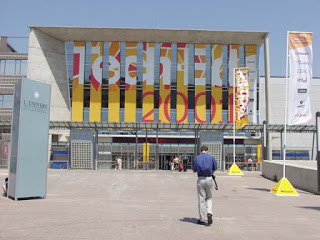
notes on .net and how open source may counter the threat, some stats and great food. we hurried to the conference area after a much too early rise. it was on the way to the conference that we realized for the first time how huge teched is.

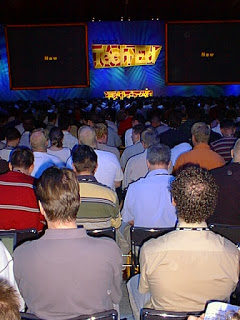
the main room was just gigantic.

we were greeted by queens barcelona anthem followed by some dull marketing fluff. among reams of uninteresting tidbits we learned that there were some 9000 attending teched. after a while anders hejlsberg entered the stage to give the first keynote. considered by some to be one of the best programmers, his performance left a lot to be desired. of course, he had to remain on the surface, this being the keynote he had no chance to demonstrate some of his considerable talents as a language / systems architect. he was quite successful to give a glimpse of the .net framework and its far-reaching impact, however. all of the days sessions centered around .net. the point that microsoft believes in open standards was driven home many times, with some credible demonstrations like microsoft’s early involvement in xml standardization and its increasing reliance on established standards like kerberos, ldap, dynamic dns, wbem (web based enterprise management), xpath, xslt, http (the list goes on) over the course of these presentations it became very clear that microsoft has unleashed something much larger than it can ever hope to handle like it has in the past when it introduced the concept of web services. web services have all the ingredients of a disruptive technology. they place simplicity where complexity and opaque systems have reigned for so long.

their complete reliance on xml for all aspects has brought them some criticism from some quarters that they are not being efficient and that xml adds nothing that was not there before. i was wondering along these lines as well. however when i saw how the concept of web services has evolved in one year i started to notice similarities to the classic and incredibly successful osi model. web services start where osi ends, but they share the concept of piling independent services on top of each other. this has been a very powerful architecture in networking systems, especially tcp/ip. since xml is such a simple representation of data it has been very easy to extend web services with additional layers and make them increasingly powerful. i believe that the benefits from a large scale adoption of xml will be reaped with ever more layers stacked on each other, with ever increasing power.

although web services are an active area for the w3c, it remains doubtful how the industry will counter microsoft’s .net juggernaut. declaring support for soap, as ibm, sun, oracle and others have done, is not going to cut it. what is needed is a credible architecture that can compete feature by feature with .net. although all the components like apache (web server), soap for apache, jabber (xml messaging), kdevelop (ide), postgresql (database), ldap (directory) exist in the open source community, they are not part of an overall architecture. it would be a major undertaking to get the developers of the respective components to talk to each other and agree on common interfaces. the old unix argument about never setting policy looks quite silly when you realize what productivity gains microsoft will be leveraging with their .net platform.

it also became quite evident that we have seen nothing yet in terms of the web services architecture. many key pieces are missing, like meta data to enable the retrieval and processing of semantics from
data (to support agent technology for instance), the questions of payment for web services and global, fine-grained security matrices (who has access to which of my data). web services are loosely coupled
but they have no mechanism to guard against api changes or to facilitate negotiations on usage terms for web services.

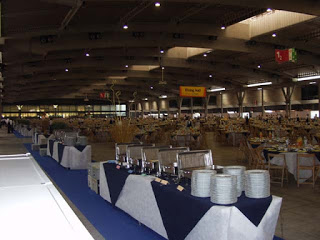
besides all these lofty ideas we came back to reality quickly when we saw the enormous amount of logistics that went into this conference. details like having a dining hall for 9000 people
or being so well organized that leaving my camera in the computer area was not a complete disaster (i struck it lucky when i got it back from the lost & found counter) made a big impression on me. the all you can eat buffets every few meters had their influence as well..

i learned a few interesting details about eai (enterprise application integration) an area where bea systems has been strong and microsoft made their debut with their biztalk server. for instance most people that believe that they need synchronous interfaces (ie immediate access to results) actually don’t.
you can fool these people with clever tricks like pretending to be synchronous on the front end via http redirects while your backend interface is in fact asynchronous. the graveyard session for the day was actually quite funny even though the main speaker had to boast about his accomplishments all the time. they shared many anecdotes like being used as a spam relay during scalability testing, their isp wrongly throttling their bandwidth on the incoming mail connection to 70 kps for 500 concurrent users 🙂 they made up for that with their end to end ipsec deployment (would have been too lovely to sniff passwords in a lan with 6000 mobile ethernet clients..) and replicating several databases in real time to london. after this session we were driven to a nice location just opposite our hotel for the swiss country dinner. it was basically one of the nicest places i have been to in quite some time. great job microsoft.

tech ed day 1

submitted directly from the conference floor via wireless ethernet.. 🙂 that’s the power of wireless i guess..
we entered barcelona after a refreshing flight with sensational view over the alps around 10. after checking into the hotel we went to the conference center where we were greeted by bunches of geeks sitting on the floor, huddled over their notebooks or their newly acquired geek toys (aka compaq ipac).

we were handed a monstrous conference backpack in bright yellow. the backpacks were just too offensive for our visual cortexes so we had to dispose them soon afterwards. we queued to get a hot new compaq ipac with a wireless ethernet card. soon afterwards we were successfully checking into the abstrakt portal. does this rule or what. somewhat relieved and with our ipacs we headed back to the hotel to chill out and play with the ipacs.

although they have a high coolness factor and it was great fun playing around with them we concluded that using the analog conference schedule still beats the online version by a lot in regard to usability. besides, the paper version does not forget your notes after a reset. after hunger sent us out to fetch some food (we found some selection of tapas) we headed back to the conference for a special student welcome dinner. microsoft must have taken a page from other conferences since we were greeted by nice hostesses. what a contrast to all these shy geeks.. unfortunately though there were not too many female geeks around, as had to be expected.
we were then driven to a restaurant and a large buffet was quickly consumed. we shared the table with 2 guys from cambridge who are working as microsoft consultants during summer break. they are currently implementing voice over ip application over gprs using the compaq ipac. to our great amusement they were avid slashdot regulars and the rest of the evening was thus spent in merry geek lore. topics ranged from umts to the singularity to debian installs. in short, a very refreshing discussion. we were then
advised as to what sessions out of the 264 we should attend. clearly there will be some hard choices to be made as some interesting sessions collide.
after we were handed a fancy schmancy jacket in brightest yellow (we kept it because it looked kinda neat for a change) we were dismissed and spent the rest of the evening catching up with various projects each of us had been silently advancing. barcelona is one heck of a nice city by night.
so many decent places to hang out.

conference week

in less than 7 hours i will be on the plane to barcelona. going to microsoft teched 2001. i hear there is a lot of criminal energy in barcelona. what the heck i’m taking my cam, notebook etc with me nonetheless. will be interesting to spend a week with my flat mates for once. 😉