We must transform the Intelligence Community into a community that dynamically reinvents itself by continuously learning and adapting as the national security environment changes. These changes include allowing our officers more autonomy in the context of improved tradecraft and information sharing. In addition, several new technologies will facilitate this transformation. 2 examples are self-organizing knowledge websites, known as Wikis, and information sharing websites known as Blogs.
Tag: collaborative
Unconferences are so 2003
New York Times-bestselling author Thomas Barnett comes to Second Life in avatar form to speak on his Blueprint for Action– October 26, 11:30-13:00. He’ll address us from the floor of a virtual UN building, speaking to an audience, one hopes, that’ll include Residents from around the globe– those in the Functioning Core, those in the Seam states, and with luck, even those from the Non-Integrating Gap itself.
barnett is very interesting, and this setting doubly so. i’ll most likely be there (as Kichiro Kawabata).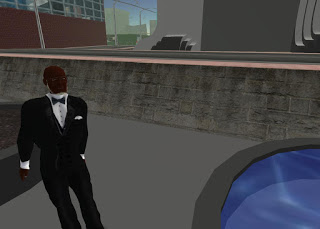
Tricking slackers into working
a year ago, i wondered about the state of free knowledge creation. in the meantime, del.icio.us, flickr and foremost, wikipedia have brought infoware to a much broader audience. i have a keen interest in peer production, and i noticed recently how i am often too tired to contribute to open source projects, but end up slacking a bit and maintaining my del.icio.us account and other infoware bits instead.
this makes me wonder if infoware with it’s immediate gratification and strong network effects will have a far deeper impact on the creation of societal wealth than open source ever will. the thought that more of that almost limitless source of energy (slacking) could be tapped.
Best of wikipedia
wikipedia featured articles links to the cream of the crop at wikipedia. it will be educational to periodically review that page and assess whether the quality drive over there can produce top-notch articles in great numbers. one of the common critiques of wikipedia is that truly great articles are hard to emerge because the collaborative editing process is vulnerable to clueless editors. it is telling how many of the featured articles are in the realm of pop culture (where presumably, more editors can contribute meaningfully). i wonder at what point the growth of articles reaches a saturation point, and the editing process shifts towards refactoring?
Collective IQ
doug engelbart requires no introduction. his 1968 demo is legendary, and here is to hoping he can teach us young upstarts some tricks to bootstrap. doug moved to the bay area in 1948 and had a life-changing epiphany that he had no goals in his career. so he settled on a goal to maximize his contribution to mankind. his goal: to boost mankind’s collective ability for coping with complex, urgent problems. at the time, there were 3 computers in the US. Doug starts talking about CODIAK capabilities, for Concurrent Development, Integration, and Application of Knowledge. he asserts that human cognitive abilities depend on their augmentation system. for each tool system, a human system is changed: Media vs Perception, Portrayal vs Organization etc. Their original system had a steep learning curve because it focussed on concepts such as transposing and groups while traditional office automation called for howto-like, step by step instructions. scaling of augmentation is a whole science to itself: Dimensionality Numbers. The example doug used was that if you were a 1000x heavier you would not be 1000x stronger, but only 100x because strength scales differently. Which would be the same as having a 10% of your strength with your current weight 🙂 Doug also mentions a sample of the increasing complexity of world problems: The State of the Future which appears every year. (2004 report) A definition of bootstrapping: “Pursue the capabilities that increase the capabilities to pursue.”
Collaborative text editing
stef just finished her master thesis on tendax, a collaborative editor that has an innovative database backend to support multiuser editing and other advanced features. on a less happy note, tendax marks the first software patent of my alma mater. stef was featured in a computerworld article about tendax. by the way, what’s up with the silly image on the tendax homepage?
Firewall videoconferencing
I have been researching various programs for video conferencing. most solutions are based around SIP which does pose unreasonable demands on firewalls for now. maybe one day, when we have wrestled back the end-to-end principle. more specifically, when SIP proxies are widely available and are easy to install. in the meantime, here is a list:
working
- skype (uses not firewalled nodes as proxies, but is audio only)
- eyeball chat (uses anyfirewall technology)
not working
- msn messenger (requires UPnP)
- aim 5.5 (requires to open special ports)
- paltalk (adware)
- ispq (requires to open special ports)
- ivisit (requires to open special ports)
- dwyco cdc32 (requires to open special ports)
- iChat AV (requires to open special ports)
- ICQ Video (requires to open special ports)
i’ll update the list as i investigate more applications. note that i only considered free solutions. there are quite a few subscription-based solutions, not sure about their firewall traversal abilities.
Document-based communication
# Tell me why you like wikis.
Wiki, briefly, are the hottest thing in Social Software right now. All this “friendster” stuff is important, but it’s just a ruse. People don’t see the real revolution that wiki represents. Wiki is terribly important because it’s the first public communication system that is DOCUMENT based. Instant Messaging, E-Mail, Internet Relay Chat (IRC), Online Message Boards, all this stuff-
It’s all MESSAGE based.
It’s a “quick signal.” You send a message to someone, and they do something different than they would have done before. “Someone.” Sometimes even a group of people. Maybe you’re on a mailing list, or something. After the message is done, it’s spent. It’s indexed by google, and someone looking for something can find your message amidst a sea of messages, and try to apply it to their situation.
But wiki is totally different. It’s document based.
The fundamental element of a wiki is the document. It’s not a one-off message. (Though, you CAN attach messages to the bottom of a wiki page. Very common.) It’s something that people can use, and refer back to, time and time again.
Real time serendipity
Dave Winer:
What a small world. Gregor Rothfuss is in Zurich, 10 minutes away from the Internet cafe I’m in. He’s coming over. Gregor is the OSCOM guy and was a semi-regular at Berkman Thursdays when he was living in the Boston area last year.
That was fun. All happened within a few minutes. We talked about lots of things, and I told Dave Bloggercon Europe should be in Eastern Europe. Dave seems to like Poland, so I’ll see whether I can make some introductions to the people at the Open Society Institute.
WTFcon london
i’ll be at WTFcon saturday and spending sunday in london too. WTF will be an open space event:
Open Space Technology is a self-organizing practice that releases the inherent creativity and leadership in people. By inviting people to take responsibility for what they care about, Open Space establishes a marketplace of inquiry, where people offer topics they care about, reflect and learn from one another, to accomplish meaningful work. It is recognized internationally as an innovative approach to creating whole systems change and inspiring the best in human performance.
the principles:
- Whoever comes are the right people
- Whatever happens is the only thing that could have
- Whenever it starts is the right time
- When it’s over it’s over
 Gregor J. Rothfuss