Tag: china

Green Cities

From the car-obsessed cities of the 20th to the cities of the 21th century. One is being built in China now

These new megacities could evolve into sprawling, polluting megaslums. Or they could define a new species of world city. Unlike New York or London, they are blank slates — less affluent, perhaps, but also free from legacy designs and technologies tailored to the world of the 19th and 20th centuries. That is a huge advantage. It took Boston 20 years and more than $14B just to reroute a freeway underground. New York can hardly install a second network of water pipes. Most of Los Angeles is too spread out for fast public transit or combined heat and power plants. And because these cities are so isolated from agricultural land, most of the food that locals eat gets shipped 100s of km. “Shanghai today is making 90% of the mistakes that American cities made” — spreading out, building up single-family homes, replacing naturally mixed-use neighborhoods with isolated zones for living, shopping, and working, and connecting it all with car travel. But fixing these problems is still possible. Dongtan breaks ground later this year on a plot about the size of Manhattan on Chongming Island.

2012-07-03: CO2-negative cities. It is well-understood that per-capita resource usage is lower in urban areas than in rural ones, and the first CO2-neutral cities are coming online. Covering vertical surfaces with plants would allow for CO2-negative cities.
2012-07-05: The first eco city, Dongtan, is so eco-friendly it doesn’t even exist.

Dongtan was a planned development described as an eco-city on the island of Chongming in Shanghai, China. Design began in 2005, and by 2010 the development had stalled. The project has been described as a failure.

2021-04-24: Green NYC

Global design firm WATG periodically rolls out speculative GIFs demonstrating how famous urban stretches can be realistically green-ified


2021-11-12: Not sure why it took so long for this to get a bit more traction, but here’s a proposal:

Urban Sequoia achieves substantially more significant CO2 reductions than has been achieved by applying these techniques separately. These strategies can be applied to buildings of all sizes and types. For cities, SOM’s prototype design is a high-rise building that can sequester 1000 tons of CO2 per year, equivalent to 48k trees. The design incorporates nature-based solutions and materials that use far less CO2 than conventional options and absorb CO2 over time. Materials like bio-brick, hempcrete, timber, and biocrete reduce the CO2 impact of construction by 50% compared to concrete and steel. A progressive approach could reduce construction emissions by 95%.

2021-11-13: Another, more ambitious concept:

Carlo Ratti Associati (CRA) has unveiled a project dubbed “the world’s first farmscraper,” to be built in Shenzhen, China. The 218-meter-high, 51-story Jian Mu Tower will contain a large-scale farm system with the ability to produce crops to feed 40k people per year, as well as offices, a supermarket, and a food court. The scheme’s façade consists of a 10k-square-meter vertical hydroponic farm extending the entire height of the building, estimated to produce 270k kilograms of food per year. The Jian Mu Tower seeks to “establish a self-sustained food supply chain” where the cultivation, harvest, sale, and consumption of food takes place under 1 roof.

China 5-Year Guidelines

the Guidelines not only follow in the spirit of previous 5-year plans, they have been developed in line with the current situation. They adopt the strategic concepts of the “Scientific Approach to Development” and “Constructing a Harmonious Socialist Society.” The goals set in the Guidelines reflect a keener attention to the issues of humanity, society and the environment, as well as the economy. And for the first time, the development index has been set to “expected” and “restricted to.”

they still do these? i like “Scientific Approach to Development” and “energy-saving and environmental protection”

Theme Cities

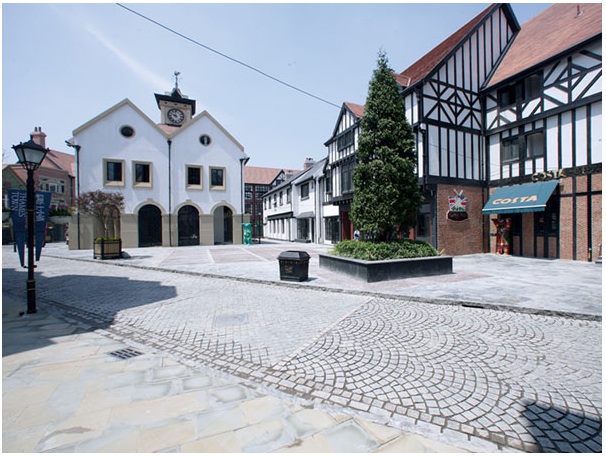
Shanghai urban planners are trying to preserve the center of the city by not building any more new highways, and by setting up 9 satellite cities, or “New Towns” far out in the Shanghai suburbs. But they need to attract people out of the city, into the outskirts–a tough job, unless you can create an atmosphere and lifestyle that one can’t find downtown. Thus the 9 theme cities, 7 based on the architecture of the UK, Italy, Germany, Spain, Sweden, Holland and Canada.

luring people to the burbs by turning them into disneylands

China Cities

Sinocity, a fictitious city in an imaginary Chinese province, reflects more reality of mid-sized Chinese cities than many will admit. The Sinocities Awards seeks to explore awards ways of dealing with this status quo of the near future.

2010-09-02: 1b city by 2040

Going to 2400 km/h in the 2030 to 2040 timeframe would enable 90% of China’s population to be 1 hour apart by low pressure maglev.

2015-04-02: City Hypergrowth. While not quite the fastest growing at 200k people / year vs Karachi at nearly 1m / year, these pictures of rapid transformation are still interesting.

Tim Franco captures the massive urbanization of Chongqing, which has been described as “the biggest city you’ve never heard of” and “China’s Detroit.”

2017-04-02: Megacity integration

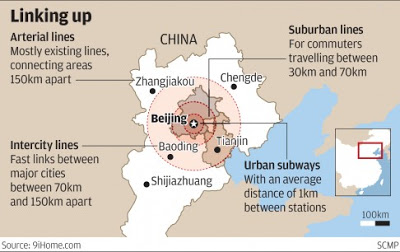
China is breaking the administrative barriers between Beijing-Tianjin-Hebei. This will enable coordinated development. Transportation, education, medical, economic, ecological services are moving towards integration in the cities which make up the 130M Jing-jin-ji megacity area.


2017-07-13: China Megacities

Chinese megacities are associated with the greatest migration in human history, namely the movement of several 100M people from the countryside into urban areas. This has created over 100 cities with a population of more than 1M. And while Westerners tend to see only the harmful effects of that transformation, it’s gone fairly smoothly. Wages and living standards have risen to create the biggest rapid boost in prosperity the world has seen, ever. Surely it’s worth taking a closer look at that.

If you spend a few days in these places, they will stand out as quite distinct. To suggest otherwise is actually to repeat a common Western imperialist meme about the Chinese, namely that they “are all the same” in some underlying manner. Observing and understanding diversity is a skill, and the Chinese megacities are one of the best places for cultivating this capacity.

2018-07-03: Faster commutes are key for integration

It seems clear that China will continue to leverage technology to enable faster commuting within city regions.

  • more high-speed rail lines
  • robotic buses
  • robotic cars and ridesharing with high-speed roads and tunnels
  • ultra-fast elevators to commute from skyscraper to skyscraper and to speed the last 300 meters.

China will do what takes to get the potential 50% GDP boost from truly efficient 1-hour connections.

2018-09-04: China Urbanism

China is creating 19 supercity clusters by strengthening the links between existing urban centers. The supercities will have 800m people and more than 80% of the country’s GDP in 2030. 287m people have moved from low-income agriculture to higher-income city industries, the largest population transfer in history. Another 40m people will migrate to cities by 2020 and the productivity gap will have more than halved since 2000.

China Internet Culture

Chinese users have lower standards for their glamor shot — blurry and what i called candid webcam shots are in.

heh
2009-03-03:

This view challenges the dominant paradigm we use to understand the Chinese internet, the Great Firewall. Rebecca argues that this makes it harder to understand cybertarianism. We’re tempted to assume that if we just lift the Firewall, China will be free… and that’s an extremely naive view. The GFW only pertains to servers hosted outside of China. For sites hosted within China, the Net Nanny is a much better metaphor for understanding content control.

it is not as straightforward as “the great firewall”

China MySpace

The front page shows 3 mainland Chinese users and 3 international users, and they can all friend each other. How do they choose who gets on the page as international users? Unclear. But Tom is every Chinese MySpace user’s first friend, as usual. Seems like there might not be that many Chinese users…or maybe not that many writing in English. Unclear.

now we only need instant translations and the fun begins for real