sky maps is extremely awesome. i will be playing with this at kitt peak next week for sure.
Tag: astronomy
Alien Oceans
If we can see the signature of oceans in Earthshine, then we should see it on Earth-like planets elsewhere in the cosmos
Notable Exoplanets
The 100s of exoplanets discovered to date are an extremely diverse group. Many are Jupiter-like gas giants, but some have a rocky surface. Many are extremely hot, orbiting close to their home star, but some are icy-cold. Some orbit massive stars, many times more brilliant than our Sun, others circle dim red dwarfs.
And yet, even in such an eclectic group, some exoplanets stand out from the crowd. These are planets that possess some unique feature that singles them out. Or they are typical planets that are better studied and better known than the others. To provide a taste of what these alien worlds are like, here is a selection of a few such notable exoplanets and what scientists know of them.
Kepler mission
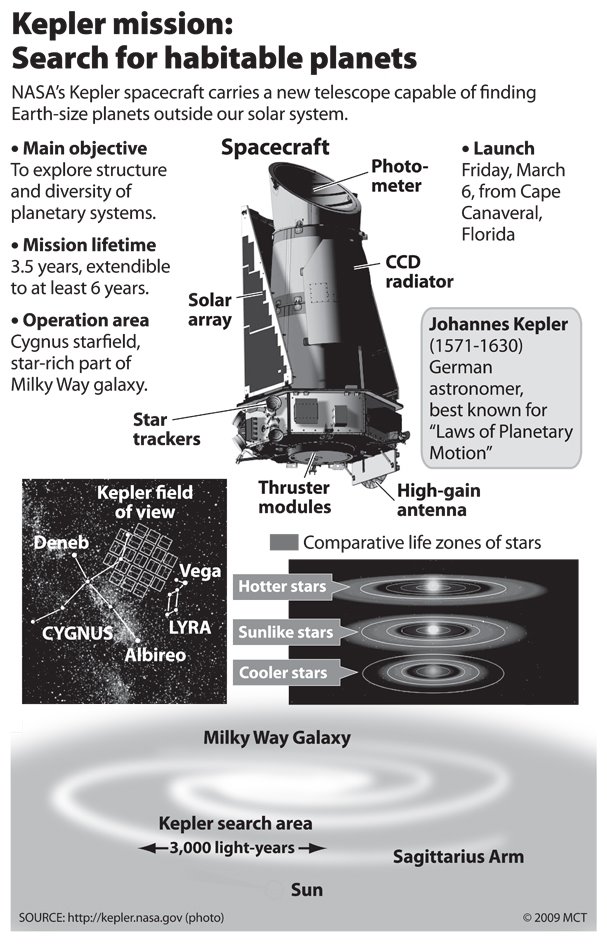
Launched today. Will search an area of 3000 light years in our neighbor arm, the sagittarius arm, for earth-like planets. Expected haul, 500.
2010-07-26: After finding more planets in the first year of the Kepler mission than all previous efforts combined: “earth-sized planets are common in the galaxy”
2011-02-01: Transit requires the right inclination for detection, and is quite unlikely, which means there should be 10k as many planets out there than they found. about 12M.
2013-11-23: Using a solar sail approach. Clever
NASA outlines ingenious plan to resurrect the Kepler planet hunter. “K2” mission would use its solar panels as a pointing device.
2015-12-15: Really awesome visualization about all the solar systems yet discovered.
2021-10-27: The final haul was 2662.
10^50 Simulated Human Mind Equivalents
milky way is 8x bigger than previously thought. new value for drake equation?
Center of the galaxy
The Sun

The Sun is now in the quietest phase of its 11-year activity cycle, the solar minimum – in fact, it has been unusually quiet this year – with over 200 days so far with no observed sunspots. The solar wind has also dropped to its lowest levels in 50 years. Scientists are unsure of the significance of this unusual calm, but are continually monitoring our closest star with an array of telescopes and satellites. Seen below are some recent images of the Sun in more active times.
Hanny’s Voorwerp

the curious blue object known as “Hanny’s Voorwerp”, noted in the galaxyzoo.org public-participation census of the Sloan Digital Sky Survey
Asymmetric Inflation
Colossal structures larger than the visible universe – forged during the period of cosmic inflation nearly 14B years ago – may be responsible for a strange pattern seen in the big bang’s afterglow
Naked-Eye GRB
GRB 080319B’s optical afterglow was 2.5m times more luminous than the most luminous supernova ever recorded, making it the most intrinsically bright object ever observed by humans in the universe. A redshift of 0.94 translates into a distance of 7.5b light years.
 Gregor J. Rothfuss