a point on a body within the Solar System which is eternally bathed in sunlight.
Tag: astronomy
1.7T Galaxies
Lyman-alpha surveys miss 90% of all galaxies, so now we have 1.7t instead of 170B.
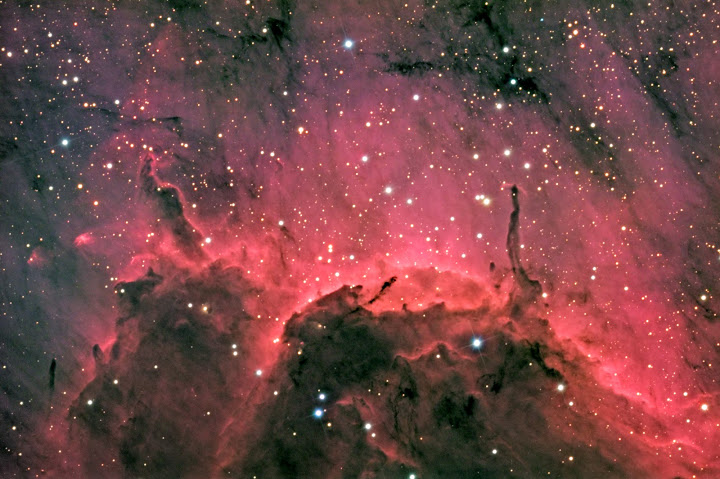
IC 5067
in may 2009, i spent a night at kitt peak national observatory, the largest on the planet, to take a picture of IC 5067. IC 5067, also known as the pelican nebula, is 2000 light years away on our spiral arm of the galaxy, the orion arm. it is 15 light years across, and an active region of star formation.
the picture was taken on a 0.5m telescope with a SBIG STL 6303E CCD camera, cooled to -15C. exposure time was 40 minutes each for red, green, blue and 2 hours for luminance.
Galactic Climate
A new map of the Milky Way galaxy proves that the sun’s motion through the spiral arms could not have caused a well-known climate-change cycle. It turns out that the Sun seems to move between spiral arms every 140m years
Extra-galactic planet
there is a way to spot planets in other galaxies. The trick is to exploit a phenomenon called microlensing in which the gravity of one star focuses the light from a more distant one towards Earth.
No exponential expansion?
The Fermi Paradox often leads to the conclusion that other advanced civilizations do not exist. This is unduly pessimistic. What the Fermi Paradox implies is that intelligent civilizations capable of exponential expansion do not exist.
Astrophysics arxiv
too bad they don’t have a feed.
Pulsar Navigation
An interstellar GPS system that has the ability to determine the position of any point in the galaxy to within 1m.
Space shuttle

A most amazing picture. Consider the distances involved. The space shuttle is about the relative size of Earth.
2012-04-27:
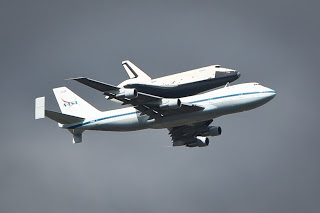


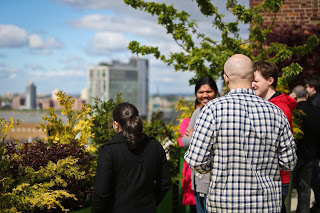


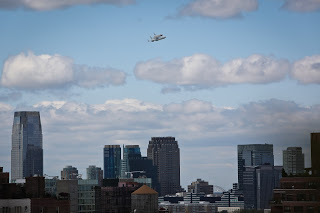
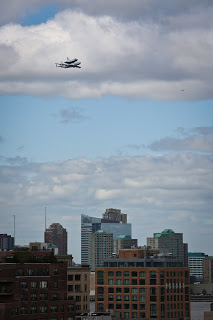
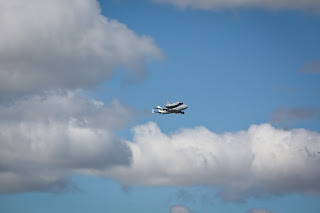


2012-10-13: Amazing swan song of the Space Shuttle program: you cost so much yet achieved so little.
A Space Shuttle on the Streets of Los Angeles The space shuttle Endeavour is on its last mission today, a 20 km creep through Los Angeles city streets on a 160-wheeled carrier. It is passing through neighborhoods and strip malls, headed toward its final destination, the California Science Center in South Los Angeles. At times, the shuttle has barely cleared trees, houses and street signs along a course heavily prepared for the trip. The move will cost an estimated $10m.

James Webb Space Telescope
The James Webb Space Telescope will collect light 9x faster than the Hubble Space Telescope
2016-11-05: Construction is complete
The telescope element of the James Webb Space Telescope (JWST), the largest space telescope ever constructed, stands completed in an enormous clean room at NASA’s Goddard Space Flight Center. JWST will now go through a series of rigorous tests, including shaking and noise tests to simulate launch conditions, and cryogenic tests to make sure it can stand up to the frigid conditions of space.
2021-11-07: Still not launched, but here’s why it matters:
The telescope is 14 years behind schedule and 20x over budget. “We’ve worked as hard as we could to catch all of our mistakes and test and rehearse. We’re going to put our zillion-dollar telescope on top of a stack of explosive material” and turn things over to fate. Other researchers want to understand the first stars. Some think Webb will see so-called “Population III stars,” primordial beasts that are hypothesized to have been roughly 10000x heavier than our sun. Such stars would help solve another major mystery of galaxy formation: how galaxies’ centers ended up with supermassive black holes — physically small yet incredibly powerful gravitational sinkholes that can weigh billions of times the mass of our sun. Nobody knows how supermassive black holes grew so heavy, or when, or why their properties are correlated with properties of their host galaxies. One theory is that Population III stars seeded the holes, but there are 1m other theories. Webb will look for signatures of the different scenarios.

2022-07-15: The first images.
 Gregor J. Rothfuss