impressive burner aesthetic in this blender movie. amazing what can be accomplished with free tools if you put in the work.
Month: May 2021
30b kWh Wastewater Heat
MTA could 2x off-peak capacity for free
In New York, the frequency of a bus or subway service is regularly adjusted every 3 months to fine-tune crowding. Where Berlin has a fixed clockface timetable in which most trains run every 5 minutes all day, New York prefers to make small changes to the frequency of each service throughout the day based on crowding. The New York approach looks more efficient on paper, but is in fact the opposite. It leads to irregular frequencies whenever trains share tracks with other trains, and weakens the system by leading to long waits. But another problem that I learned about recently is that it is unusually inconvenient for labor, and makes the timetabling of trains too difficult. New York should timetable its trains differently. Berlin offers a good paradigm, but is not the only one. As far as reasonably practical, frequency should be on a fixed clockface timetable all day. This cannot be exactly 5 minutes in New York, because it needs more capacity at rush hour, but it should aim to run a fixed peak timetable and match off-peak service to peak service. It’s a large increase in service. Frequency-ridership spirals work in your favor here. Increases in service require small increases in expenditure, even assuming variable costs rise proportionately – but they in fact do not, since regularizing frequency around a consistent number and reducing the peak-to-base ratio make it possible to extract far more hours out of each train driver, as in Berlin. Net of the increase in revenue coming from better service, such a system is unlikely to cost more in public expenditure.
This remains true even assuming no pay cuts for drivers in exchange for better work conditions. Pay cuts are unlikely anyway, but improving the work conditions for workers, especially junior workers, does make it easy to hire more people as necessary. The greater efficiency of workers under consistent timetabling without constant fidgeting doesn’t translate to lower pay, but to much more service, in effect taking those 550 annual hours and turning them into 900 through much higher off-peak frequency. It may well reduce public expenditure: more service and thus greater revenue from passengers on the same labor force.
they’d have to stop constantly messing with the schedule, which is pure insanity.
NIMBY Art Piece
a great illustration for why community boards and zoning need to be destroyed.
Radiolyctic Life
Radioactive decay can sustain life deep below the surface. Radiation from unstable atoms in rocks can split water molecules into hydrogen and chemically reactive peroxides and radicals; some cells can use the hydrogen as fuel directly, while the remaining products turn minerals and other surrounding compounds into additional energy sources. Radiolysis is instrumental not just in the hydrogen and sulfur cycles on Earth, but in the cycle most closely associated with life: that of carbon. Analyses of water samples from the same Canadian mine showed very high concentrations of acetate and formate, organic compounds that can support bacterial life. Moreover, measurements of isotopic signatures indicated that the compounds were being generated abiotically. The researchers hypothesized that radiolytic products were reacting with dissolved carbonate minerals from the rock to produce the large quantities of carbon-based molecules they were observing.

See also these Chernobyl fungi
a robot sent into the still-highly-radioactive Chernobyl reactor had returned with samples of black, melanin-rich fungi that were growing on the ruined reactor’s walls. “Just as the pigment chlorophyll converts sunlight into chemical energy that allows green plants to live and grow, our research suggests that melanin can use a different portion of the electromagnetic spectrum – ionizing radiation – to benefit the fungi containing it” Since ionizing radiation is prevalent in outer space, astronauts might be able to rely on fungi as an inexhaustible food source on long missions or for colonizing other planets
UAV L1 Autonomy Safety
EASA has a roadmap for autonomous flight with 3 levels of autonomy: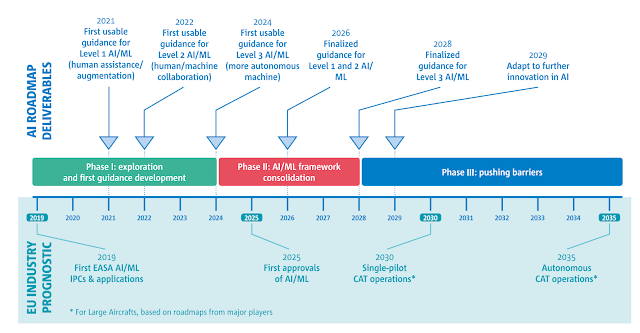

They, in collaboration with my friends at Daedalean, just released their approach how to certify the safety of the whole L1 system, a first for a ML system in aviation, as far as I know. This ought to help the nascent UAV market with overcoming regulatory barriers. You can get a sense for the state of the art with the EHang 216 drone in this autonomous test flight with the CEO on board.
Commerce by Sail
A Hudson River merchant ship is bringing goods to Red Hook again after 100 years. This summer, Merrett’s schooner returns for her first full season. The backbone of each run will be harvests from Hudson Valley Malt and Stone House Grain delivered to breweries and distilleries from Poughkeepsie to Brooklyn, including Wild East and Strong Rope in Gowanus, and Van Brunt Stillhouse in Red Hook––but future shipments will also include everything from pillows and maple syrup to yarn and salt.
Starline
let’s hope this goes somewhere, unlike Glass. perhaps this can be bootstrapped via C-level status symbol purchases, like cisco telepresence (which was 10 years ahead of its time)
Parasitical Life Extension
Infected Temnothorax ants live at least 3x longer than their siblings, and perhaps in excess of 10 years, approaching that of ant queens, who can survive up to 20 years. When Foitzik cracks open infected Temnothorax colonies, the parasitized workers do little more than stare expectantly skyward. Down to the molecular level, the parasite is pulling the strings. She has split open Temnothorax abdomens and counted up to 70 tapeworms inside. From there, the worms can unleash a slurry of proteins and chemicals that futz with the ant’s core physiology, likely impacting their host’s hormones, immune system, and genes. What they achieve appears to be a rough pantomime of how ant queens attain their mind-boggling life span, a feat humans still don’t understand. The tapeworms’ grasp of ant aging is far more advanced than ours.
Outdoor Dining arms race
What started as a haphazard collection of tables and chairs set up in blocked-off parking spaces has evolved into a seemingly non-negotiable extension of running a restaurant in NYC. There are local construction companies dedicated to building outdoor dining shelters. New restaurants are baking outdoor dining setups into their startup costs. For those who can afford it, the constant upgrading of outdoor dining — still only a temporary allowance in the city — hasn’t showed any signs of slowing down as indoor capacity restrictions have loosened. “It’s like the face of the restaurant now”

 Gregor J. Rothfuss