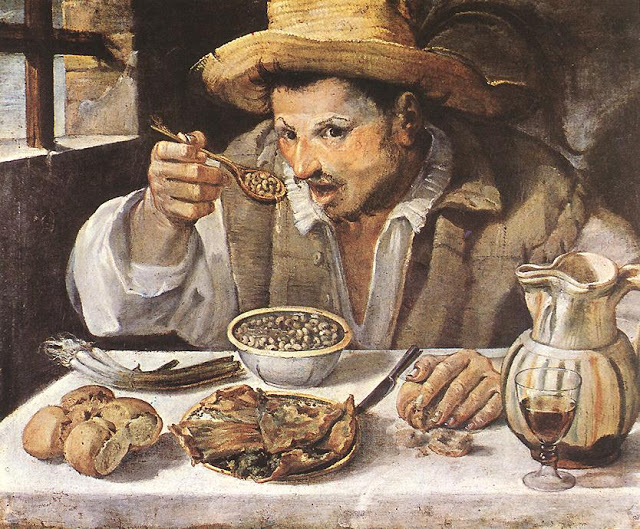
Most people in the early modern world—not just in Europe, but everywhere—were illiterate farmers and pastoralists whose diet was hyper-minimalist by contemporary standards. This is not to say that their food tasted bad, necessarily. But it was clearly very simple, and very starch-heavy. From China to Europe to sub-Saharan Africa, gruels and stews made out of staple grains or legumes were the daily fare. Italian farmers weren’t eating eggplant parmesan or spaghetti with meatballs. They were typically eating either boiled beans or grains, day after day after day. The acute eyes of Bruegel the Elder captured one example of this universal food of the premodern peasantry. In Bruegel’s The Harvesters, a team of peasants is taking a break for a mid-day meal which seems to consist entirely of bread and bowls of what I am guessing is a wheat-based gruel, something akin to Cream of Wheat. The jugs they’re drinking out of probably contain small beer.
 Gregor J. Rothfuss