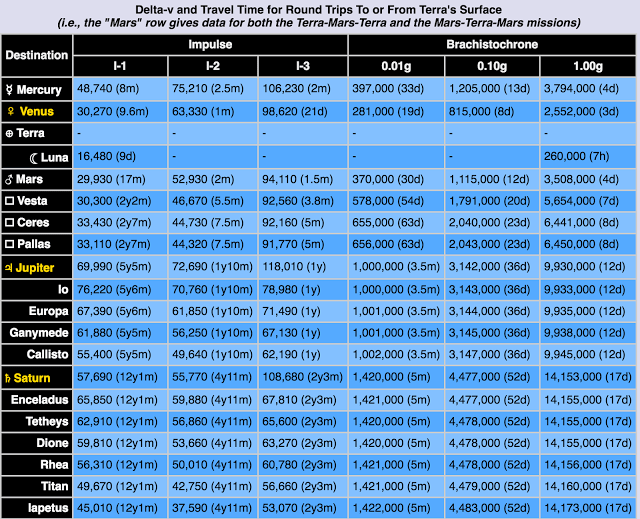
ProjectRho has round trip space mission times based on 3 types of rocket missions and 3 levels of constant acceleration. Constant acceleration could be achieved with an antimatter catalyzed fusion propulsion system like Positron Dynamics is developing
15 days 1 way to Mars with a constant 0.01 G acceleration and deceleration.
6 days 1 way to Mars with a constant 0.1G acceleration and deceleration.
2 days 1 way to Mars with a constant 1G acceleration and deceleration.
2022-02-19: It is also possible to get to Mars in 45 with Laser Thermal Propulsion: A Earth-based Laser heats up onboard propellant. This has very promising characteristics:
For lower velocity missions within the solar system, coupling the laser to the spacecraft via a reaction mass (i.e., propellant) is a more efficient way to use the delivered power than reflecting it off a lightsail. Reflecting light only transfers a tiny bit of the photon’s energy to the spacecraft, but absorbing the photon’s energy and putting it into a reaction mass results in greater energy transfer. The greater power that can be delivered results in greater thrust, so a more intense propulsive maneuver can be performed nearer to Earth. The closer to Earth the propulsive burn is, the smaller the laser array needs to be in order to keep the beam focused on the spacecraft, making it more feasible as a near-term demonstration of directed energy propulsion. The scaled-up version of our design (Mission Mars 2a) intended for crewed missions used a 40-ton spacecraft derived from the Orion capsule and European Service Module. The greater payload requires a more powerful (4 GW) laser to effectuate the same 45-day transit to Mars, but the laser array occupies the same 10-m footprint on earth.
The other mission we considered was a cargo mission (Mission Mars 2b). Robert Zubrin often makes the point that—even if advanced propulsion capable of high thrust and high specific impulse was available—he would still opt for a 6-month free-return trajectory and use the enhanced propulsion capability to bring more payload. So, the Mars 2b mission uses the performance of laser thermal propulsion to maximize the amount of cargo that could be brought to Mars with a Hohmann-like transfer, and shows that the payload could be increased by a 10x over what a Centaur upper stage—with the same mass of propellant—could throw to Mars.

 Gregor J. Rothfuss