Month: June 2015

Wolf Monkey societies

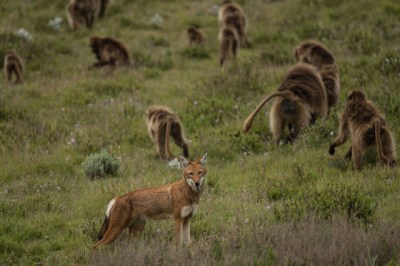
In the alpine grasslands of eastern Africa, Ethiopian wolves and gelada monkey are giving peace a chance. The geladas – a type of a baboon – tolerate wolves wandering right through the middle of their herds, while the wolves ignore potential meals of baby geladas in favor of rodents, which they can catch more easily when the monkeys are present.

The unusual pact echoes the way dogs began to be domesticated by humans.

When walking through a herd – which comprises many bands of monkeys grazing together in groups of 600 to 700 individuals – the wolves seem to take care to behave in a non-threatening way. They move slowly and calmly as they forage for rodents and avoid the zigzag running they use elsewhere.

This suggested that they were deliberately associating with the geladas. Since the wolves usually entered gelada groups during the middle of the day, when rodents are most active, he wondered whether the geladas made it easier for the wolves to catch the rodents – their primary prey.

2015 Nebula Award Winners

Novel:
Annihilation, Jeff VanderMeer (Winner)
The Goblin Emperor, Katherine Addison
Trial by Fire, Charles E. Gannon
Ancillary Sword, Ann Leckie
The Three-Body Problem, Cixin Liu, translated by Ken Liu
Coming Home, Jack McDevitt

Novella:
Yesterday’s Kin, Nancy Kress (Winner)
We Are All Completely Fine, Daryl Gregory
“The Regular,” Ken Liu
“The Mothers of Voorhisville,” Mary Rickert
Calendrical Regression, Lawrence Schoen
“Grand Jeté (The Great Leap),” Rachel Swirsky

Mega-journals

on the current state of open access journals, which have improved many, though not all, aspects of scientific publishing. it’s good that articles are now mostly freely available, and data can be reused under creative commons, but the actual format is still awkward pdfs instead of a more wiki-like process that would make it far easier to work in citations and keep them fresh.

US legal reach

rather than sending troops around the world, maybe the US should do more of this global stamping out of corruption. if only there was as much zeal to stamp out corruption domestically.

Europe is also more wedded to the doctrine of “comity”, which holds that courts should not act in a way that demeans the jurisdiction, laws or judicial decisions of another country. “In practice, this translates into keeping your collective nose out of other nations’ legal affairs, with a few exceptions, such as war crimes

AI prospects for biology

Banging through it all, though, to come up with a model that fit the data, tweaking and prodding and adjusting and starting all over when it didn’t work – which is what the evolutionary algorithms did – takes something else: inhuman patience and focus. That’s what computers are really good at, relentless grinding. I can’t call it intelligence, and I can call it artificial intelligence only in the sense that an inflatable palm is an artificial tree. I realize that we do have to call it something, though, but the term “artificial intelligence” probably confuses more than it illuminates.

2022-12-09: Some new hopes for paper mining, but see this caveat.

SciHub has 88m papers, and if we assume that we can extrapolate the Semantic Scholar dataset statistics (2600 words per article) with some paper loss due to old/faulty PDFs, it could be reasonable to expect 200b tokens of scientific knowledge, 10x bigger than the Minerva training set of Arxiv papers (21b tokens). This is a 10x boost in technical knowledge that would exist inside current LLMs.

There will be a universal language of physical science work that does not speak directly to humans. Monolithic cloud labs alone may not be optimal deployment of automated biology in the future. Projects like PyHamilton demonstrate growing open source communities for benchtop automation, and the SayCan collaboration by Google and Everyday Robots is a reminder of how multifunctional robots are steadily progressing (as well as ultralight indoor drones). As the cost curve goes down and the natural-language programmability goes up, there may be an intersection at which it is easier to convert an existing lab environment/protocol into an automated one, rather than to outsource work to a physically separate facility. Or, there may be a steady-state solution that some tasks are optimal for large automated warehouses and others are optimized for more distributed, edge labs. If there is any future of multiple robotic work providers, then interoperability will become a bottleneck, which will motivate a universal formalization of life science work.