Most Arizonans take exception to the Daylight Saving Time observed by the rest of America. Arizona tried DST for a year (1967), but decided the extra hour of daylight was not necessarily a good thing. The desert summers were already too friggin’ hot. But then there’s the Navajo Rejection of the Arizona Exception: the northeast corner of Arizona is part of the Navajo Nation (which extends across 3 states) and in an effort to keep the same time on the entire reservation, they observe DST. However, the Hopi Tribe doesn’t agree with the Navajo DST decision. Yes, the Hopi Reservation, which is completely enclosed by the Navajo Nation, has declined DST… resulting in the Hopi Repudiation of the Navajo Rejection of the Arizona Exception. Finally, there’s Tuba City, located in the western reaches of the Navajo Nation, just east of Arizona’s palefaces, just west of the main Hopi Reservation and just north of the Hopi Reservation’s exclave (not enclave) containing Moenkopi. Tuba City is caught between the Hopi and a hard place. Navajo tribal offices and schools in Tuba City observe DST, but most businesses don’t (“so as not to confuse the tourists”). In Tuba City, it’s possible to walk next door and enter a whole different time zone. The community of Jeddito, Arizona, southeast of Tuba City, lies within an exclave of the Navajo Nation, which is surrounded by the Hopi Reservation, which is surrounded by the Navajo Nation. If you decided to drive the 144 km from Jeddito to Tuba City on Route 264, you would start in DST (Jeddito, Navajo exclave), switch to standard time (Hopi Reservation), switch back to DST (Navajo Nation), switch back to standard time (Moenkopi, Hopi exclave) and switch back to DST (Tuba City, Navajo Nation). And if you began your drive 32 km east of Jeddito, in Steamboat Canyon, you could add 2 more time zone changes, to visit a grand total of 7 time zones during your 176-km trip on Route 264 (actually, you need to drive only 154 km to get the full effect).
Month: June 2015
Health insights from Genomics
we will generate more health insights in the next 10 years than we’ve had in the last 100
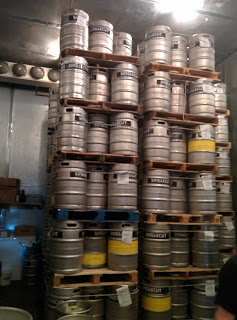
SingleCut
exploring northern astoria yields single cut. good times.











Peak Sprawl
We tend to think of urban sprawl in America as a product of the Interstate Highway System built in the 1950s and 1960s. Metro area residents who might have been inclined to live near work in the city took the chance to head up the road, find a parcel of land for a single-family home, and commute into work by car. Others followed and pushed development farther out until we got the sprawled out metros we know today.
Some new work published today in the journal PNAS challenges this timeline—showing evidence of sprawl dating back to the 1920s. Using precise, street-level data at the county level, Christopher Barrington-Leigh of McGill University and Adam Millard-Ball of UC-Santa Cruz report that sprawl was rising well before 1950, then grew steadily through the 1990s. The researchers also conclude that US sprawl peaked around 1994 and has been falling ever since.
Trade-Agreement Troubles
But these days signing such agreements is risky for countries. ISDS lawsuits used to be rare, but they’re becoming a growth industry. Nearly 100 have been filed in the past 2 years, as against some 500 in the 25 years before that. Investor protection, previously a sideshow in corporate law, is now a regular part of law-school curricula. “We’ve also seen an expansion in the types of claims that have been brought”. ISDS was originally meant to protect investors against seizure of their assets by foreign governments. Now ISDS lawsuits go after things like cancelled licenses, unapproved permits, and unwelcome regulations.
Spornosexuality
While the Barbie doll’s body has been getting thinner and thinner over the years, action figures such as GI Joe have been getting more muscular. It is not only size but definition. One study, co-authored by Harvard’s Pope and Olivardia in 1999, compared action toys from different decades. The earliest models had no abdominal muscles; the 1970s models showed some; but by the mid-1990s the toys displayed ‘the sharply rippled abdominals of an advanced bodybuilder’. Tellingly, Ken, Barbie’s boyfriend, was the exception, but then he is regarded as a doll not an action figure, and is aimed at girls.
The perils of worldbuilding
It’s not difficult to understand the appeal of expansive, intricate artificial worlds in works of fiction. They safely transport us from our everyday lives to new lands and galaxies far, far away. They don’t just give us a new narrative to digest, but an entirely new universe with its own logic, laws and rules, and we – the audience – are invited to become participants, seeking to fill in the cracks and gaps. But should great works of fiction demand more from readers and viewers than merely assisting in worldbuilding? Should they make us contemplate and challenge the built worlds that advertisers, governments and corporations have already created around us? Incisively written by the US blogger Evan Puschak (also known as The Nerdwriter), working from some ideas from the English author and critic M John Harrison, The Perils of Worldbuilding is a shrewd take on the appeal of imagined worlds, and their potential pitfalls.
The lost luggage store
If you’ve ever wondered where your lost airline baggage in the US ended up, there’s a good chance it’s Alabama. More precisely, the Unclaimed Baggage Center, a retail store filled with treasures from unfortunate travelers’ misplaced bags. For decades the operation has been quietly buying up the unclaimed checked bags and carry-on items that airlines find themselves holding for more than 90 days, after which they legally become airline property. The sprawling store in the small town of Scottsboro, Alabama—spanning the length of a city block, with a retail floor measuring 4000 m2—stocks some 6000 items daily, 85% of which come from lost luggage. The remainder comes from the unclaimed cargo the company also buys up.
Helium-Filled Planets
Lots of exoplanets may have helium-rich atmospheres. We don’t have any planets like this in our solar system, so this is something of a surprise. They would look decidedly odd to our eyes. Instead of the deep rich colors of our gassy planets, these helium planets would be somewhat colorless, gray or white.
Detecting new concepts in the brain
it is now known how specific concrete objects are coded in the brain — neuroscientists can identify which object, such as a house or a banana, someone is thinking about from its functional magnetic resonance imaging (fMRI) brain signature
 Gregor J. Rothfuss