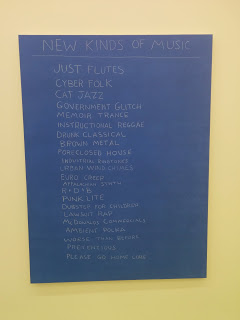
new kinds of music: cat jazz, foreclosed house
book titles: spooky salad, giving up with style
exhibitions: history is written by the winners, but art history is written by losers
baby names: quinoa, keepsake



Month: February 2015
ice on the hudson & east river







Hyperreal CGI

David O’Reilly, animator and creator of the indie game Mountain, and Kim Laughton, post-internet artist, have started the tumblr blog #HYPERREALCG. It’s dedicated to “showcasing the world’s most impressive & technical hyper-real 3d art.”
Adventures in the Anthropocene
this seems to be a terraforming apologia, but it comes highly recommended, so i bought it.
A different cluetrain
- We’re living in an era of increasing automation. And it’s trivially clear that the adoption of automation privileges capital over labour (because capital can be substituted for labour, and the profit from its deployment thereby accrues to capital rather than being shared evenly across society).
- A side-effect of the rise of capital is the financialization of everything—capital flows towards profit centers and if there aren’t enough of them profits accrue to whoever can invent some more (even if the products or the items they’re guaranteed against are essentially imaginary: futures, derivatives, CDOs, student loans).
- Since the collapse of the USSR and the rise of post-Tiananmen China it has become glaringly obvious that capitalism does not require democracy. Or even benefit from it. Capitalism as a system may well work best in the absence of democracy.
- The iron law of bureaucracy states that for all organizations, most of their activity will be devoted to the perpetuation of the organization, not to the pursuit of its ostensible objective. (This emerges organically from the needs of the organization’s employees.)
- Governments are organizations.
- We observe the increasing militarization of police forces and the privileging of intelligence agencies all around the world. And in the media, a permanent drumbeat of fear, doubt and paranoia directed at “terrorists” (a paper tiger threat that kills fewer than 0.1% of the number who die in road traffic accidents).
- Money can buy you cooperation from people in government, even when it’s not supposed to.
- The internet disintermediates supply chains.
- Political legitimacy in a democracy is a finite resource, so supplies are constrained.
- The purpose of democracy is to provide a formal mechanism for transfer of power without violence, when the faction in power has lost legitimacy.
- Our mechanisms for democratic power transfer date to the 18th century. They are inherently slower to respond to change than the internet and our contemporary news media.
- A side-effect of (7) is the financialization of government services (2).
- Security services are obeying the iron law of bureaucracy (4) when they metastasize, citing terrorism (6) as a justification for their expansion.
- The expansion of the security state is seen as desirable by the government not because of the terrorist threat (which is largely manufactured) but because of (11): the legitimacy of government (9) is becoming increasingly hard to assert in the context of (2), (12) is broadly unpopular with the electorate, but (3) means that the interests of the public (labour) are ignored by states increasingly dominated by capital (because of (1)) unless there’s a threat of civil disorder. So states are tooling up for large-scale civil unrest.
- The term “failed state” carries a freight of implicit baggage: failed at what, exactly? The unspoken implication is, “failed to conform to the requirements of global capital” (not democracy—see (3)) by failing to adequately facilitate (2).
- I submit that a real failed state is one that does not serve the best interests of its citizens (insofar as those best interests do not lead to direct conflict with other states).
- In future, inter-state pressure may be brought to bear on states that fail to meet the criteria in (15) even when they are not failed states by the standard of point (16). See also: Greece.
- As human beings, our role in this picture is as units of Labour (unless we’re eye-wateringly rich, and thereby rare).
- So, going by (17) and (18), we’re on the receiving end of a war fought for control of our societies by opposing forces that are increasingly more powerful than we are.
Have a nice century!
Memetic engineering
Right now people in my professional world (content platform pontificators) are avidly discussing the traffic garnered by a single picture of a blue-and-black dress that could also—depending on how your neurons are firing—look white-and-gold. “It’s the perfect meme, can never be topped: (1) Putting people on 2 teams, (2) a hint of magic, and (3) some science.”
Dreading email
Virginia Heffernan and Paul Ford have never met, but have often crossed paths—we live in New York City; were editors at Harper’s Magazine; write about technology; and write for The Message on Medium. For no particular reason we’ve started sending emails to see who can make the other person experience the most profound sense of dread and panic.
From: Virginia Heffernan
To: Paul Ford
Subject: can you watch my kids tonight?
I know it’s short notice but you’d really be saving us. I’ve got a pre-Oscars bookmaking pow-wow at Candace Bushnell’s (eyeroll!) and they just need dinner, baths and for you to kind of lie with them in their loft beds while they go to sleep. The sleep part takes an hour, tops. I usually fall asleep then! But no then just clean up dinner stuff and quickly rub down the tub, and you’re free to have burritos, whatever’s in the freezer. YOU ARE A GODSEND ROCKSTAR. See you in 20 mins?
Superhuman arcade games
Hours after encountering its first video game, and without any human coaching, the AI has not only become better than any human player but has also discovered a way to win that its creator never imagined. A game like Crazy Climber is a closer analogue to the real world than chess is, and in the real world humans still have the edge. Moreover, whereas Deep Blue was highly specialized, and preprogrammed by human grandmasters with a library of moves and rules, DeepMind is able to use the same all-purpose code for a wide array of games.
OODA Loop
Boyd’s ongoing theoretical analyses and discourses resulted in “Patterns of Conflict” briefings and the insightful and useful OODA Loop. Seldom has one man made such great contributions and engendered massive change through pure grit and determination. Ultimately, Boyd’s perceptions not only influenced military aviation but his “maneuver warfare” doctrines, adopted by upcoming officers, also influenced US Marine Corps fighting methodology at the very core.
Peak code?
The simulation suggests that “technological progress can be immiserating” and that even talented software programmers may face tough times in an ever more automated economy. The reason lies in the durability and reusability of software. Code is not used up; it accumulates. As the cost of deploying software for productive work (ie, the cost of automation) goes down, demand for new code spikes, bringing lots of new programmers into the labor market. The generous compensation provided to the programmers leads at first to higher savings and capital formation, fueling the boom. But “over time,” the model reveals, “as the stock of legacy code grows, the demand for new code, and thus for high-tech workers, falls.”
 Gregor J. Rothfuss